History and the Census: Abraham Lincoln
One year after Abraham Lincoln was born in 1809, the 1810 Census counted 7,239,881 people in the United States, including 1,191,362 enslaved people and 186,446 people classified as Free Colored. Shortly before Lincoln's election as the nation's 16th president, the 1860 Census reported that the population had grown to 31,443,321—including 3,953,760 enslaved people and 488,070 people classified as Free Colored.
Jump to:
History and the Census: Abraham Lincoln
November marks several key events and anniversaries in the life of Abraham Lincoln. Lincoln became the first Republican candidate to win a presidential election on November 6, 1860, defeating Democrat Stephen A. Douglas, Southern Democrat John C. Breckinridge, and Constitutional Union Party candidate John Bell. Lincoln's victory was especially significant because the Republican Party had been established only six years earlier, in 1854.


Lincoln's election, the secession of Southern states, and the subsequent Civil War divided the United States between the Union and Confederacy. The bloody conflict eventually claimed the lives of approximately 620,000 Union and Confederate soldiers. Later that year, Lincoln proclaimed that the nation should observe the last Thursday of November as a day of “Thanksgiving and Praise.”
Lincoln delivered the “Gettysburg Address” at the dedication of the Gettysburg National Cemetery on November 19, 1863. In his brief speech, Lincoln connected the Civil War to the principles of equality and self-government, declaring that the nation was founded on the proposition that “all men are created equal” and calling for “a new birth of freedom.” The address, delivered in just a few minutes, became one of the most influential speeches in American history.
The themes of equality and freedom expressed in the Gettysburg Address remained central to Lincoln's reelection campaign the following year. In the November 8, 1864, presidential election, Lincoln faced former Union General George B. McClellan, the Democratic nominee. Although the Democratic Party platform called for an immediate cessation of hostilities and negotiations to end the war, McClellan personally rejected the platform's peace plank and favored continuing the war to preserve the Union. Despite growing concern over mounting casualties and a desire to end the conflict, Lincoln received 55 percent of the popular vote and won 212 electoral votes to McClellan's 21.
Here are some more interesting facts about Abraham Lincoln's impact on our nation and daily lives:
- Abraham Lincoln was born February 12, 1809, in Hodgenville, Kentucky. The town in LaRue County first appeared as a separately enumerated place in 1850 when it was home to 182 inhabitants. More recently, the 2020 Census reported 3,235 people lived in Hodgenville.
- Abraham and Mary Todd Lincoln married in Springfield, Illinois, on November 11, 1842. Two years before, the 1840 Census counted 2,579. In 2025, the Census Bureau estimated Springfield's population was 112,989.
- On April 14, 1865, Abraham Lincoln was shot by John Wilkes Booth at Ford's Theatre in Washington, DC, while attending a performance of the three-act comedy Our American Cousin. Lincoln died at 7:22 a.m. the following morning. Less than three hours later, Vice President Andrew Johnson took the presidential oath of office becoming the nation's 17th president.
- Although President George Washington was the first president to proclaim a national day of Thanksgiving, on October 3, 1789, Lincoln's Thanksgiving Proclamation, issued 74 years later on October 3, 1863, called on Americans to observe the last Thursday of November as a day of "Thanksgiving and Praise." Lincoln's proclamation helped establish the tradition of an annual national Thanksgiving observance in November.
- Abraham Lincoln has left an indelible mark on the nation's geography in the more than 160 years since his death. The United States is home to many towns, counties, and landmarks named for Lincoln, including Lincoln, Nebraska; Lincoln, Illinois; Lincoln County, Kansas; and Lincoln County, New Mexico. More than 100,000 commuters travel under the Hudson River between Weehawken, New Jersey, and Midtown Manhattan using the Lincoln Tunnel. Transcontinental travelers can follow the Lincoln Highway across the nation, while visitors to New York City's Lincoln Center for the Performing Arts can attend performances by the Metropolitan Opera. In Chicago, residents and visitors enjoy the museums, outdoor activities, and zoo in the city's Lincoln Park neighborhood.
- The U.S. Navy has named two ships after Abraham Lincoln. Construction began on the first, the George Washington-class fleet ballistic-missile submarine USS Abraham Lincoln (SSBN-602), at the Portsmouth Naval Shipyard in Kittery, Maine, on November 1, 1958. Construction of the present-day USS Abraham Lincoln, a Nimitz-class aircraft carrier (CVN-72), began on November 3, 1984, at Newport News Shipbuilding in Newport News, Virginia, and the ship was commissioned on November 11, 1989. The carrier's motto, “Shall Not Perish,” comes from Lincoln's Gettysburg Address.
- Got Abe in your pocket? Abraham Lincoln appears on pennies produced since 1909, the Illinois and South Dakota state quarters, the fourth U.S. Presidential $1 coin issued in 2010, the $5 bill, and numerous stamps issued by the U.S. Postal Service.

President Abraham Lincoln delivers his "Gettysburg Address" on November 19, 1863.
This Month in Census History
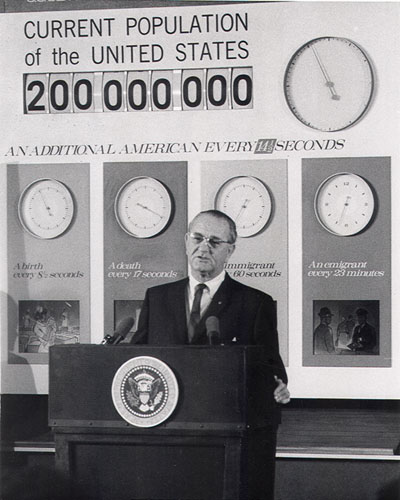
President Lyndon B. Johnson announces that the census population clock reached the 200 million mark.
On November 20, 1967, President Lyndon B. Johnson announced that the United States had reached a population of 200 million. At 11:03 a.m., the U.S. Census Bureau’s population clock in the lobby of the Department of Commerce headquarters in Washington, DC, reached the milestone. Unlike a decennial census, which counts people at a specific point in time, the population clock estimated the nation’s changing population using demographic information on births, deaths, and migration.
The milestone came just seven years after the 1960 Census counted 179,323,175 Americans. Johnson marked the occasion at a ceremony at the Commerce Department and joked that the Census Bureau could not identify the actual 200 millionth American because the population clock was based on statistical estimates. A special commission nevertheless investigated the matter and determined that the likely 200 millionth American was a boy born on June 21, 1967, at Seaton Hospital in Austin, Texas.
Reaching 200 million Americans was more than a statistical milestone. It demonstrated the dramatic population growth the nation had experienced since the first federal census in 1790, when the population was fewer than 4 million. The Census Bureau's population clock has continued to provide a constantly updated estimate of the nation's population, becoming a highly visible way of illustrating America's demographic changes.
Related Information
Attorney Abraham Lincoln
Census records from 1790 through 1950 are available to the public through the National Archives and Records Administration under the federal government’s 72-year rule. These records provide a remarkable window into the lives of Americans—including future presidents—by documenting where they lived, their ages, occupations, family members, and other characteristics.
At the time of the 1850 and 1860 Censuses, Abraham Lincoln lived and practiced law in Springfield, Illinois. The 1850 Census enumerated Lincoln on November 7 and listed him as a 40-year-old attorney born in Kentucky. His household included his wife, Mary, and their children Robert and Edward; their sons William and Thomas were born after the 1850 enumeration.
The 1860 Census provides a snapshot of Lincoln on the eve of his presidency. Enumerated shortly before the 1860 presidential election, the census recorded Lincoln, Mary, and their sons Robert, William, and Thomas in Springfield. Within months, Lincoln would leave Illinois for Washington, DC, after being elected the nation's 16th president.

Abraham Lincoln's 1850 Census record.
Related Information


Lincoln Motor Company

A Liberty 12 Model A, V-12 Engine manufactured by Lincoln Motors.
Henry Leland, a former manager of the Cadillac division of General Motors, and his son Wilfred Leland, formed the Lincoln Motor Company in August 1917. The company was established during World War I to manufacture Liberty V-12 aircraft engines for the U.S. government. Liberty 12 engines powered numerous aircraft including the de Havilland DH-4, the Navy-Curtiss NC-4, Fokker T2, Loening Model 23, Douglas World Cruiser, Douglas M-1 Mailplane, and Curtiss H-16 flying boat.

Leland chose to name the company for President Abraham Lincoln, whom he had voted for in 1864. After the war, the Lelands converted their Detroit factory from producing aircraft engines to manufacturing automobiles. The first Lincoln automobile, the Model L, was introduced in 1920 as a large, luxurious car aimed at the growing high-end automobile market.
The Lincoln Motor Company struggled with production problems, high costs, and declining economic conditions after World War I. By late 1921, the company was in severe financial difficulty and was placed in receivership. On February 4, 1922, the Ford Motor Company purchased Lincoln for $8 million, rescuing the company from collapse and giving Ford an entry into the luxury automobile market dominated by Cadillac. Henry Ford's son, Edsel Ford, became president of Lincoln and played a major role in transforming the marque into one of America's leading luxury automobile brands.

