History and the Census: Maya Angelou
Author Maya Angelou was born April 4, 1928. During her lifetime, she published 32 books beginning with her autobiography I Know Why the Caged Bird Sings in 1969 followed by a poetry collection in 1971. The U.S. Census Bureau collects data about authors like Angelou, finding that during the pay period that included March 12, 2023, 1,127,087 people were employed in the Independent Artists, Writers, and Performers (NAICS 7115) sector.
Jump to:
History and the Census: Maya Angelou
Author, poet, performing artist, and civil rights activist Maya Angelou was born on April 4, 1928. Angelou faced numerous challenges that helped shape her writing. Her portrayal of growing up Black in the United States and handling of difficult topics have made her books staples in American classrooms for decades.

Author, poet, and Civil Rights activist Maya Angelou was born as Marguerite Annie Johnson on April 4, 1928, in St. Louis, Missouri

Angelou suffered from selective mutism, a severe anxiety disorder, as a result of childhood trauma. During this time, she developed a passion for literature and poetry. She sang and danced at clubs in California and toured Europe with a production of the opera Porgy and Bess. In 1957, she recorded a calypso music album and soon after performed those songs in the movie Calypso Heat Wave. After moving to New York City, New York, in 1959 to focus on writing, she met Reverend Martin Luther King, Jr. She became increasingly active in the Civil Rights Movement and other human rights causes. After her close friend Malcolm X was assassinated, she briefly resumed her singing career in Hawaii before returning to Los Angeles, California, to write and begin working on her autobiography in 1968.
Angelou had more than a decade of writing, acting, playwriting, and singing credits, when she became internationally famous after the publication of her autobiography I Know Why the Caged Bird Sings in 1969. The memoir, which recounts her childhood in the South, her experience of abuse, and her journey to overcome it, became a popular addition to school reading lists, though its graphic content has made it one of the most frequently banned books in the United States. In 1971, she published her first collection of poetry, Just Give Me a Cool Drink of Water 'fore I Diiie. One year later, she became one of the first Black women to have a screenplay produced as a major motion picture.
Over the next decade, Angelou continued working as a critically acclaimed performing artist and writer. In 1982, she was named the Reynolds Professor of American Studies at Wake Forest University—a position she held until her death in 2014. Renewed interest in Angelou's work followed her recitation of the poem On the Pulse of Morning at President William J. Clinton's 1993 inauguration. She remained a prolific writer, poet, lecturer, screenwriter, songwriter, and feature film director. However, she still found time to support political candidates, advocate for human rights causes, and serve as a consultant for the Martin Luther King, Jr. Memorial in Washington, D.C.
In 2013, Angelou published the seventh and final volume of her autobiography series, Mom & Me & Mom. She died at her home in Winston-Salem, North Carolina, on May 28, 2014. Her loss was memorialized by presidents, legislators, singers, actors, athletes, and writers. Common among those tributes was the recognition that Angelou's honesty and dedication to her craft would continue to inspire millions of people around the world.
You can learn more about Maya Angelou using data collected by the Census Bureau. For example:
- Maya Angelou's 1969 autobiographies detail her life growing up in St. Louis, Missouri; Stamps, Arkansas; and San Francisco, California.
- Angelou was born in St. Louis, in 1928. After moving to Stamps in 1931, she returned to St. Louis in the mid-1930s. Angelou lived in St. Louis during the 1930 Census, when the city population was 821,960. When she left St. Louis in 1940, the city's population had decreased to 816,048. In 2024, the Census Bureau estimated the population of St. Louis to be 279,695.
- Angelou moved to Stamps to live with her grandmother in 1931. One year earlier, the 1930 Census counted 2,705 people living in the town. As the town's railroad and lumber economy declined, so too did its population. In 2023, the Census Bureau estimated the town's population at 1,510.
- In 1940, Angelou moved to San Francisco with her mother and brother. That year, 634,536 people lived in the city. The Census Bureau estimated San Francisco's population to be 827,526 in 2024.
- In 1943, when Angelou was 15 years old, she lied about her age to become one of San Francisco's first Black streetcar conductors. Three years earlier, the 1940 Census reported that there were 17,785 bus and street railway conductors in the United States. Nationwide, only 174 bus and street railway conductors were female.
- Before she was a famous poet and author, Maya Angelou was a motion picture actress. Her acting career spanned nearly five decades, beginning with the 1957 film Calypso Heat Wave. Her last film role was in the 2006 comedy Madea's Family Reunion. According to census data, when Angelou began her acting career, 18,288 people identified themselves as actors in 1950, and 13,488 did so in 1960. More recently, the Census Bureau estimated there were 50,798 actors in the United States in 2024.
- In 1981, Angelou moved to Winston-Salem, North Carolina, after accepting a lifetime professorship at Wake Forest University. One year earlier, Winston-Salem's population was 131,885. She continued to teach classes at the university until 2011. When she died at her Winston-Salem home in 2014 at age 86, the city was home to an estimated 234,469 people. More recently, the Census Bureau estimated that 255,769 people called Winston-Salem home in 2024.
- Angelou sold millions of books as her autobiographies and poetry continue to be staples of high school and college English classes. The majority of her books remain in print and are published by some of the 11,216 employer firms in the nation's Newspaper, Periodical, Book, and Directory Publishers (NAICS 5131) sector. During the pay period that included March 12, 2023, these firms employed 278,369 people. Sales, value of shipments, or revenue for these firms were more than $87 billion that year.
- Maya Angelou read her poem On the Pulse of Morning at the first inauguration of President Bill Clinton on January 20, 1993. She was the second poet to read a poem at a presidential inauguration, after Robert Frost. Frost recited The Gift Outright at John F. Kennedy's 1961 inauguration ceremony. Angelou won the first of three Grammy Awards for Best Spoken Word or Non-Musical Album for On the Pulse of Morning in 1994. She later won spoken word Grammys in 1995 and 2002, and was nominated for that award in 1998 and 2008. Additional accolades included Pulitzer Prize nominations in 1971 (Just Give Me a Cool Drink of Water 'fore I Diiie) and 1972 (Georgia, Georgia); a Tony Award nomination in 1973 (Look Away); an Emmy nomination for Outstanding Single Performance by a Supporting Actress in Comedy or Drama Series in 1977 (Roots); the National Endowment for the Arts' National Medal of Arts in 2000; and the Presidential Medal of Freedom in 2010. In 2022, the U.S. Mint featured Angelou on the first quarter of its American Women Quarters Program.
- In 2002, Angelou partnered with a national greeting card company to feature her work in cards and gifts. In 2023, the Census Bureau's County Business Patterns series reported there were 106 establishments in the Greeting Card Publishers (NAICS 51191) sector in the United States. During the pay period that included March 12, 2023, these establishments employed 13,005 people.

Maya Angelou recited her poem "On the Pulse of Morning" at the 1993 Presidential Inauguration of William J. Clinton. U.S. Capitol, Washington, D.C. January 20, 1993.
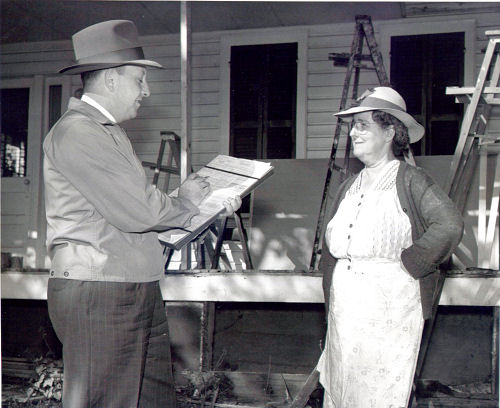
An enumerator conducts an interview during the 1940 Census.
This Month in Census History
Between 1790 and 1820, Census Day was in August. It moved to June from 1830 to 1900. In 1910, households provided their data as of April 15.
In 1920, Census Day moved to January 1 because officials believed the earlier date would improve the accuracy of the agriculture census conducted at the same time as the population count.
Census Day moved to April 1 in 1930, and has remained there ever since.
On April 1, 2020, the census found that the nation's population was 331,449,281.
Related Information

Census Bureau Authors
Many authors and poets got their inspiration from their work at the Census Bureau.
Bernard Malamud worked in the Census Bureau's Agriculture Division and wrote stories at lunch. He won the National Book Award for The Magic Barrel in 1958 and a Pulitzer Prize and second National Book Award for his novel The Fixer. In 1984, his novel The Natural was adapted to a popular movie.
Thelma Strabel worked as a census taker before the Saturday Evening Post magazine serialized her 1940 novel Reap the Wild Wind. In 1942, Cecil B. DeMille directed a big-screen adaptation of the novel starring John Wayne.
Ann Crispin was a Census Bureau computer programmer before writing popular science fiction books in the Star Wars and Star Trek series.
Census taker Marcelino "Mena" Crisologo y Pecsan dedicated his career to Ilocano and Filipino art and culture. He published the first Ilocan language translation of Don Quixote, wrote novels, plays, and founded the Ilokanos Writers Association of the Philippines.
Ken Hechler worked for the Population Division during the 1940 Census. His 1957 book The Bridge at Remagen was made into a movie in 1969. He also edited President Franklin D. Roosevelt's official papers, served as West Virginia's secretary of state, and served in the U.S. House of Representatives.

Marcelino Crisologo y Pecsan's translation of Don Quixote.
Related Information

Writers, Books, and Census Data
Do you want to learn about other famous authors using Census Bureau data and records? Visit our pages about Little House on the Prairie author Laura Ingalls Wilder; Robert L. May who wrote the popular Christmas book, Rudolph the Red-Nosed Reindeer; L. Frank Baum, author of the Wizard of Oz; children's book author, Theodor "Dr. Seuss" Geisel; and science fiction authors like Robert A. Heinlein, Isaac Asimov, and others.


