Manual Tab Component
The Manual Tab Component creates custom tabs to display full page content under each tab. Users navigate between the tabs to access the page content. The component displays one page per tab.
The difference between this component and the Dynamic Tab Component, is this component allows the use of custom tabs.
On This Page:
Purpose
The Manual Tab Component is useful when you need to organize related content into separate views without overwhelming the user.
Avoid using tabs to simply navigate to different areas of a website. Instead, only use tabs when the topics all fall within the same context.
The Manual Tab Component displays content of different pages, available by navigating between the component’s displayed tabs and allows content authors to insert whole containers from other pages, with a maximum of one page per tab.
Tabs are built manually with custom labels/titles and a minimum of two tabs are required. The first tab is selected by default when a site user navigates to the page.
Examples
View on public site:

Component Example
Page Title 7
Prior to conducting one of our economic surveys, the U.S. Census Bureau may contact you by mail or email to request that you review and update the contact information for your organization. Updated contact information allows the U.S. Census Bureau to communicate with survey respondents efficiently.
If you receive a request to review and update the contact information for your organization, the U.S. Census Bureau may have selected your company/establishment/government for one of our economic surveys.
The letter or emails you receive will provide a Username and Password that can be entered at the survey website. Once logged in, review the information presented, answer a few questions, provide any contact updates, and submit your response. It is expected to take just a few minutes to complete this request.
If you are contacted by the Census Bureau, here are few common ways to verify the legitimacy of a Census Bureau communication:
- Census Bureau Website Address: Any web address we provide will include "census.gov". If you do not see “census.gov” in the URL provided, it is not from the U.S. Census Bureau.
- Census Bureau Email Address: Correspondence sent in the form of a letter or email will contain reporting instructions and a phone number and/or email address for survey assistance. Legitimate Census Bureau email addresses include “@census.gov”.
- If you receive an email from us, hover your cursor over the sender email address and ensure that the pop-up that is displayed shows the email address that is listed. If it doesn’t match, this is not an email from the Census Bureau.
Configure Dialog
The configure dialog allows the content author to define multiple tabs. See below for more about the Tab Component dialog.
Web Standard
Individual pages that are in tabs should have redirects to their tabbed versions. This way users can only see the tabbed version of the page. To have this redirect added, submit a ticket to CNMP Web Support.
Tab: Enter Tabbed Content
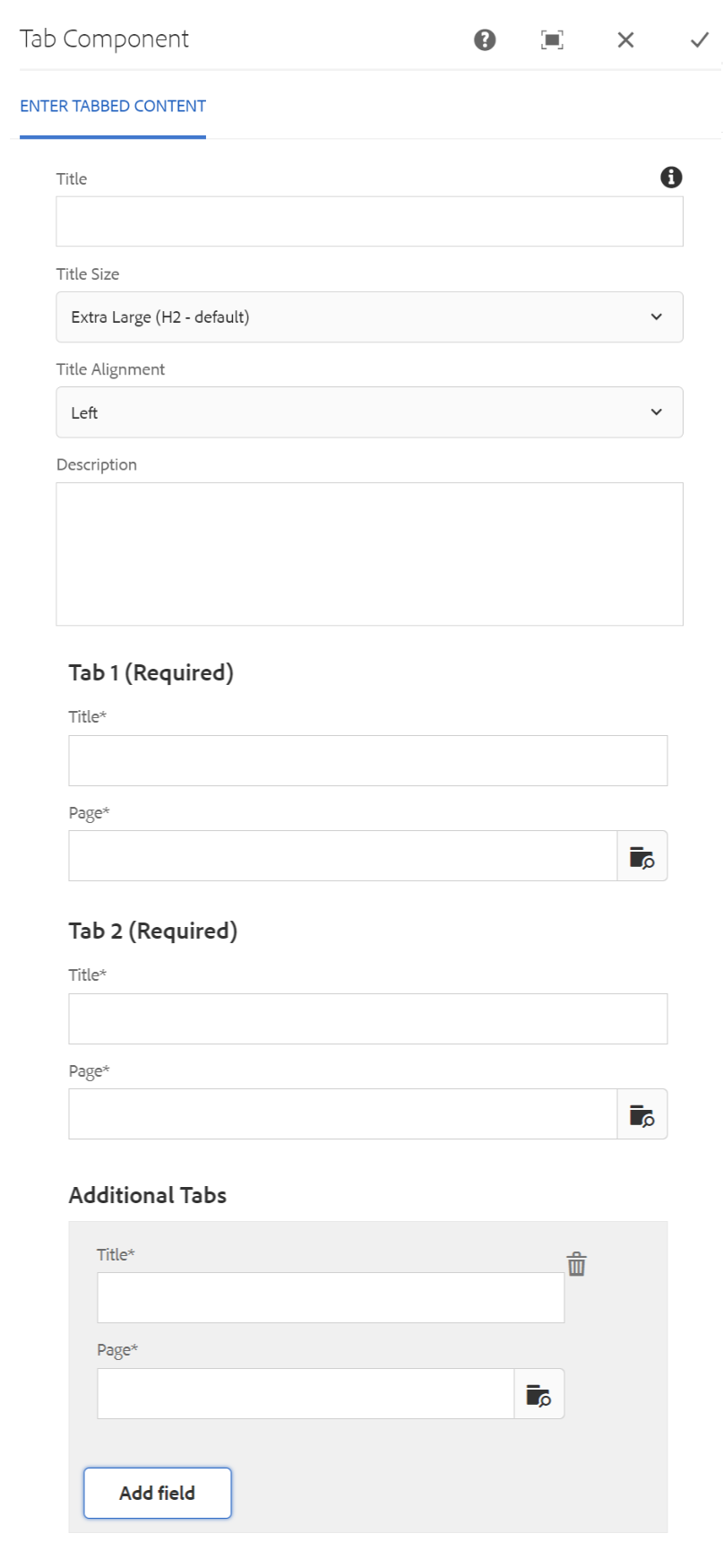
- Title – If you'd like to add a Section Title, insert it here.
- Title Size – Size of the title text. (H2 default) This will override the page's current title size.
- Title Alignment – Overrides the default alignment of the title text.
- Description – If you'd like to add a description, insert it here. Displayed underneath the title.
- Tab 1 (Required)
- Title – Required title for the first tab.
- Page – Page where the tab component will pull in the main content container.
- Tab 2 (Required)
- Title – Required title for the second tab.
- Page – Page where the tab component will pull in the main content container.
- Additional Tabs
- Title – Required title for the third, fourth, fifth, etc. tab.
- Page – Page where the tab component will pull in the main content container.
- Tab 1 (Required)
Developer Resources
Expand the section below to see the Tab Component HTML output.
<div class="uscb-tab-list">
<div class="uscb-h1 uscb-medium uscb-hide-sm uscb-tab-selected-item">Page Title 1</div>
<div class="aem-Grid aem-Grid--12 aem-Grid--default--12 ">
<div class="textimage parbase aem-GridColumn aem-GridColumn--default--12"><div class="uscb-overflow-auto" style="background-color: ; color: ; background-image: url(); background-repeat: no-repeat; background-position: right bottom; background-size: contain;">
<a name="par_textimage" style="visibility:hidden"></a>
<div id="ti1897460770" style="color: #bbc7cd;"></div>
<div class="uscb-color-primary uscb-layout-row uscb-layout-align-flex-start uscb-text-align-left ">
<h2 style="color: ;" class="uscb-h2">Abstract</h2>
</div>
<section style="overflow: none;">
<div class="uscb-text-media-media
uscb-print-hide
uscb-float-right uscb-margin-L-25">
<div class="uscb-margin-TB-10 uscb-layout-align-center-center">
<a filetrack="http://author-publish.dev.census.gov/content/dam/Census/library/working-papers/2021/adrm/RRS2021-01.pdf|RESEARCH REPORT SERIES OR STUDY SERIES|Tab Component_756162" href="/content/dam/Census/library/working-papers/2021/adrm/RRS2021-01.pdf" target="_new" onclick="linkClick(this, 'Text and Image Component');" class="uscb-text-link">
<img class="uscb-border-1px-gray " src="http://author-publish.dev.census.gov/library/working-papers/2021/adrm/RRS2021-01/_jcr_content/root/responsivegrid/textimage.textthumbnail.png/1615819903562.png" alt="RESEARCH REPORT SERIES OR STUDY SERIES" title="RESEARCH REPORT SERIES OR STUDY SERIES">
</a>
</div>
<div class="uscb-margin-TB-10 uscb-layout-align-start-center">
<a tabindex="0" href="/content/dam/Census/library/working-papers/2021/adrm/RRS2021-01.pdf" class="uscb-text-link uscb-text-image-attachment">
Download RESEARCH REPORT SERIES OR STUDY SERIES [PDF - <1.0 MB]
</a>
</div>
</div>
<div style="color: " class="uscb-text-image-text uscb-text-media-text uscb-padding-LR-0">
<p class="uscb-body-text" style="color: ;">
</p><p>Disclosure avoidance techniques are used by agencies to prepare releases of statistics and microdata when internal data contain information considered sensitive to individual subjects. Differential privacy (DP) techniques have become popular in the literature and are finding increasing use in practical applications. One fundamental DP technique to protect sensitive data is to add noise from a selected distribution in such a way that mathematical privacy criteria are satisfied. An analyst making use of such data in a statistical model may wish to account for uncertainty introduced by the added noise. This work considers Bayesian regression models which regard the agency noise - or equivalently, the unreleased sensitive data - as augmented data. Given other random variables in the model, conditional distributions of these augmented data form weighted densities, but a method of drawing from them may not be apparent. We revisit the direct sampling method proposed by Walker et al. (JCGS 2011) and explore several customizations to address issues encountered in the basic version of the algorithm. Draws from the desired conditional distributions may be then taken reliably, largely avoiding the need for rejections or manual tuning. The customized direct sampler is used to complete the specification of a Gibbs sampler to fit a Lognormal regression model where agency noise has been added to both the outcome and some of the covariates. Demonstrations compare inference using the sensitive internal data versus the privacy-protected release.</p>
<p></p>
</div>
</section>
</div>
</div>
<div class="othersinseries list parbase aem-GridColumn aem-GridColumn--default--12"><!-- SDI include (path: /library/working-papers/2021/adrm/RRS2021-01/_jcr_content/root/responsivegrid/ois.nocache.html/census/components/common/body/othersinseries.vsdi, resourceType: census/components/common/body/othersinseries) -->
</div>
</div>
</div>