Dynamic Tab Component
The Dynamic Tab Component displays full page content under each tab. Users navigate between the tabs to access the page content. The component displays one page per tab.
The difference between this component and the Manual Tab Component, is this component uses the standard sorting choices (building the tab order) of publication date, collection year or month, and reference year or month.
On This Page:
Purpose
The Dynamic Tab Component is useful when you need to organize related content into separate views without overwhelming the user.
In contrast to the Manual Tab Component, the Dynamic Tab Component does not rely on the author to manually order the tabs; instead, it offers preset manners by which to order the tabs. Tabs can be built by collection month/year, by reference month/year, or by publication date and can be sorted manually or from oldest to newest or newest to oldest.
Content authors should use the Dynamic Tab Component when they have a set of pages, releases, or data that tends to be organized by a preset order to parse items.
Note:
Tabs are not selectable by the author when in Edit mode. Use Preview mode, View as Published or view on Author-Publish to interact with the tabs as a reader of the published content would.

Component Example

April 28, 2021
APRIL 28, 2021 — Today the U.S. Census Bureau released a new set of “demonstration data” to help the data user community evaluate the latest update to the new Disclosure Avoidance System that will protect published 2020 Census Public Law (P.L.) 94-171 Redistricting data. The demonstration data use previously released 2010 Census data to illustrate the impact of the latest iteration of the new system. As with previous censuses, the disclosure avoidance methods – also known as differential privacy – are not applied to the apportionment census counts.
Metrics included in today’s release show that the latest update meets or exceeds specialized accuracy targets based on use cases provided by the Department of Justice for the redistricting process and enforcement of the Voting Rights Act of 1965.
The release, in the form of “Privacy-Protected Microdata Files,” is the first that reflects an increase in the “privacy-loss budget” (PLB). The “budget” has nothing to do with any sort of financial value. It refers to a chosen limit on how much privacy is traded for increased accuracy. That increased PLB is reflected in the accuracy of population counts and demographic characteristics at various levels of geography.
Today’s update uses a privacy-loss budget of 10.3 for persons and 1.9 for housing units (approximating the anticipated final PLB level). All previous “beta” releases used a privacy-loss budget of 4.0 for persons and 0.5 for housing units for development comparison purposes. We are including separate files using both the latest and previous PLBs. It is important to understand that the PLB is logarithmic, meaning every additional number in the PLB scale represents an exponential increase in the PLB.
We encourage data users to closely analyze today’s demonstration data and email feedback to [email protected]. (Include “April PPMF” in the subject line.) Feedback received by May 28 will be considered.
For more information and updates on the 2020 Census Disclosure Avoidance System visit our website and subscribe to our newsletter.
No news release associated with this product. Tip sheet only.
###
Configure Dialog
The configure dialog allows the content author to define multiple tabs. See below for more about the Tab Component dialog.
Web Recommendation
Individual pages that are in tabs should have redirects to their tabbed versions. While not required for these pages it is strongly recommended. This way users can only see the tabbed version of the page. To have this redirect added, submit a ticket to CNMP Web Support.
Tab: Page Tab

- Title – If you'd like to add a Section Title, insert it here.
- Title Size – Size of the title text. (H2 default)
- Title Alignment – Overrides the default alignment of the title text.
- Description – If you'd like to add a description, insert it here.
- Build Tabs Using – Choose between Child Pages or Fixed List (AEM)
- Build Tab Names Using – Choose between Publication Date, Collection Month, Collection Year, Reference Month, or Reference Year.
- Sort Option – Choose between Manual Sort, Newest to Oldest, or Oldest to Newest.
Tab: Child Pages

- Parent Page – Allows you to select a page to list its child pages (i.e., pages nested under the selected page).
Note:
The parent page URL is limited to the first level of child pages. Leave empty to use current page.
Tab: Fixed List (AEM)
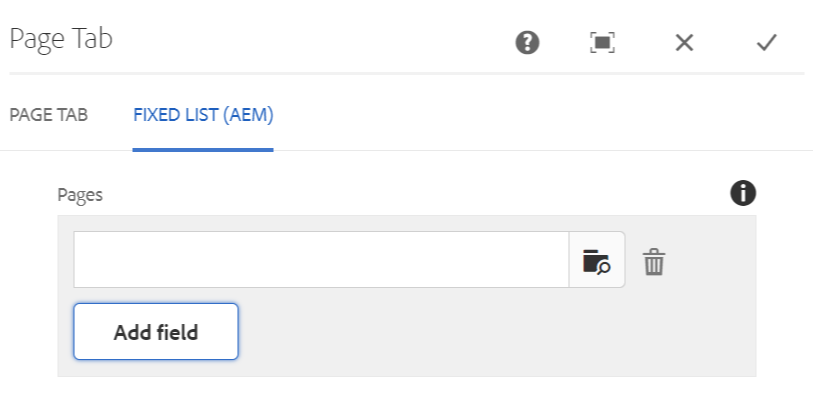
- Add Field – Allows you to select specific AEM pages to build tabs.
Developer Resources
Expand the section below to see the Tabbed Page Component HTML output.
<div class="uscb-tab-list">
<div class="uscb-h1 uscb-medium uscb-hide-sm uscb-tab-selected-item">September 30, 2021</div>
<div class="aem-Grid aem-Grid--12 aem-Grid--default--12 ">
<div class="textimage parbase aem-GridColumn aem-GridColumn--default--12"><div class="uscb-overflow-auto" style="background-color: ; color: ; background-image: url(); background-repeat: no-repeat; background-position: right bottom; background-size: contain;">
<a name="par_textimage" style="visibility:hidden"></a>
<div id="ti36694489" style="color: #bbc7cd;"></div>
<section style="overflow: none;">
<div style="color: " class="uscb-text-image-text uscb-text-media-text uscb-padding-LR-0">
<p class="uscb-body-text" style="color: ;">
</p><p><b>SEPT. 30, 2021</b> — The U.S. Census Bureau today released new data from the sixth phase of the <a href="https://www.census.gov/data/experimental-data-products/small-business-pulse-survey.html">Small Business Pulse Survey</a> (SBPS). Data collection began August 16. Results will be released weekly August 26 to October 21. New content in the SBPS Phase 6 covers difficulties hiring employees, new workplace norms, changes in demand for goods or services, and price changes from suppliers. In addition, Phase 6 will include information consistent with previous phases regarding location closings and openings, changes in employment, workplace vaccine and testing requirements, supply chain disruptions, and expectations concerning future operations.</p>
<p>Weekly data are available at the national, sector, state and metropolitan statistical area (MSA) level for the largest MSAs and Puerto Rico through the <a href="https://portal.census.gov/pulse/data/">SBPS interactive tool</a> and <a href="https://portal.census.gov/pulse/data/#downloads">downloadable files</a>. Sector and subsector data are also available. The SBPS collects near real-time data on the effects of the coronavirus pandemic on small businesses. These data inform federal and state decision-making.</p>
<p>No news release associated with this product. Tip sheet only.<br>
</p>
<p style="text-align: center;">###<br>
</p>
<p></p>
</div>
</section>
</div>
</div>
</div>
</div>