Dynamic Tab Component
The Dynamic Tab Component displays full page content under each tab. Users navigate between the tabs to access the page content. The component displays one page per tab.
The difference between this component and the Manual Tab Component, is this component uses the standard sorting choices (building the tab order) of publication date, collection year or month, and reference year or month.
On This Page:
Purpose
The Dynamic Tab Component is useful when you need to organize related content into separate views without overwhelming the user.
In contrast to the Manual Tab Component, the Dynamic Tab Component does not rely on the author to manually order the tabs; instead, it offers preset manners by which to order the tabs. Tabs can be built by collection month/year, by reference month/year, or by publication date and can be sorted manually or from oldest to newest or newest to oldest.
Content authors should use the Dynamic Tab Component when they have a set of pages, releases, or data that tends to be organized by a preset order to parse items.
Note:
Tabs are not selectable by the author when in Edit mode. Use Preview mode, View as Published or view on Author-Publish to interact with the tabs as a reader of the published content would.

Component Example

July 29, 2021
JULY 29, 2021 — The U.S. Census Bureau’s schedule for the release of 2020 Census redistricting data; the 2020 income, poverty and health insurance coverage statistics from the Annual Social and Economic Supplement to the Current Population Survey; and the 2020 American Community Survey is as follows:
Aug. 12 (no embargo)
- 2020 Census Redistricting Data Legacy Format — The Census Bureau will provide redistricting data in the legacy format that state officials have used the last two decades. These data will consist of 2020 Census population counts by race, Hispanic origin, and voting age, as well as housing unit data for counties, places, census tracts and blocks.
Tuesday, Sept. 14 (no embargo)
- National 2020 Income, Poverty and Health Insurance Coverage Statistics: Current Population Survey Annual Social and Economic Supplement — Annual release of national-level income, poverty (including official 2020 poverty rate), and health insurance coverage statistics. The reports will include statistics for calendar year 2020 and compare trends with previous years.
- National 2020 Supplemental Poverty Measure Estimates: Current Population Survey Annual Social and Economic Supplement — Annual release of supplemental poverty estimates for the nation and states.
Sept. 16 (no embargo)
- 2020 Census Redistricting Data Easier-to-Use Format — The Census Bureau will provide states and the public with the same data released in a legacy format in August. States will receive an easier-to-use toolkit of DVDs/flash drives with integrated browsing software for official state recipients. The public will have access to the data on data.census.gov. These data will consist of the same 2020 Census population counts by race, Hispanic origin and voting age, as well as housing unit data for counties, places, census tracts and blocks.
November
- 2020 American Community Survey (ACS) 1-Year Experimental Estimates — The ACS is one of the most comprehensive sources of information about the U.S. population, providing crucial demographic, social, economic and housing statistics. The COVID-19 pandemic significantly disrupted our ability to reach people and limited their ability to participate in the 2020 ACS. Therefore, instead of providing the standard 1-year data products, the Census Bureau will release a series of estimates using “experimental” weights from the 1-year data. It will also release a research paper detailing the methodology for the experimental weights.
December
- 2020 ACS 1-Year Public Use Microdata Sample (PUMS) with Experimental Weights — The Census Bureau plans to release a 2020 ACS 1-year PUMS file containing experimental weights for research use.
- 2016-2020 ACS 5-Year Estimates — The Census Bureau is still reviewing the quality of the 2016-2020 ACS 5-year estimates against our statistical quality standards, but tentatively plans to release the 5-year estimates.
January 2022 (no embargo)
- 2016-2020 ACS 5-Year Variance Replicate Estimates (VRE) — The VRE allow users to calculate margins of error when collapsing ACS data within a table or across geographies. This is dependent on the tentative release of the 2016-2020 ACS 5-Year Estimates in December.
February 2022 (no embargo)
- 2016-2020 American Community Survey 5-Year PUMS Files — This is dependent on the tentative release of the 2016-2020 ACS 5-Year Estimates in December.
About 2020 Census Redistricting Data
The official 2020 Census redistricting data summary file will be used to redraw federal, state and local legislative districts under Public Law 94-171. The census data are used by state officials to realign congressional and state legislative districts in their states to account for population shifts since the 2010 Census. The redistricting data includes counts of population by race, ethnicity (Hispanic or Latino origin), and voting age; housing occupancy status; and group quarters population at the census block level. The data will also be available to the public at <www.data.census.gov>.
About the Annual Social and Economic Supplement to the Current Population Survey
The Current Population Survey (CPS) serves as the nation’s primary source of statistics on labor force characteristics. The Annual Social and Economic Supplement provides the official annual statistics on the nation’s poverty levels as well as statistics on income, health insurance coverage, marital status, educational attainment, employee benefits, work schedules, school enrollment, noncash benefits, and migration. The Census Bureau and the Bureau of Labor Statistics have conducted the CPS for more than 50 years. The statistics are used by government policymakers as important indicators of our nation’s economy and for planning and evaluating many government programs.
About the American Community Survey
The American Community Survey (ACS) provides a wide range of important statistics about people and housing for every community across the nation. The results are used by a wide variety of users from town and city planners to retailers and homebuilders. The survey is the only source of local estimates for most of the 40 topics it covers, such as income, poverty, health insurance coverage, education, occupation, language, ancestry, and housing costs. The COVID-19 pandemic posed numerous challenges to collecting ACS data in 2020, as described in our recent Adapting the American Community Survey Amid COVID-19 blog. Because of the underlying quality concerns, the Census Bureau urges caution in using the experimental estimates.
###
Configure Dialog
The configure dialog allows the content author to define multiple tabs. See below for more about the Tab Component dialog.
Web Recommendation
Individual pages that are in tabs should have redirects to their tabbed versions. While not required for these pages it is strongly recommended. This way users can only see the tabbed version of the page. To have this redirect added, submit a ticket to CNMP Web Support.
Tab: Page Tab

- Title – If you'd like to add a Section Title, insert it here.
- Title Size – Size of the title text. (H2 default)
- Title Alignment – Overrides the default alignment of the title text.
- Description – If you'd like to add a description, insert it here.
- Build Tabs Using – Choose between Child Pages or Fixed List (AEM)
- Build Tab Names Using – Choose between Publication Date, Collection Month, Collection Year, Reference Month, or Reference Year.
- Sort Option – Choose between Manual Sort, Newest to Oldest, or Oldest to Newest.
Tab: Child Pages

- Parent Page – Allows you to select a page to list its child pages (i.e., pages nested under the selected page).
Note:
The parent page URL is limited to the first level of child pages. Leave empty to use current page.
Tab: Fixed List (AEM)
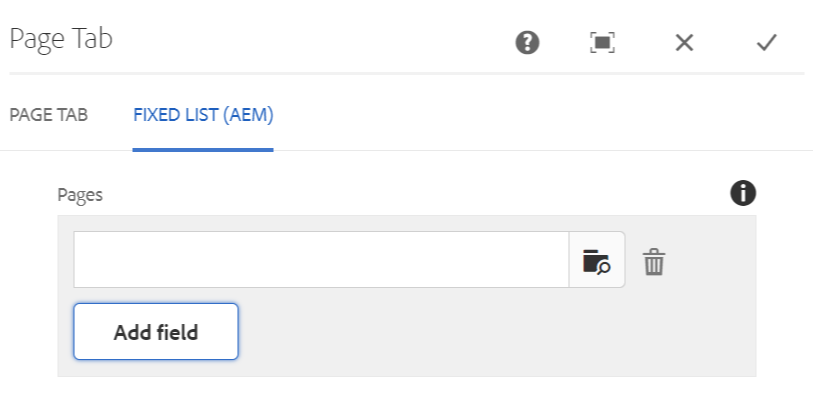
- Add Field – Allows you to select specific AEM pages to build tabs.
Developer Resources
Expand the section below to see the Tabbed Page Component HTML output.
<div class="uscb-tab-list">
<div class="uscb-h1 uscb-medium uscb-hide-sm uscb-tab-selected-item">September 30, 2021</div>
<div class="aem-Grid aem-Grid--12 aem-Grid--default--12 ">
<div class="textimage parbase aem-GridColumn aem-GridColumn--default--12"><div class="uscb-overflow-auto" style="background-color: ; color: ; background-image: url(); background-repeat: no-repeat; background-position: right bottom; background-size: contain;">
<a name="par_textimage" style="visibility:hidden"></a>
<div id="ti36694489" style="color: #bbc7cd;"></div>
<section style="overflow: none;">
<div style="color: " class="uscb-text-image-text uscb-text-media-text uscb-padding-LR-0">
<p class="uscb-body-text" style="color: ;">
</p><p><b>SEPT. 30, 2021</b> — The U.S. Census Bureau today released new data from the sixth phase of the <a href="https://www.census.gov/data/experimental-data-products/small-business-pulse-survey.html">Small Business Pulse Survey</a> (SBPS). Data collection began August 16. Results will be released weekly August 26 to October 21. New content in the SBPS Phase 6 covers difficulties hiring employees, new workplace norms, changes in demand for goods or services, and price changes from suppliers. In addition, Phase 6 will include information consistent with previous phases regarding location closings and openings, changes in employment, workplace vaccine and testing requirements, supply chain disruptions, and expectations concerning future operations.</p>
<p>Weekly data are available at the national, sector, state and metropolitan statistical area (MSA) level for the largest MSAs and Puerto Rico through the <a href="https://portal.census.gov/pulse/data/">SBPS interactive tool</a> and <a href="https://portal.census.gov/pulse/data/#downloads">downloadable files</a>. Sector and subsector data are also available. The SBPS collects near real-time data on the effects of the coronavirus pandemic on small businesses. These data inform federal and state decision-making.</p>
<p>No news release associated with this product. Tip sheet only.<br>
</p>
<p style="text-align: center;">###<br>
</p>
<p></p>
</div>
</section>
</div>
</div>
</div>
</div>