Dynamic Tab Component
The Dynamic Tab Component displays full page content under each tab. Users navigate between the tabs to access the page content. The component displays one page per tab.
The difference between this component and the Manual Tab Component, is this component uses the standard sorting choices (building the tab order) of publication date, collection year or month, and reference year or month.
On This Page:
Purpose
The Dynamic Tab Component is useful when you need to organize related content into separate views without overwhelming the user.
In contrast to the Manual Tab Component, the Dynamic Tab Component does not rely on the author to manually order the tabs; instead, it offers preset manners by which to order the tabs. Tabs can be built by collection month/year, by reference month/year, or by publication date and can be sorted manually or from oldest to newest or newest to oldest.
Content authors should use the Dynamic Tab Component when they have a set of pages, releases, or data that tends to be organized by a preset order to parse items.
Note:
Tabs are not selectable by the author when in Edit mode. Use Preview mode, View as Published or view on Author-Publish to interact with the tabs as a reader of the published content would.

Component Example

November 30, 2021
NOV. 30, 2021 — The U.S. Census Bureau today released experimental 1-year estimates from the American Community Survey (ACS), one of the nation’s most comprehensive sources of population and housing information about the United States. The experimental data cover a limited number of topics for the nation, all 50 states and the District of Columbia. A technical report, blog and 1-Year Public Use Microdata Sample (PUMS) experimental data were also released.
The Census Bureau typically releases three different sets of ACS data estimates each year in the form of 1-year and 5-year period data sets, as well as 1-year supplemental estimates. Our release is different this year due to the impacts of the COVID-19 pandemic, which disrupted ACS data collection in 2020. Given the limitations, we were unable to collect information from certain segments of the population, as explained in the previously released blog and analytical report, An Assessment of the COVID-19 Pandemic’s Impact on the 2020 ACS 1-Year Data.
The people who did respond to the survey had significantly different social, economic and housing characteristics from those who didn’t, resulting in nonresponse bias in the data. The Census Bureau determined the standard 2020 ACS 1-year estimates did not meet statistical quality standards and decided to ultimately release estimates as an experimental product.
The working paper, Addressing Nonresponse Bias in the American Community Survey During the Pandemic Using Administrative Data, details modifications to the ACS weighting procedures for the 2020 experimental data. Weighting can mitigate the effects of nonresponse bias, which occurs when the characteristics of people who complete the survey (respondents) differ from those of people who do not complete the survey (nonrespondents). The blog provides an overview of the report and experimental methodology.
The 2020 1-year PUMS files include experimental weights and data on approximately 1% of the U.S. population while protecting the confidentiality of survey respondents. The files provide population and housing characteristics down to Public Use Microdata Areas (PUMAs), which are special nonoverlapping areas that partition each state into contiguous geographic units. They are drawn after each decennial census so that they contain no fewer than 100,000 people.
The Census Bureau does not recommend comparing the 2020 ACS 1-year experimental estimates with our standard ACS estimates or the decennial census, or comparing the 2020 1-year PUMS data with standard pre-tabulated products or PUMS-based estimates from previous years. In addition, because the experimental weighting procedure was designed primarily to produce experimental estimates for states, estimates for PUMAs should be used with caution as the experimental weights are not optimized to produce estimates for these areas.
Recognizing the difficulty that the lack of standard 1-year ACS estimates will have on data user communities, the Census Bureau previously provided a list of resources offering technical data assistance. Additional resources are available in the press kit. More information on changes to the 2020 ACS 1-year release is available at www.census.gov/programs-surveys/acs/data/experimental-data.html.
The Census Bureau announced in early November that the 2016–2020 ACS 5-year data release originally targeted for December 2021 had been delayed. Additional time is needed to continue refining our methodology to minimize the impact of nonresponse bias on the 5-year estimates.
No news release associated with this product. Tip sheet only.
###
Configure Dialog
The configure dialog allows the content author to define multiple tabs. See below for more about the Tab Component dialog.
Web Recommendation
Individual pages that are in tabs should have redirects to their tabbed versions. While not required for these pages it is strongly recommended. This way users can only see the tabbed version of the page. To have this redirect added, submit a ticket to CNMP Web Support.
Tab: Page Tab

- Title – If you'd like to add a Section Title, insert it here.
- Title Size – Size of the title text. (H2 default)
- Title Alignment – Overrides the default alignment of the title text.
- Description – If you'd like to add a description, insert it here.
- Build Tabs Using – Choose between Child Pages or Fixed List (AEM)
- Build Tab Names Using – Choose between Publication Date, Collection Month, Collection Year, Reference Month, or Reference Year.
- Sort Option – Choose between Manual Sort, Newest to Oldest, or Oldest to Newest.
Tab: Child Pages

- Parent Page – Allows you to select a page to list its child pages (i.e., pages nested under the selected page).
Note:
The parent page URL is limited to the first level of child pages. Leave empty to use current page.
Tab: Fixed List (AEM)
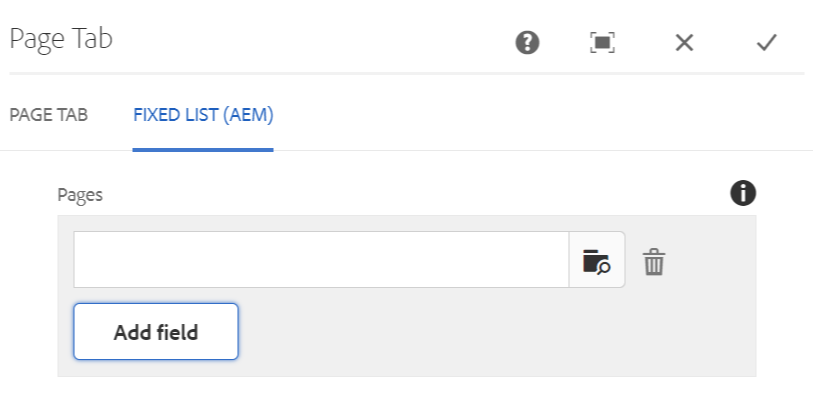
- Add Field – Allows you to select specific AEM pages to build tabs.
Developer Resources
Expand the section below to see the Tabbed Page Component HTML output.
<div class="uscb-tab-list">
<div class="uscb-h1 uscb-medium uscb-hide-sm uscb-tab-selected-item">September 30, 2021</div>
<div class="aem-Grid aem-Grid--12 aem-Grid--default--12 ">
<div class="textimage parbase aem-GridColumn aem-GridColumn--default--12"><div class="uscb-overflow-auto" style="background-color: ; color: ; background-image: url(); background-repeat: no-repeat; background-position: right bottom; background-size: contain;">
<a name="par_textimage" style="visibility:hidden"></a>
<div id="ti36694489" style="color: #bbc7cd;"></div>
<section style="overflow: none;">
<div style="color: " class="uscb-text-image-text uscb-text-media-text uscb-padding-LR-0">
<p class="uscb-body-text" style="color: ;">
</p><p><b>SEPT. 30, 2021</b> — The U.S. Census Bureau today released new data from the sixth phase of the <a href="https://www.census.gov/data/experimental-data-products/small-business-pulse-survey.html">Small Business Pulse Survey</a> (SBPS). Data collection began August 16. Results will be released weekly August 26 to October 21. New content in the SBPS Phase 6 covers difficulties hiring employees, new workplace norms, changes in demand for goods or services, and price changes from suppliers. In addition, Phase 6 will include information consistent with previous phases regarding location closings and openings, changes in employment, workplace vaccine and testing requirements, supply chain disruptions, and expectations concerning future operations.</p>
<p>Weekly data are available at the national, sector, state and metropolitan statistical area (MSA) level for the largest MSAs and Puerto Rico through the <a href="https://portal.census.gov/pulse/data/">SBPS interactive tool</a> and <a href="https://portal.census.gov/pulse/data/#downloads">downloadable files</a>. Sector and subsector data are also available. The SBPS collects near real-time data on the effects of the coronavirus pandemic on small businesses. These data inform federal and state decision-making.</p>
<p>No news release associated with this product. Tip sheet only.<br>
</p>
<p style="text-align: center;">###<br>
</p>
<p></p>
</div>
</section>
</div>
</div>
</div>
</div>