Dynamic Tab Component
The Dynamic Tab Component displays full page content under each tab. Users navigate between the tabs to access the page content. The component displays one page per tab.
The difference between this component and the Manual Tab Component, is this component uses the standard sorting choices (building the tab order) of publication date, collection year or month, and reference year or month.
On This Page:
Purpose
The Dynamic Tab Component is useful when you need to organize related content into separate views without overwhelming the user.
In contrast to the Manual Tab Component, the Dynamic Tab Component does not rely on the author to manually order the tabs; instead, it offers preset manners by which to order the tabs. Tabs can be built by collection month/year, by reference month/year, or by publication date and can be sorted manually or from oldest to newest or newest to oldest.
Content authors should use the Dynamic Tab Component when they have a set of pages, releases, or data that tends to be organized by a preset order to parse items.
Note:
Tabs are not selectable by the author when in Edit mode. Use Preview mode, View as Published or view on Author-Publish to interact with the tabs as a reader of the published content would.

Component Example

April 21, 2021
APRIL 21, 2021 — The U.S. Census Bureau today released a report that examines trends in computer and internet use in 2018. The report, Computer and Internet use in the United States: 2018, is based on statistics from the American Community Survey (ACS) and examines trends at the national, state and county levels.
Computer use has grown considerably over the past few decades. The percentage of households using the internet has also increased over time. The internet has impacted our work life as well by facilitating greater ability to work from home. The report uses data from the Current Population Survey to provide historical context and data from the ACS to highlight more current patterns.
Highlights
- Among all households in 2018, 92% had at least one type of computer and 85% had a broadband internet subscription. The ACS considers desktops, laptops, tablets, and smartphones as computers, along with selected computing technologies such as smart home devices and single-board computers.
- Smartphone ownership surpassed ownership of all other computing devices. Smartphones were present in 84% of households, while 78% of households owned a desktop or laptop. Tablet ownership fell behind at 63%.
- Urban residents were more likely than rural residents to use computing devices (93% of urban households compared to 89% of rural households) and were more likely to have any sort of internet subscription (86% of urban households compared to 81% of rural households).
- Higher rates of internet subscription were found in households with higher household income and those where the householder had a higher level of educational attainment. Characteristics associated with lower subscription rates were a householder who rented rather than owned a home, households with limited English speaking ability and households with at least one person who was disabled.
- Over one-half of all households (53%) had “high connectivity” – a term used here to refer to households with a laptop or desktop computer, smartphone, tablet, and a broadband internet connection.
- While many households had home-based internet connections, others relied on a cell phone provider and connected to the internet through a smartphone. Households relying only on a smartphone were more likely to make $25,000 or less, be headed by someone under 35 years old or have a Black or Hispanic householder.
Data in this report are subject to sampling and nonsampling error. Comparisons of estimates take sampling error into account and are significant at the 90% confidence level or higher, unless otherwise noted. Because of rounding, some details may not sum to totals. For information on sampling and estimation methods, confidentiality protection and sampling/nonsampling errors, see the Accuracy of the Data documents for 2019.
No news release associated with this report. Tip Sheet only.
###
Configure Dialog
The configure dialog allows the content author to define multiple tabs. See below for more about the Tab Component dialog.
Web Recommendation
Individual pages that are in tabs should have redirects to their tabbed versions. While not required for these pages it is strongly recommended. This way users can only see the tabbed version of the page. To have this redirect added, submit a ticket to CNMP Web Support.
Tab: Page Tab

- Title – If you'd like to add a Section Title, insert it here.
- Title Size – Size of the title text. (H2 default)
- Title Alignment – Overrides the default alignment of the title text.
- Description – If you'd like to add a description, insert it here.
- Build Tabs Using – Choose between Child Pages or Fixed List (AEM)
- Build Tab Names Using – Choose between Publication Date, Collection Month, Collection Year, Reference Month, or Reference Year.
- Sort Option – Choose between Manual Sort, Newest to Oldest, or Oldest to Newest.
Tab: Child Pages

- Parent Page – Allows you to select a page to list its child pages (i.e., pages nested under the selected page).
Note:
The parent page URL is limited to the first level of child pages. Leave empty to use current page.
Tab: Fixed List (AEM)
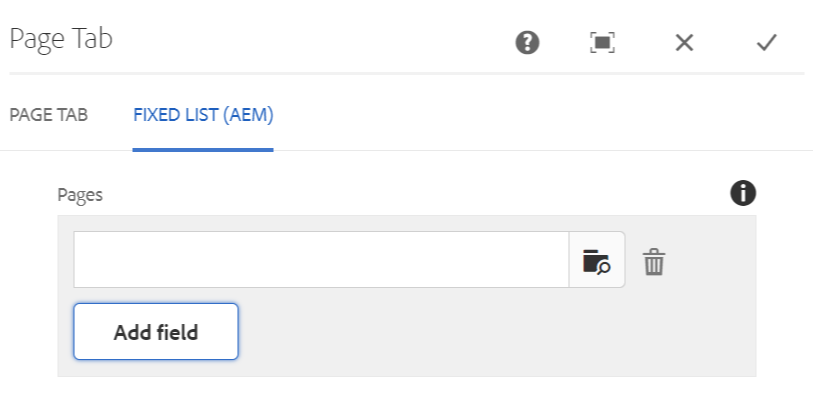
- Add Field – Allows you to select specific AEM pages to build tabs.
Developer Resources
Expand the section below to see the Tabbed Page Component HTML output.
<div class="uscb-tab-list">
<div class="uscb-h1 uscb-medium uscb-hide-sm uscb-tab-selected-item">September 30, 2021</div>
<div class="aem-Grid aem-Grid--12 aem-Grid--default--12 ">
<div class="textimage parbase aem-GridColumn aem-GridColumn--default--12"><div class="uscb-overflow-auto" style="background-color: ; color: ; background-image: url(); background-repeat: no-repeat; background-position: right bottom; background-size: contain;">
<a name="par_textimage" style="visibility:hidden"></a>
<div id="ti36694489" style="color: #bbc7cd;"></div>
<section style="overflow: none;">
<div style="color: " class="uscb-text-image-text uscb-text-media-text uscb-padding-LR-0">
<p class="uscb-body-text" style="color: ;">
</p><p><b>SEPT. 30, 2021</b> — The U.S. Census Bureau today released new data from the sixth phase of the <a href="https://www.census.gov/data/experimental-data-products/small-business-pulse-survey.html">Small Business Pulse Survey</a> (SBPS). Data collection began August 16. Results will be released weekly August 26 to October 21. New content in the SBPS Phase 6 covers difficulties hiring employees, new workplace norms, changes in demand for goods or services, and price changes from suppliers. In addition, Phase 6 will include information consistent with previous phases regarding location closings and openings, changes in employment, workplace vaccine and testing requirements, supply chain disruptions, and expectations concerning future operations.</p>
<p>Weekly data are available at the national, sector, state and metropolitan statistical area (MSA) level for the largest MSAs and Puerto Rico through the <a href="https://portal.census.gov/pulse/data/">SBPS interactive tool</a> and <a href="https://portal.census.gov/pulse/data/#downloads">downloadable files</a>. Sector and subsector data are also available. The SBPS collects near real-time data on the effects of the coronavirus pandemic on small businesses. These data inform federal and state decision-making.</p>
<p>No news release associated with this product. Tip sheet only.<br>
</p>
<p style="text-align: center;">###<br>
</p>
<p></p>
</div>
</section>
</div>
</div>
</div>
</div>