Changes to the Health Insurance Question in the 2025 American Community Survey
Estimated read time: 7 minutes
American Community Survey (ACS) content is designed to meet the needs of federal government agencies and is a rich source of local area information useful to state, local and tribal governments, universities, businesses and private individuals. In response to the 2022 Content Test and stakeholder feedback, the U.S. Census Bureau in 2025 made changes to a question in the ACS that asks respondents about their health insurance coverage.
The health insurance question is designed to gauge state and local health insurance needs and help the Department of Health and Human Services (HHS) and other federal agencies better distribute resources where they are most needed.
The changes were introduced to:
- Improve the measure of public coverage and accuracy of direct purchase coverage.
- Reduce the reporting of single-service, noncomprehensive insurance plans.
- Reduce erroneous reports of multiple coverage.
Figure 1 shows the original health insurance question in the 2024 ACS (left) alongside the new one (right) in the 2025 ACS and onward.
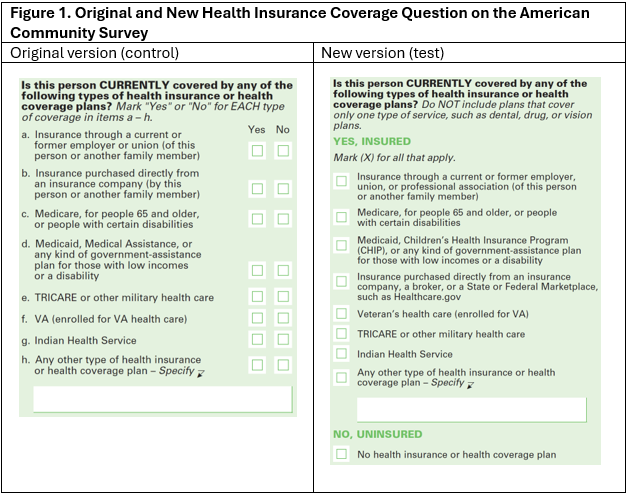
The table below shows changes made to the question and to the processing of the data.
| Change to 2025 American Community Survey Health Insurance Question | Purpose | |
|---|---|---|
| Answer List | ||
| “Mark X for all that apply” (instead of a series of yes/no questions). | Reduce respondent burden. | |
| Order | Direct purchase coverage moved down (after Medicare and Medicaid). | Reduce overreporting of direct purchase coverage; improve reporting of public coverage. |
| VA and TRICARE changed places. | Reduce confusion identified during cognitive testing (evaluation of how respondents understand, process and complete survey questions). | |
| Addition of clarifying text | “Marketplace” and “Healthcare.gov” added to direct purchase option. | Improve measurement of direct purchase; reduce misreporting of marketplace plans as public coverage. |
| “Professional association” added to the employer coverage option. | Improve measurement of group plans. | |
| “CHIP” added to the Medicaid option. | Reduce undercount of Medicaid. | |
| “Veterans” was spelled out in the VA healthcare option. | Improve reporting of veteran’s healthcare and distinguish it from TRICARE. | |
| Added option for “uninsured.” | Improve measurement of insured vs uninsured. | |
| Question Instruction | ||
| Instructions were added to not include plans that cover only one type of service (such as dental, vision and prescription drug plans). | Help focus respondents’ attention on comprehensive coverage and reduce overreporting of direct purchase coverage. | |
| Data Processing | ||
| All write-ins were coded into an existing insurance category. Now, we will only code write-ins if a respondent does not select another valid insurance type. | Prevent inflation of direct purchase or multiple coverage types; more efficient use of resources. | |
| The entire processing routine was updated. | To be cleaner, more logical and help prevent over-imputation of multiple-coverage types. | |
Content Test
The content test we performed in 2022 reviewed the wording, format and placement of both new and revised ACS questions, including on health insurance coverage. Content tests involve the testing, research and evaluation processes used to determine the best wording, format and placement of proposed new questions or revisions to existing questions on the ACS. This process ensures that each new or modified question has been carefully considered, fully tested and will collect quality data without reducing overall respondent participation. The 2022 Content Test consisted of a nationally representative sample of 120,000 housing unit addresses, excluding Puerto Rico, Alaska and Hawaii.
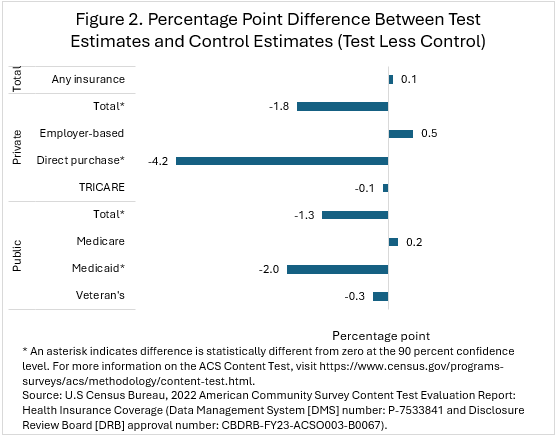
Figure 2 shows how estimates of health insurance types differed when the question was updated. There was no significant difference between the two question versions in the percentage of people with any health insurance, but the test version produced lower estimates of public coverage (-1.3 percentage points) and private insurance (-1.8 percentage points), though these differences were not significantly different from one another.
Within private insurance, the only significant decline was in direct-purchase coverage (-4.2 percentage points). Within public insurance, the only significant decline was in Medicaid coverage (-2.0 percentage points). However, when restricting the comparison to people who had Medicaid coverage without other types of insurance, the difference (-0.6 percentage points) between test and control wasn’t significant.
Another important result from the content test was that the share of the population reporting multiple types of health insurance coverage decreased from 16.1% in response to the control question to 11.2% in the test version. This is consistent with testing goals and also explains why estimates were lower than the control version for specific health coverage types — yet the overall uninsured rate did not change significantly.
Overall, there was a slight difference in the share of write-in answers between the control (4.5%) and the test (4.0%) questions (even without the processing change which will result in fewer write-ins). This is important because write-ins may reflect that respondents misunderstand the question or do not know how to categorize their insurance.
We drew two key conclusions from the content test:
- Implementation of the test question was supported by the findings of a reduction in write-ins, a decrease in reports of multiple coverage and a decrease in direct purchase insurance.
- While there was no significant difference in Medicaid-only coverage, the significant decrease in overall Medicaid coverage between the control and the test questions requires further research. The 2022 ACS Content Test Evaluation report recommended further research into how Medicaid reporting in surveys compares to administrative records to better understand reporting errors.
Medicaid Match Study
After the content test, the Census Bureau launched a Medicaid match study, linking content test data to administrative records from the Center for Medicare and Medicaid Services to evaluate the accuracy of self-reported Medicaid coverage. For each matched record, we compared self-reported Medicaid status against administrative records to classify responses as accurate or erroneous.
Across the linked dataset, the majority of respondents were correctly classified in both the control and test versions of the survey (Figure 3).
While the test version had lower rates of Medicaid receipt than the control version, the accuracy of reporting was not significantly different. 17.4% of control respondents and 16.0% of test respondents reported Medicaid coverage and were confirmed as enrolled in the administrative records — a true positive, meaning their survey response was confirmed by an administrative record.
Similarly, 73.8% of control respondents and 75.8% of test respondents reported no Medicaid coverage and the records confirmed they were not enrolled — a true negative or correct "no." Together, these two groups represent respondents whose survey answers aligned with what the administrative data showed.
When comparing areas of disagreement, the study found offsetting rates of higher false positives in control (2.2% vs 1.2% in test) but higher false negatives in test (7.5% vs 6.6% in control).
Overall, the share of respondents whose Medicaid status matched administrative records was not statistically different between the control (91.2%) and the test (91.3%) groups.
| Survey Data | |||
|---|---|---|---|
| Source: Lindstrom, Rachel, “2022 ACS Content Test Medicaid Match Study,” 2026, U.S. Census Bureau, (Data Management System [DMS] number: P-7533841and Disclosure Review Board [DRB] approval number: CBDRB-FY26-0248). | |||
| Administrative Data | Reported Medicaid | Reported No Medicaid | |
| Has Medicaid | True positive Control: 17.4% Test: 16.0% |
False negative Control: 6.6% Test: 7.5% |
|
| Doesn’t have Medicaid | False positive Control: 2.2% Test: 1.2% |
True negative Control: 73.8% Test: 75.3% |
|
Relevance for Data Users
The ACS 1-year health insurance coverage estimates will be released in October on data.census.gov as well as in an annual health insurance brief and current and historical tables. However, the Census Bureau recommends that data users compare 2025 health insurance estimates to previous years with caution. Data users should also be aware that the estimates for health insurance coverage in the comparison profiles, which compare 2025 health insurance estimates to the previous years’ estimates, will not appear on data.census.gov. Comparison guidance and user notes will be released alongside the 1-year data.
The health insurance estimates are included in the 1-year ACS release for geographies with populations of at least 65,000, which covered 861 counties in 2024 (27% of all counties). Furthermore, data users can access health insurance estimates using the 1-year supplemental (“K”) tables for geographies with populations of 20,000 or more, which covered 1,919 counties in 2024 (60% of all counties):
- K202701: with or without health insurance by age.
- K202702: with or without private health insurance.
- K202703: with or without public health insurance.
The health insurance variable will be excluded from the 2021-2025 ACS 5-year tables until the research to bridge the estimates can be completed. We expect to publish 5-year health insurance estimates with the 2022-2026 ACS 5-year data release.
Although health insurance will be excluded from the 2021-2025 ACS 5-year products, four demonstration tables will be released that will provide unofficial 5-year estimates of insured and uninsured rates overall and by age and sex for the levels of geography covered by the standard ACS 5-year tables. These tables will not bridge the change in methodology, but rather assume that high-level reports of insured vs uninsured are consistent across the 5-year period, which contains data before and after the change to the health insurance question.