State Complete Count Commissions Best Practices
State Complete Count Committees and State Complete Count Commissions play an integral role in ensuring a complete and accurate count of the community in the decennial census. This document summarizes best practices from past SCCCs and recent stakeholder meetings.
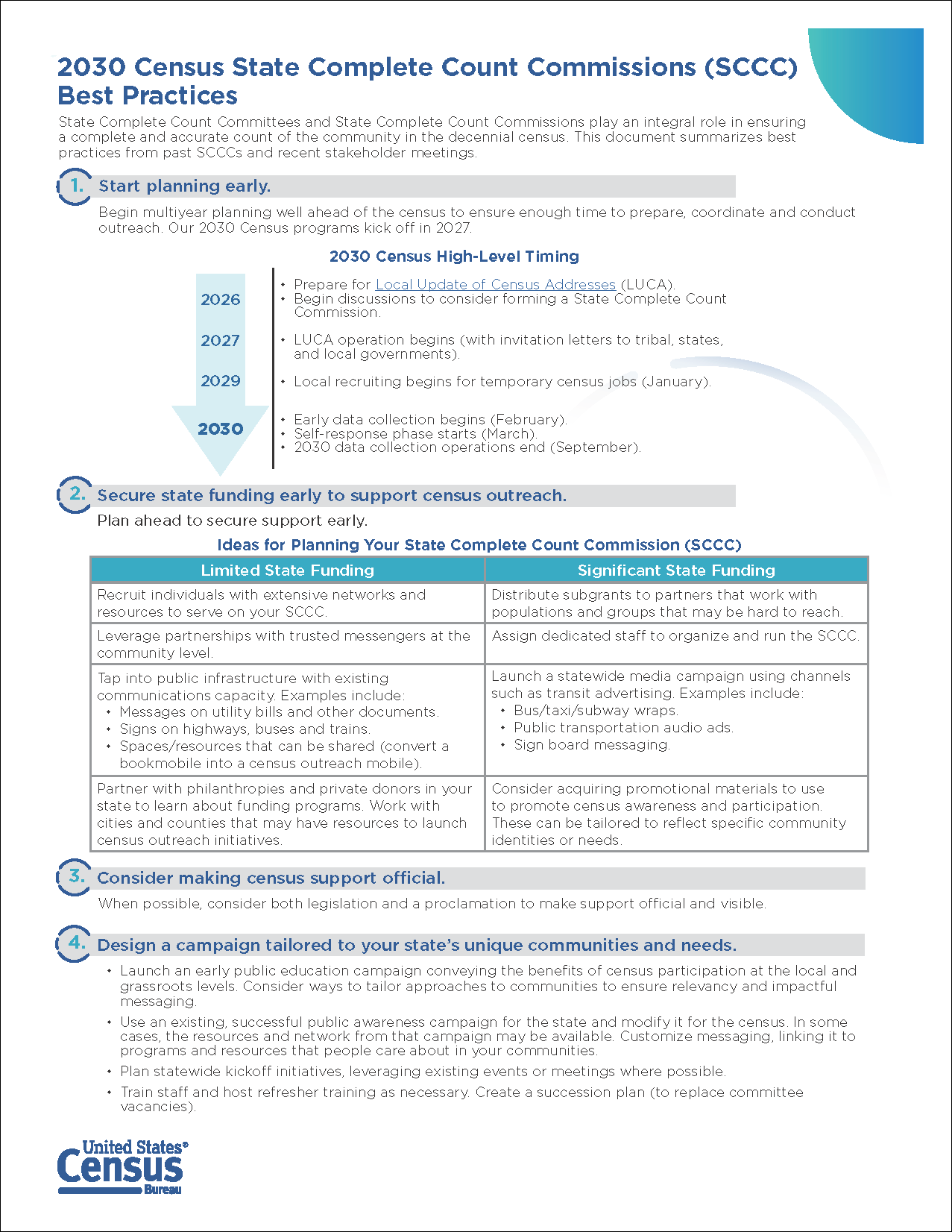
Begin multiyear planning well ahead of the census to ensure enough time to prepare, coordinate, and conduct outreach. Our 2030 Census programs kick off in 2027.
| 2030 Census High-Level Timing | |
|---|---|
| 2026 |
|
| 2027 |
|
| 2029 |
|
| 2030 |
|
Plan ahead to secure support early.
| Ideas for Planning Your State Complete Count Commission (SCCC) | |
|---|---|
| Limited State Funding | Significant State Funding |
| Recruit individuals with extensive networks and resources to serve on your SCCC. | Distribute subgrants to partners that work with populations and groups that may be hard to reach. |
| Leverage partnerships with trusted messengers at the community level. | Assign dedicated staff to organize and run the SCCC. |
Tap into public infrastructure with existing communications capacity. Examples include:
|
Launch a statewide media campaign using channels such as transit advertising. Examples include:
|
| Partner with philanthropies and private donors in your state to learn about funding programs. Work with cities and counties that may have resources to launch census outreach initiatives. | Consider acquiring promotional materials to use to promote census awareness and participation. These can be tailored to reflect specific community identities or needs. |
When possible, consider both legislation and a proclamation to make support official and visible.
- Launch an early public education campaign conveying the benefits of census participation at the local and grassroots levels. Consider ways to tailor approaches to communities to ensure relevancy and impactful messaging.
- Use an existing, successful public awareness campaign for the state and modify it for the census. In some cases, the resources and network from that campaign may be available. Customize messaging, linking it to programs and resources that people care about in your communities.
- Plan statewide kickoff initiatives, leveraging existing events or meetings where possible.
- Train staff and host refresher training as necessary. Create a succession plan (to replace committee vacancies).
- Encourage counties and cities to appoint state liaisons by 2027 to coordinate local efforts, create Complete Count Committees (CCCs), and engage in joint planning.
- Consider collaborating with state data centers that may have input on outreach and support needs.
- Find ways to share state goals across communities, adjust strategies in areas where goals still need to be met, and celebrate milestones and accomplishments. For example, some 2020 SCCCs sponsored a contest in the state for highest self-response rates—and some states even challenged other states.
- Consider funding local grants, especially for programs aimed at increasing census awareness and response in areas with historically low participation.
- Acknowledge/highlight partners and volunteers, and foster connections between partners for collaboration.
- Model support for census programs by participating in programs like Local Update of Census Addresses (LUCA), Participant Statistical Areas Program (PSAP), and Boundary Annexation Survey (BAS). State participation in these programs is critical.
- It’s also important to provide support to county jurisdictions who might not have the financial or technical resources to participate in these programs.
- Develop an online resource hub for others to access materials and information for their communities. Include general information, timing, ways to respond, testimonials addressing various community needs, and available support services.
- Direct audiences to the Census Bureau’s 2030 Census website for up-to-date information, and cross-link webpages to your social media outlets (and vice versa) to maximize engagement.
- Use state networks to tap into existing local agencies and public organizations (such as schools, libraries, police and fire departments). Ask these trusted groups to share information on their networks and platforms. For example, a state library can reach out to local branches on its network and even leverage bookmobiles.
- Enlist trusted voices, including elected officials, community-based organizations, and civic groups (such as places of worship or food pantries) to share information about the census.
- Tie outreach to existing events (such as concerts, school meetings, sports events, or festivals).
- Promote 2030 Census job opportunities by partnering with colleges, workforce agencies, and community groups. This is especially important at the local level to ensure census staff know and understand their communities.
- Expand broadband and public internet access in your state, including access points at government buildings (such as libraries or schools). This will help ensure people can apply for census jobs and complete the 2030 Census questionnaire online.
For more information, visit the 2030 Census Partners Page.
Page Last Revised - March 31, 2026