
Thirty States and the District of Columbia Collected Nearly $3.6 Billion in Estimated Cannabis Excise Tax Revenues Between July 2025 and June 2026
While cannabis remains illegal federally, 30 states and the District of Columbia (D.C.) collect excise taxes on cannabis sales. Their contributions to state tax receipts have reached new heights: an estimated $3.55 billion in combined tax revenue between July 2025 and June 2026.
And the numbers keep growing.
When implementing cannabis taxes, states aim to generate revenue without driving prices so high that consumers turn to illegal markets.
When the U.S. Census Bureau began collecting cannabis excise tax revenue data in 2021 as part of the Quarterly Summary of State and Local Government Tax Revenue (QTAX) survey, only 19 states and D.C. imposed a cannabis excise tax. In the 5 years since, 11 more states entered the market for a total of 31, including D.C. (Table 1).
Alabama became the latest entrant when medical-only sales began in May 2026.
| State | Legislative/sales dates | Source |
|---|---|---|
| Alabama | Medical cannabis law enacted in 2021 but licensing and legal challenges delayed sales until May 20, 2026. | Patients, Caregivers, & Physicians – Alabama Medical Cannabis Commission |
| Connecticut | Legal recreational cannabis market began Jan. 10, 2023. | Governor Lamont Announces Start of Adult-Use Cannabis Sales at Connecticut’s First Group of Licensed Retailers |
| Delaware | Measure signed into law legalizing adult-use cannabis market in 2023 but sales did not begin until Aug. 1, 2025. | Delaware Reports Strong Start to Recreational Marijuana Sales - State of Delaware News |
| Maryland | Legal recreational cannabis market began July 1, 2025. | Adult Use Cannabis Information |
| Minnesota | Legal recreational cannabis market began Aug. 1, 2023. | News Releases / Office of Cannabis Management |
| Mississippi | Legal medical-only cannabis market began Jan. 1, 2023. | Cannabis Quarterly Report 4th qtr FY2026.pdf |
| New Mexico | Legal cannabis sales begin April 1, 2022. | Cannabis in New Mexico - NM RLD |
| Ohio | Legal recreational cannabis market began Aug. 6, 2024. State previously had a medical cannabis market that was not subject to an excise tax. | About DCC | Ohio Department of Commerce |
| Rhode Island | Legal recreational cannabis market began Dec. 1, 2022. | Taxation_of_Adult_Use_Recreational_Cannabis.pdf |
| Vermont | Legal cannabis market began Oct. 1, 2022. | Cannabis Excise Tax Statistics | Department of Taxes |
| West Virginia | Medical-only legal cannabis market began in late 2021. | 2023 Biennial Report_Final_12.20.23.pdf |
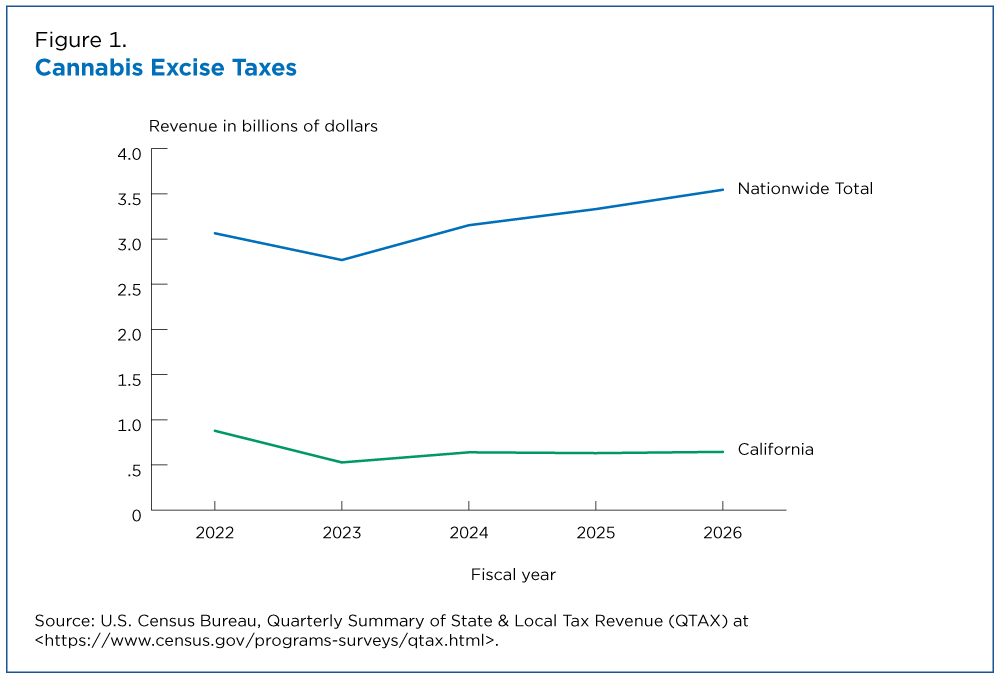
Since the bureau began tracking the data, total cannabis tax revenue increased 15.7%, rising from $3.06 billion in fiscal year (FY) 2022 to $3.55 billion in FY 2026 (Table 2).

California Fluctuation
The sizable drop in FY 2023 total revenue can be largely attributed to California.
Prior to FY 2023, California levied both a 15% retail excise tax and a cultivation tax. On July 1, 2022, the state eliminated the cultivation tax to ease the tax burden, lower market prices and curb the black market.
As a result, California’s cannabis tax revenues fell from $878.56 million in FY 2022 to $528.23 million in FY 2023. The nationwide decline in FY 2023 reflected California’s policy shift, but totals climbed again in subsequent years as more states began collecting cannabis taxes (Figure 1).
California showcased the difficulty of changing tax structures.
When implementing cannabis taxes, states aim to generate revenue without driving prices so high that consumers turn to illegal markets. That’s why they experiment with various tax structures, including excise taxes on cannabis wholesale, cultivation and retail.
Even retail excise taxes often differ by product weight, THC content or form (such as “flower” or “vapor” products).
A Growing Industry
Washington and Montana each collect more than $50 per resident in cannabis excise taxes annually, the nation’s highest per capita revenue, driven by particularly high retail excise rates of 37% and 20%, respectively (Figure 2).

Alaska collects more than $30 per resident despite having no retail excise tax. Instead, the state relies solely on a $50-per-ounce cultivation tax applied when cannabis is transferred to licensed establishments.
States with recreational markets typically collect more revenue per resident than medical-only states, which are more common in the South.
Delaware and Minnesota have rapidly growing recreational markets.
Minnesota issued 324 new cannabis business licenses in 2025 and increased its excise tax rate from 10% to 15%. The state collected $34.44 million in FY26 compared to just $16.57 million in FY25. This is expected to increase more as the market expands.
Delaware began collecting cannabis excise taxes Aug. 1, 2025, at a rate of 15%. Revenue collections continue to rise as newly licensed businesses enter the marketplace.
About QTAX
The Census Bureau’s Quarterly Summary of State and Local Government Tax Revenue provides quarterly estimates of state and local government tax revenue at the national level, as well as detailed tax revenue data for individual states.
Related Statistics
Subscribe
Our email newsletter is sent out on the day we publish a story. Get an alert directly in your inbox to read, share and blog about our newest stories.
Contact our Public Information Office for media inquiries or interviews.
Related America Counts Stories
-
TaxationFundamental Shifts in State Taxes in Past CenturyJune 17, 2026Income and sales taxes have largely replaced property taxes, once the lion’s share of state tax revenue.
-
Business and EconomyState Lottery Ticket Sales Soar as Prizes Get LargerApril 08, 2026While sales nearly doubled to $104.7 billion from 2008 to 2024, state lottery prizes more than doubled to $70.2 billion in FY 2024.
-
Business and EconomyState Governments Parlay Sports Betting Into Tax WindfallDecember 10, 2025Total state-level sports betting tax revenues has increased 382% since the third quarter of 2021, when data collection began.
-
Families and Living ArrangementsU.S. Parents Gave $26.6 Billion to Their Adult Children in 2024September 30, 2026About 2.6 million parents provided financial support to 3.7 million children age 21 and over who did not live at home.
-
Business and EconomyAmerican Manufacturing: A History in Census DataSeptember 28, 2026On the 15th anniversary of Manufacturing Day, we celebrate the sector’s contribution to the U.S. economy.
-
EducationBeyond Diplomas: Nondegree Credentials Linked to Higher EarningsSeptember 22, 2026High school graduates and even those with college degrees earned more with nondegree credentials targeting specific work skills.
-
Emergency PreparednessCalm Atlantic Hurricane Season Could Mean Active One in the PacificSeptember 17, 2026Census Bureau data tools can help communities prepare for and recover from hurricanes and other disasters wherever they are.