
Parental Financial Support Does Not End When Children Grow Up, Even After They Move Out
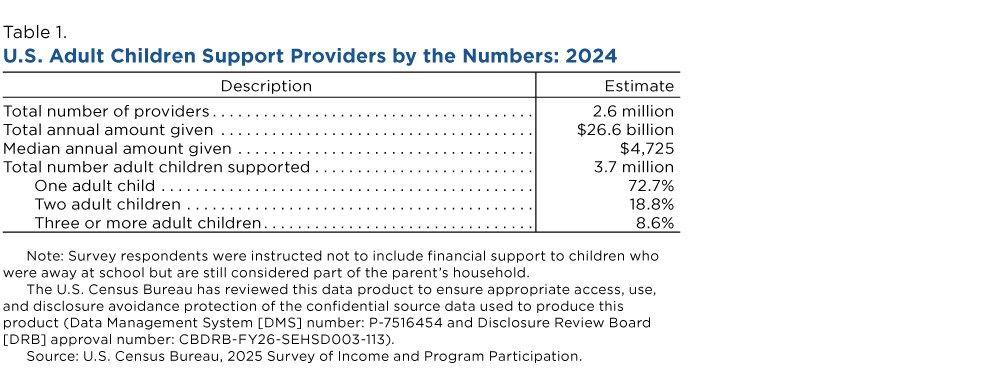
About 2.6 million U.S. parents provided $26.6 billion in financial support to 3.7 million children 21 or over who lived outside their households, according to the U.S. Census Bureau’s 2025 Survey of Income and Program Participation (SIPP).
This does not take into account money parents spent on adult children living at home. In 2024, 58.3% of men and 56.4% of women ages 18 to 34 lived with their parents.
Most parents (72.7%) financially supported one adult child; 18.8% provided support to two and 8.6% to three or more.
The SIPP is the only survey that asks for detailed information on support provided to specific people who live outside the household, the number of people supported and annual amounts.
This was voluntary financial support and could be given in a lump sum or in regular payments throughout the year. Adult children may use this parental support to cover bills, food and other expenses.
Historical Patterns
Figure 1 shows the total annual amounts given to children 21 or older living outside the household during the 11-year span from 2014 to 2024.
Because this financial support is informal, fluctuations in the amounts given are expected. However, it is worth highlighting that there was a significant increase in support in 2017 that remained elevated in 2018, coinciding with an increase in earnings of all workers. This was followed by a significant drop in support in 2020, the year the COVID-19 pandemic hit.
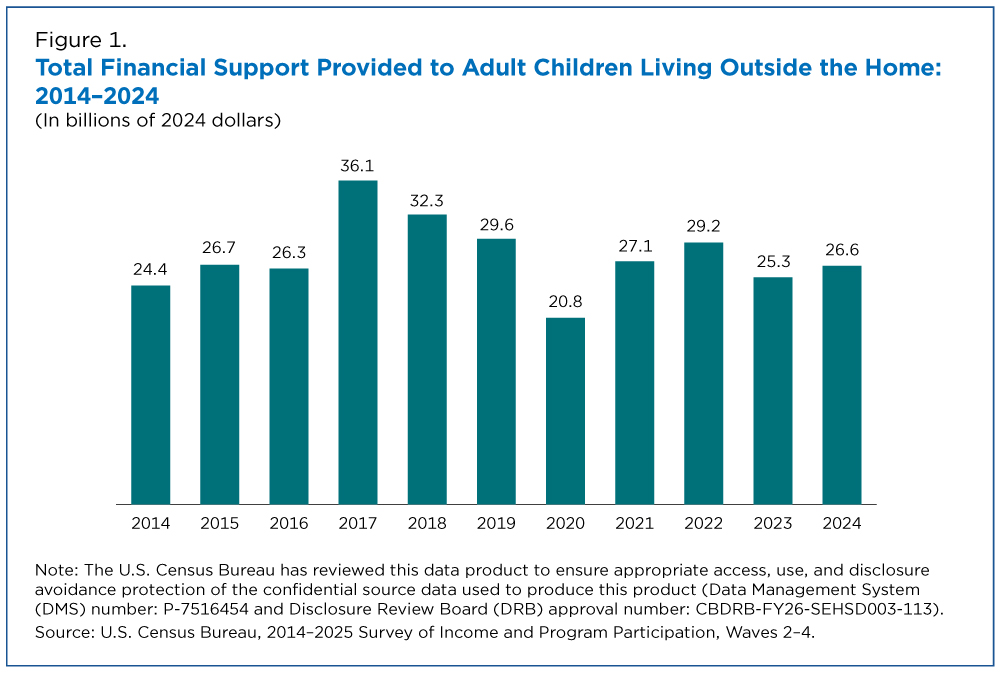
Table 1 shows that in 2024, the total median annual amount provided to adult children was $4,725 (half gave more and half gave less).
Most parents (72.7%) financially supported one adult child; 18.8% provided support to two and 8.6% to three or more.
Who Provided Support to Adult Children?
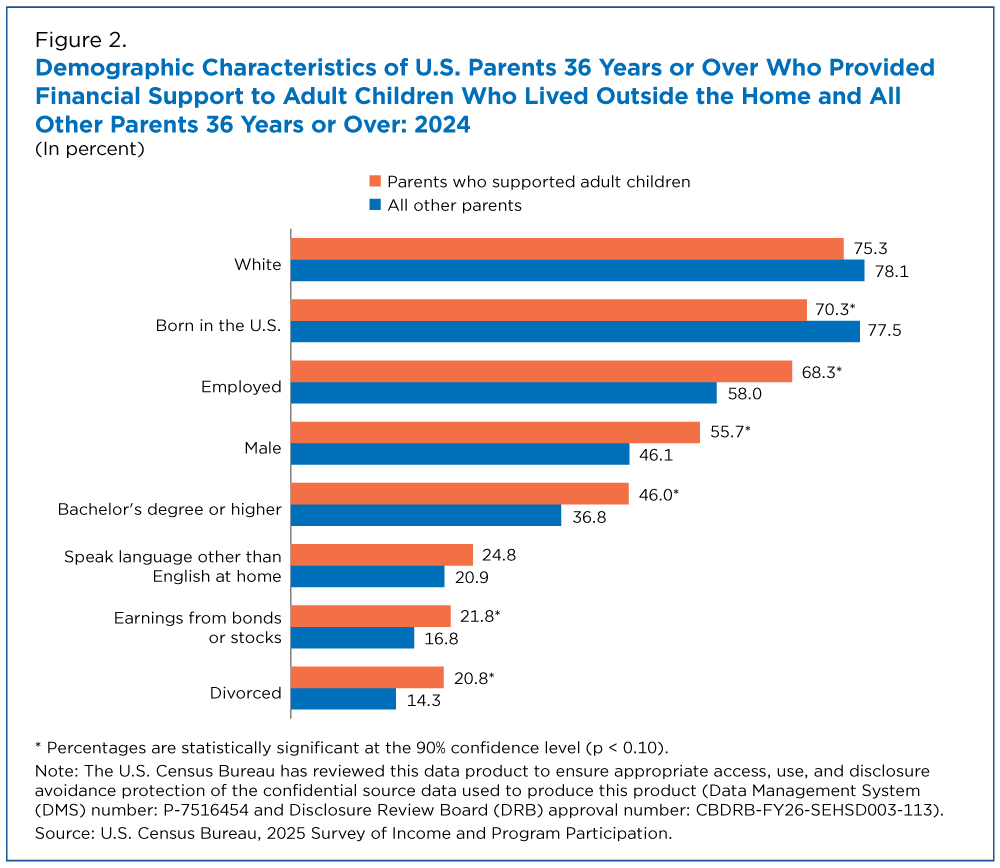
Parents who financially supported their adult children differed demographically from other parents age 36 and over. As Figure 2 shows, they were less likely to be born in the United States (70.3% vs. 77.5%) and more likely to:
- Be men (55.7% vs. 46.1%).
- Be employed (68.3% vs. 58.0%).
- Have a bachelor’s degree or higher (46.0% vs. 36.8%).
- Be divorced (20.8% vs. 14.3%).
- Have earned income from bonds or stocks (21.8% vs. 16.8%).
Parents financially helping adult children had a higher median annual income than those that did not provide support ($63,440 versus $41,930). However, their median household incomes were not statistically different ($110,700 versus $98,110).
This might be explained by the presence of larger households among those who did not support adult children — around 48.3% lived in households with three or more people compared to 31.3% of those who supported adult children.
Financial Support May Also Go to Parents and Other Relatives
In 2024, around 11.4 million people in the United States gave $78.1 billion to 19.0 million people living outside their households. In addition to the support provided to adult children, they financially supported:
- 7.2 million parents ($20.2 billion).
- 5.8 million relatives other than parents and adult children ($22.8 billion).
- 2.4 million nonrelatives ($8.4 billion).
Nearly two-thirds (64.6%) of providers gave financial support to either parents or adult children, in keeping with other findings showing these two groups are the primary recipients of financial assistance.
About the SIPP
The SIPP is a nationally representative, longitudinal survey administered by the Census Bureau that provides comprehensive information on the dynamics of income, employment, household composition and government program participation.
More information is available on the SIPP webpage. Technical documentation and more information about SIPP data quality are on the SIPP Technical Documentation webpage. The estimates presented here are subject to sampling and nonsampling error.
Related Statistics
Subscribe
Our email newsletter is sent out on the day we publish a story. Get an alert directly in your inbox to read, share and blog about our newest stories.
Contact our Public Information Office for media inquiries or interviews.
Related America Counts Stories
-
PopulationMost Young Adults Had Not Reached Key Milestones of Adulthood in 2024August 05, 2025Less than 25% of 25- to 34-year-olds lived outside their parental home, worked, were married and had kids in 2024, down from almost half in 1975.
-
Families and Living ArrangementsU.S. Adults Provided $17.5 Billion in Support to Parents in 2020June 14, 2023Almost as many U.S. adults voluntarily provided financial support to parents as those who paid mandatory child support.
-
EmploymentGenerational Wealth: How High Earners Help Their Children’s CareersAugust 12, 2025Young workers saw 24% greater earnings than peers when their first job was with a parent’s employer. Higher earners and blue-collar workers benefited most.
-
Emergency PreparednessEarthquake Risk May Hit Closer to Home Than You ThinkOctober 14, 2026The 140th anniversary of the Charleston earthquake reminds us of the risks to people, housing and economies in places not typically associated with earthquakes.
-
Emergency PreparednessTornado Activity Shifts East — Heightening Risks in the SouthOctober 07, 2026Census data can help vulnerable communities that have a concentration of mobile homes cope with more frequent tornado activity over a longer season.
-
Families and Living ArrangementsU.S. Parents Gave $26.6 Billion to Their Adult Children in 2024September 30, 2026About 2.6 million parents provided financial support to 3.7 million children age 21 and over who did not live at home.
-
Business and EconomyAmerican Manufacturing: A History in Census DataSeptember 28, 2026On the 15th anniversary of Manufacturing Day, we celebrate the sector’s contribution to the U.S. economy.