309 Counties Had Sustained High Poverty for Two Decades
In 309 or almost 10% of U.S. counties, mostly in the South, poverty rates stayed at 20% or more for two decades, according to the recently released American Community Survey (ACS) 5-year estimates.
The latest ACS release allows us to compare changes in poverty rates in most of the nation’s 3,144 counties and county equivalents in five-year periods over the span of 20 years: 2005-2009; 2010-2014; 2015-2019; and 2020-2024.
In this analysis, counties are considered in sustained poverty if their poverty rates remained at 20% or higher in each of the four nonoverlapping 5-year periods.
About 85% of the 309 counties that had high poverty rates during all four 5-year cycles were in the South. Many of these sustained poverty counties were concentrated in a few informal subregions like the Mississippi Delta and Appalachia.
Nationally, about 33% of counties had at least one 5-year period of high poverty (20% or more) — including more than half of all counties in the South. These counties account for around 16% of U.S. population.
The share of a region’s population, excluding some populations (detailed below), living in one of these counties was 23.5% in the South, 12.6% in the Midwest, 12.5% in the Northeast and 10.5% in the West.
How Poverty Is Measured
Poverty status is determined by comparing annual income to a set of dollar values (poverty thresholds) that vary by family size, number of children and the householder’s age.
A family and its members are in poverty if the family’s pretax income is less than the dollar value of its poverty threshold. Poverty status of people not living in families is determined by comparing individuals’ income to their poverty threshold.
The poverty measure excludes children younger than age 15 who are not related to the householder; people living in institutional group quarters; and people living in college dormitories or military barracks.
Places in Poverty
The ACS allows us to measure sustained poverty in places in addition to individual rates.
It’s an important insight as research suggests people living in higher poverty areas experience more acute systemic problems than those in lower poverty areas.
Poor living conditions like less desirable housing, limited job opportunities and lack of access to medical services are exacerbated when high poverty rates exist over time, affecting all residents whether or not they’re poor themselves.
Government agencies seek to identify high-poverty areas as targets for increased levels of support. A 2023 U.S. Census Bureau report found that 341 counties and around 6% of the U.S. population had been in persistent high poverty for 30 years.
How County Poverty Rates Changed Over Time
From 2005 to 2009, 640 counties (of 3,133 that could be compared) had a poverty rate of 20% or higher. This increased to 839 counties in the next 5-year period (2010-2014) but, along with the national poverty rate, decreased from 590 in 2015-2019 and to 476 during the most recent 2020-2024 period.
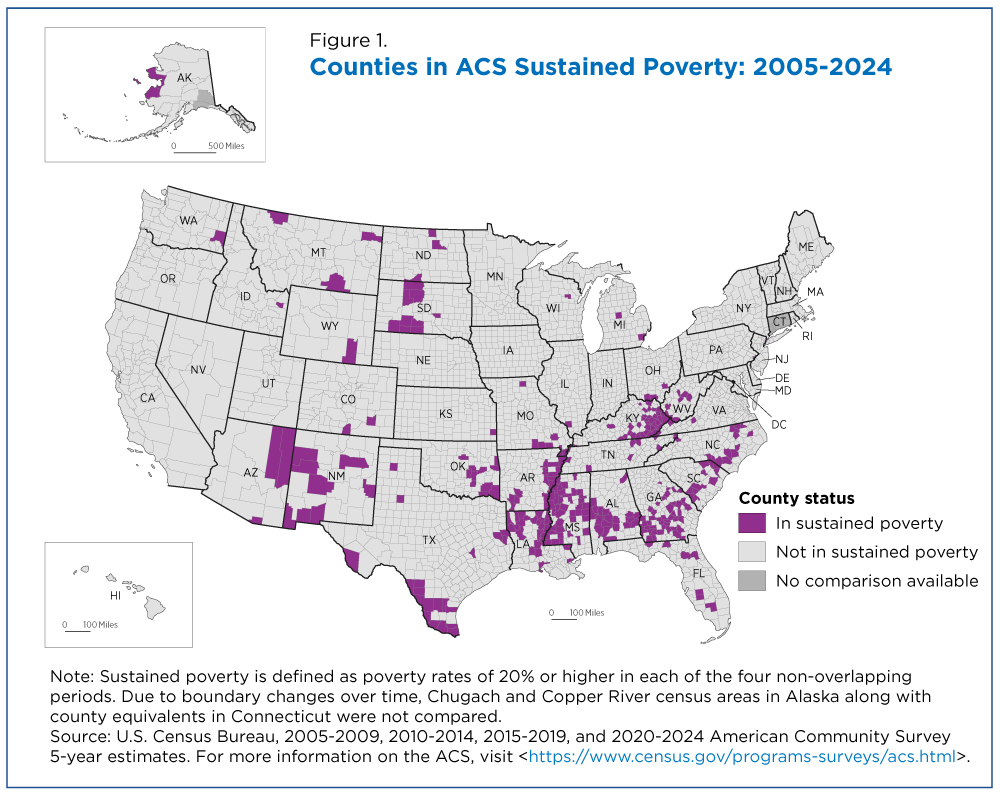
About 85% of the 309 counties that had high poverty rates during all four 5-year cycles were in the South (Figure 1). Many of these sustained poverty counties were concentrated in a few informal subregions like the Mississippi Delta and Appalachia.
There was less of a southern concentration when measured by the share of people in the 2020-2024 poverty universe living in sustained poverty counties: 7.3% of the population in the South; 5.6% in the Northeast; 3.8% in the Midwest; and 1.0% in the West.

Sustained Poverty by State
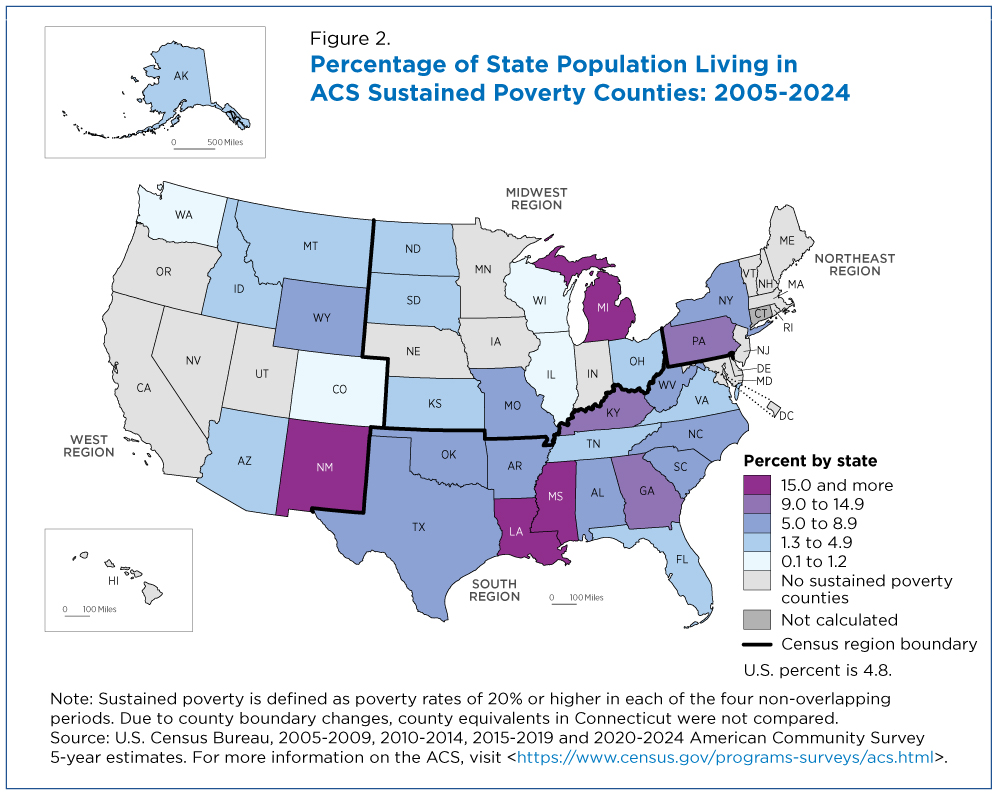
Figure 2 shows the percentage of population in each state that lived in counties in sustained poverty for 20 years.
- States where at least 9% of their population lived in sustained poverty counties: Mississippi (36.0%), Louisiana (28.3%), New Mexico (19.3%), Michigan (18.4%), Kentucky (13.4%), Pennsylvania (12.2%) and Georgia (11.4%).
- States with no sustained high-poverty counties: California, Connecticut, Delaware, District of Columbia, Hawaii, Indiana, Iowa, Kansas, Maine, Maryland, Massachusetts, Minnesota, Nebraska, Nevada, New Hampshire, New Jersey, Oregon, Rhode Island, Utah, and Vermont.
Note that Connecticut is included even though the county equivalents could not be compared because of a statewide reorganization that changed county boundaries. However, all counties in all previous 5-year periods were below 20% as were the 2020-2024 new boundary county equivalents.
High Poverty Counties in at Least Three 5-Year Spans
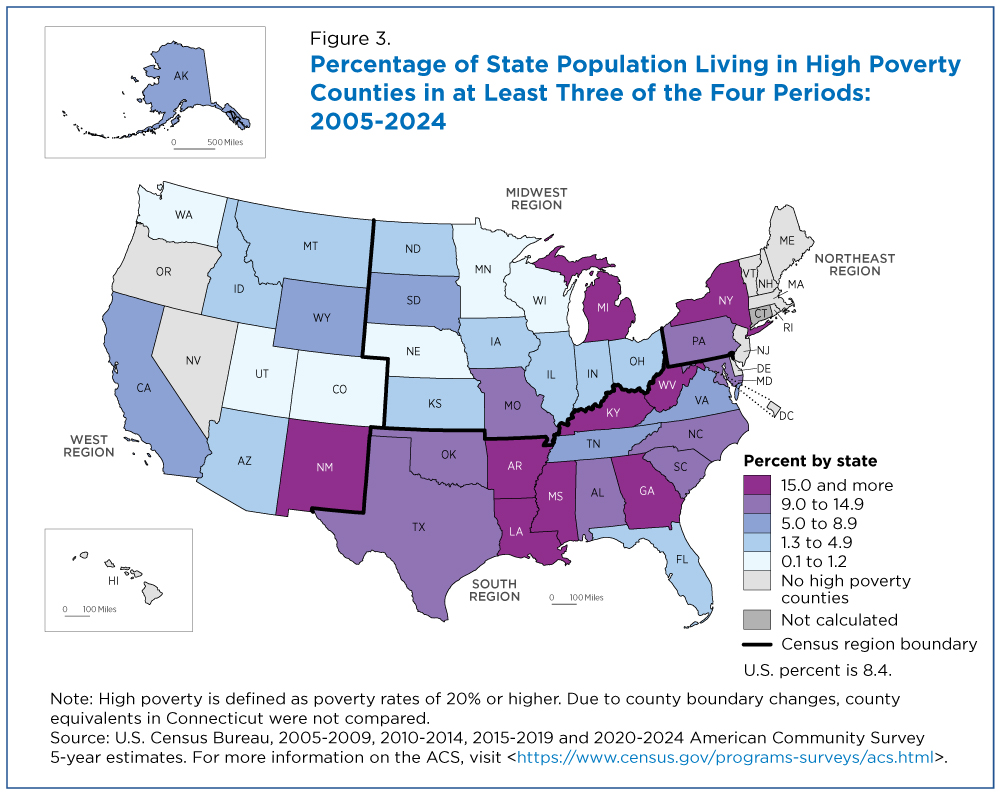
Nearly 200 additional counties (more than 500 total) had a 20% or higher poverty rate in at least three of the five-year periods.
From 2020 to 2024, at least 15% of the population in nine states lived in counties with high poverty rates while 12 states had no counties with high poverty rates. (Figure 3).
Nationwide, 16.1% of counties had a high poverty rate in at least three of the ACS 5-year periods.
- States with 15% or more of population living in those counties: Mississippi (49.1%), Louisiana (35.3%), New Mexico (31.1%), West Viginia (22.9%), New York (20.6%), Michigan (19.5%), Kentucky (18.0%), Arkansas (17.2%) and Georgia (15.0%).
- States with no population living in those counties: Connecticut (referenced above), Delaware, the District of Columbia, Hawaii, Maine, Massachusetts, Nevada, New Hampshire, New Jersey, Oregon, Rhode Island and Vermont.
Counties in High Poverty in at Least One 5-Year Span
Nearly a third (over 1,000) of all counties had high poverty rates in at least one 5-year period over the 20-year span.
- Five states had greater than 40% of their population living in such counties: Mississippi (67.6%), Arkansas (47.3%), Louisiana (45.3%), New Mexico (44.9%) and West Virginia (43.7%).
- The District of Columbia and six states had no such counties: Connecticut (referenced above), Delaware, New Hampshire, New Jersey, Rhode Island and Vermont.
The ACS Turns 20
The recent release marks the 20th anniversary of the ACS, which collects detailed social, economic, housing and demographic information from a sample of households across the 50 states and the District of Columbia.
The survey provides key insights into the changing needs and conditions of communities by producing estimates on a wide range of geographies, including 5-year data for every U.S. county.
Additional poverty data from the 2024 release is available at Census Bureau Data. Links to poverty estimates from other Census Bureau surveys like the Current Population Survey Annual Social and Economic Supplement (CPS ASEC) and the Survey of Income and Program Participation (SIPP) are available on this poverty topics page.
Related Statistics
Subscribe
Our email newsletter is sent out on the day we publish a story. Get an alert directly in your inbox to read, share and blog about our newest stories.
Contact our Public Information Office for media inquiries or interviews.
-
Income and PovertyOlder Adults and Child Poverty Rates Changed in Many States in 2023September 12, 2024American Community Survey data released today show that despite a decline in child poverty rates in 2023, they remain higher than other age groups.
-
Income and PovertySupplemental Poverty Rate Below Official Rate in Only 10 StatesSeptember 09, 2025Annual national SPM rates ranged from 12.4% to 12.9% and official poverty rates ranged from 10.6% to 11.5% between 2022 and 2024.
-
Income and PovertyMajority of Older Adults in Poverty in 2021 Lived AloneJune 25, 2024New Census Bureau report explores demographic characteristics, living arrangements and income sources of older adults living in poverty.
-
Families and Living ArrangementsU.S. Parents Gave $26.6 Billion to Their Adult Children in 2024September 30, 2026About 2.6 million parents provided financial support to 3.7 million children age 21 and over who did not live at home.
-
Business and EconomyAmerican Manufacturing: A History in Census DataSeptember 28, 2026On the 15th anniversary of Manufacturing Day, we celebrate the sector’s contribution to the U.S. economy.
-
EducationBeyond Diplomas: Nondegree Credentials Linked to Higher EarningsSeptember 22, 2026High school graduates and even those with college degrees earned more with nondegree credentials targeting specific work skills.
-
Emergency PreparednessCalm Atlantic Hurricane Season Could Mean Active One in the PacificSeptember 17, 2026Census Bureau data tools can help communities prepare for and recover from hurricanes and other disasters wherever they are.