
New Data Show Characteristics of Opposite-Sex Couples Who Lived Together in 2025
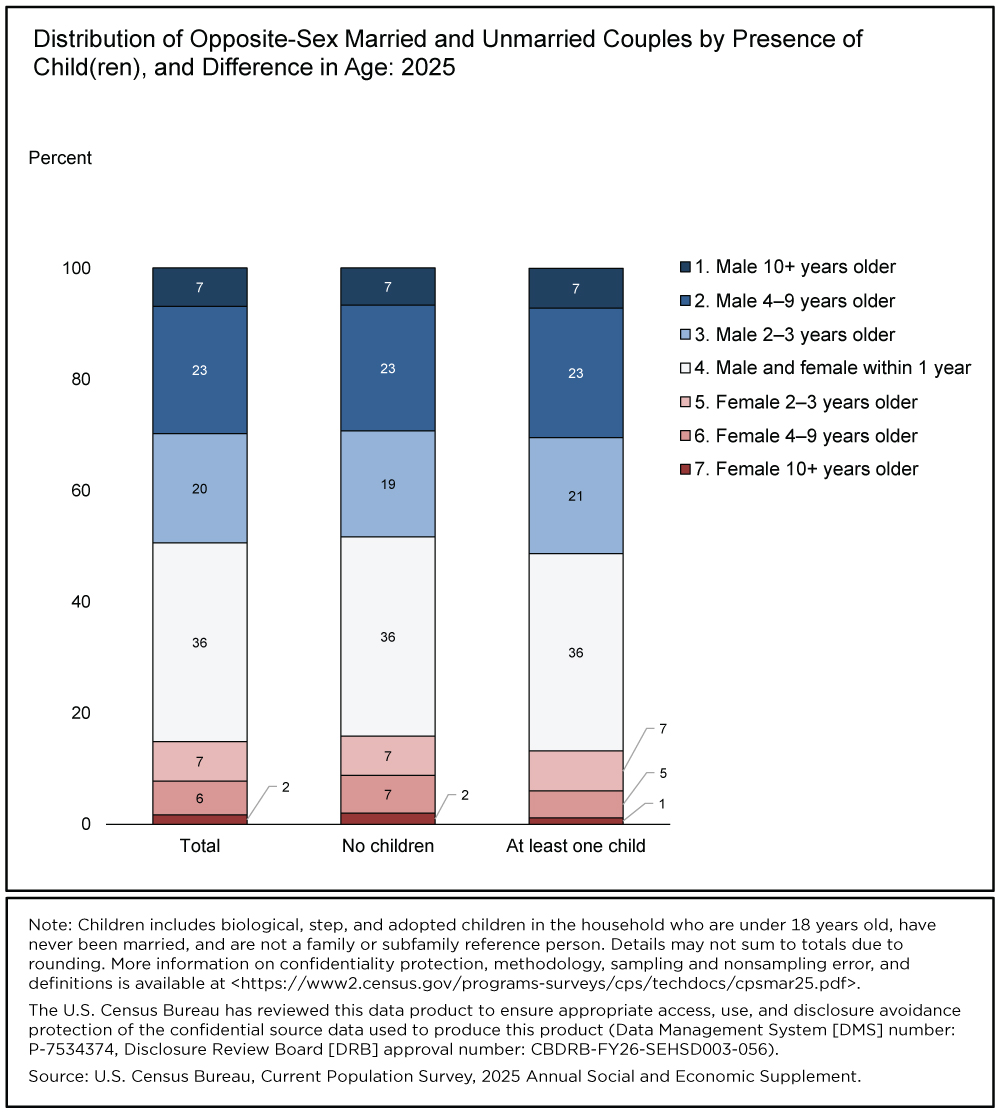
Partners in more than a third of U.S. opposite-sex couples were within a year of the same age, while in about 7%, the man was at least 10 years older.
Using data from the Current Population Survey Annual Social and Economic Supplement, a new interactive data visualization compares characteristics of partners in married and unmarried opposite-sex couples living together in 2025.
In 5.1 million couples, the male partner was 10 or more years older than his female partner, compared to about 1.3 million couples where the female partner was 10 or more years older than her partner.
Characteristics include age, earnings and educational attainment by couple type (married or unmarried) and by the presence of at least one child.
Note: Select the image to go to the interactive data visualization.
Among all opposite-sex couples who lived together in 2025:
- In 5.1 million couples, the male partner was 10 or more years older than his female partner, compared to about 1.3 million couples where the female partner was 10 or more years older than her partner.
- Nearly three-fifths (59%) of couples included members with the same level of education.
- In 52% of all opposite-sex couples, the man earned at least $5,000 more annually than his partner, and in 26% of couples, partners’ annual earnings were within $5,000 of each other.
- Among opposite-sex couples without children in the household, 36% had partners who earned within $5,000 of each other annually compared to less than 10% of those with at least one child in the household.
The Census Bureau also published 2025 estimates in historical tables on topics including the living arrangements of adults and children, marital status, households and families.
More data visualizations on families and living arrangements are available:
About the Research
All comparative statements have undergone statistical testing and, unless otherwise noted, are statistically significant at the 90% confidence level. All data are subject to sampling, nonsampling, modeling and other errors.
The technical documentation provides more information on data collection, standards and accuracy.
Related Statistics
Subscribe
Our email newsletter is sent out on the day we publish a story. Get an alert directly in your inbox to read, share and blog about our newest stories.
Contact our Public Information Office for media inquiries or interviews.
Related America Counts Stories
-
Families and Living ArrangementsCouples’ Finances: Married but SeparateSeptember 24, 2025While most married couples had joint bank accounts, fewer shared all their financial accounts.
-
Families and Living ArrangementsNumber of Same-Sex Couple Households Nearly Doubled From 2005 to 2024April 01, 2026Census Bureau data show demographic and economic characteristics of same- and opposite-sex couple U.S. households.
-
FertilityChildlessness on the Rise — Except for Women Ages 45 to 50September 23, 2025From 2014 to 2024, the share of older mothers rose as fewer teens and women in their 20s and 30s had children.
-
Emergency PreparednessTornado Activity Shifts East — Heightening Risks in the SouthOctober 07, 2026Census data can help vulnerable communities that have a concentration of mobile homes cope with more frequent tornado activity over a longer season.
-
Families and Living ArrangementsU.S. Parents Gave $26.6 Billion to Their Adult Children in 2024September 30, 2026About 2.6 million parents provided financial support to 3.7 million children age 21 and over who did not live at home.
-
Business and EconomyAmerican Manufacturing: A History in Census DataSeptember 28, 2026On the 15th anniversary of Manufacturing Day, we celebrate the sector’s contribution to the U.S. economy.
-
EducationBeyond Diplomas: Nondegree Credentials Linked to Higher EarningsSeptember 22, 2026High school graduates and even those with college degrees earned more with nondegree credentials targeting specific work skills.