
Census Bureau Provides Resources, Data Tools, Website for Small Businesses
The smallest possible businesses, nonemployer establishments (those with no paid employees), accounted for 78.4% of all U.S. establishments in 2023, and brought in nearly $1.8 trillion in revenue that year — proof of the power of small business in America’s economy.
The Small Business Administration (SBA) defines a small business as an independent business with fewer than 500 employees and has celebrated Small Business Week every May since 1963 to recognize U.S. entrepreneurs and small business owners.
The U.S. Census Bureau plays a part too, tracking key data points and resources to provide a rich profile of the nation’s small businesses.
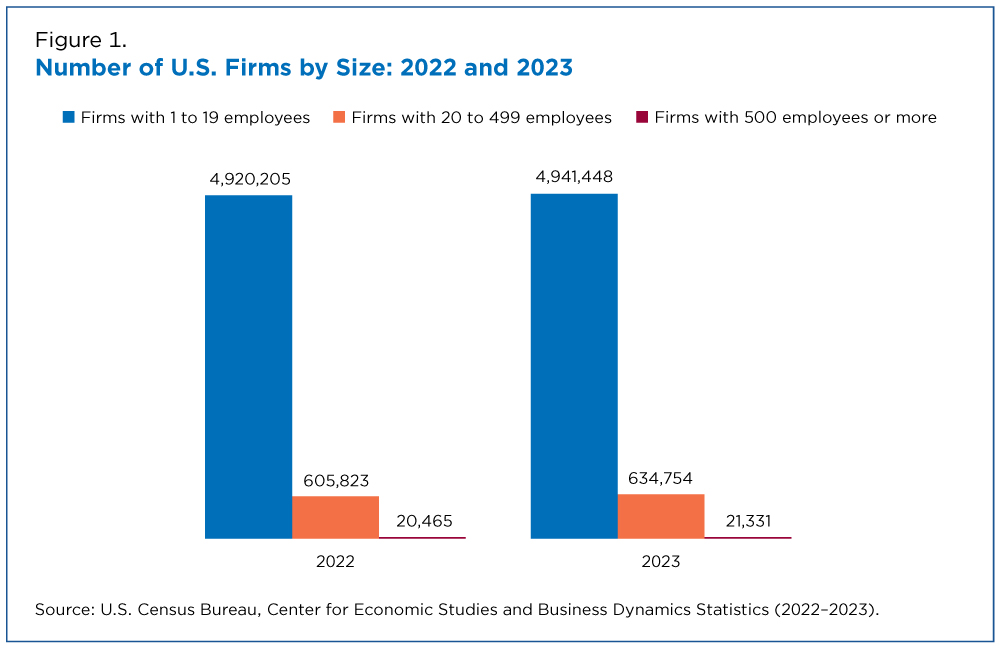
There were 5.58 million U.S. firms that had at least one employee but fewer than 500 employees in 2023, up from 5.53 million in 2022.
The SBA is set to host events across the country during Small Business Week – May 3 to May 9, 2026 – including a free virtual summit for aspiring entrepreneurs and small business owners, and in-person sessions on a variety of business topics. Additionally, a recently recorded Census webinar on Creating a Data-Driven Business Plan is available on demand here.
The Nation’s Small Business Landscape
The Census Bureau publishes a variety of data and resources about the nation’s small businesses.
There were 5.58 million U.S. firms that had at least one employee but fewer than 500 employees in 2023, up from 5.53 million in 2022, according to the annual Business Dynamics Statistics (Figure 1).
An establishment is a single physical location of a business. A firm is a business organization consisting of one or more establishments under the same owner.
In addition to these small employer businesses (those with at least one paid employee), there are many self-employed U.S. entrepreneurs who run nonemployer businesses.
In 2023, there were 30,427,808 nonemployer establishments, up from 29,811,495 in 2022 – and they brought in nearly $1.8 trillion (6.4% of the Gross Domestic Product or GDP in 2023) in total revenue, according to Nonemployer Statistics (NES).
Nonemployer businesses operate in all sectors of the economy like retail, manufacturing and services.
Women-Owned Employer Businesses
The number of employer businesses owned by women jumped nearly 20% (from 1,134,549 to 1,356,990) between 2017 and 2023, according to the 2024 Annual Business Survey (ABS), which reported 2023 data.
Of those businesses, the number owned by veterans and minorities also went up. Between 2017 and 2023 (Note: Minority-owned firms are classified as any race and ethnicity combination other than non-Hispanic and White):
- The number of female veteran-owned employer firms grew 25.7%.
- The number of minority women-owned employer firms grew 49.8%.
Measuring the Pulse of U.S. Businesses
The Census Bureau’s Business Trends and Outlook Survey (BTOS) publishes data every two weeks, helping measure the “pulse” of the U.S. economy.
The BTOS covers current performance, changes in revenue, employment, hours worked, demand and prices from U.S. employer businesses.
It provides local, state and federal officials near real-time, nationally representative data for policy and decision-making, including after natural disasters or during economic crises. It also provides insights into recovery after these events.
BTOS data products were designed to allow users to understand business trends across the economy. Data is provided by employment class sizes with granular breakouts of firms ranging from one to four employees to those with less than 500 employees.
How to Start or Expand Your Small Business
Interested in starting a small business?
Use the Census Bureau webpage to find data tools and free training opportunities. Among them:
- Small Business resource page. Helps businesses identify their customer needs and tap into new markets.
- Census Business Builder (CBB). A suite of services to help entrepreneurs examine competitors and the best location(s) to start their businesses. Small businesses can use the CBB to craft their own business plans.
- Data User Guidance: Purposes and Uses of Economic Census Statistics. Provides key examples of how small businesses can use census data and tools for business planning.
- Webinars. The Census Bureau hosts a variety of talks on business-related subjects, like last year’s webinar on Building a Better Business Plan Using Free Census Data.
Related Statistics
Subscribe
Our email newsletter is sent out on the day we publish a story. Get an alert directly in your inbox to read, share and blog about our newest stories.
Contact our Public Information Office for media inquiries or interviews.
Related America Counts Stories
-
Business and EconomyThe Steady Rise of the Nonemployer BusinessJuly 30, 2025New data confirm growth in nonemployer numbers outpaced their employer counterparts in 2023, continuing pre- and post-COVID 19 pandemic trends.
-
Business and EconomyWhy Own a Business?August 19, 2025Employer businesses are most often owned by someone who strives to make money and be their own boss, according to the 2023 Annual Business Survey.
-
Business and EconomyAbility to Borrow Money Offers Clues to Financial Health of BusinessesFebruary 10, 2026Most employer businesses that applied for credit got what they asked for, according to the latest available data from the Annual Business Survey.
-
Families and Living ArrangementsU.S. Parents Gave $26.6 Billion to Their Adult Children in 2024September 30, 2026About 2.6 million parents provided financial support to 3.7 million children age 21 and over who did not live at home.
-
Business and EconomyAmerican Manufacturing: A History in Census DataSeptember 28, 2026On the 15th anniversary of Manufacturing Day, we celebrate the sector’s contribution to the U.S. economy.
-
EducationBeyond Diplomas: Nondegree Credentials Linked to Higher EarningsSeptember 22, 2026High school graduates and even those with college degrees earned more with nondegree credentials targeting specific work skills.
-
Emergency PreparednessCalm Atlantic Hurricane Season Could Mean Active One in the PacificSeptember 17, 2026Census Bureau data tools can help communities prepare for and recover from hurricanes and other disasters wherever they are.