
List of Top 15 Last Names in the United States Has Changed Less in the Last 230 Years Than You Might Think
Smith. Johnson. Williams. Brown. Jones. Miller. Davis. Wilson.
These names were among the most common in the United States in 1790, when the first census was taken.
Little has changed 230 years later. Despite a more than 84-fold increase in the population, those same names remained among the top 15 in the most recent 2020 Census.
The U.S. Census Bureau today released the 2020 Names Data, which tallies rankings of the nation’s most popular monikers and how many people share each one.
Last names tend to cluster by racial and Hispanic origin group, and each group experiences a different amount of clustering.
And for the first time since 1990, the tables also list the most popular first names by race and Hispanic origin and by sex — showing less variety among the most popular men’s first names than women’s names.
As a result, eight of the top 10 most-used first names in the United States were traditionally male.

The data release is a tally of all the first names reported in the 2020 Census and a separate tally of the last names. It is not a release of the full legal names of census respondents.
The term “predominantly” is used where the majority of people using certain names identified with a single Race, Hispanic origin, or Sex category. For example, “Garcia” is a predominantly Hispanic last name because 91% of the people named Garcia chose Hispanic in their response to the 2020 Census.
Leading Last Names
The top five last names (Smith, Johnson, Williams, Brown and Jones) were the same for three decades — 2000, 2010 and 2020 — and among the top 15 in 1790 (Figure 1).
“It is certainly surprising given the enormous change in population since then … and the immigration in that period from all around the world,” said Joshua Comenetz, senior geographer at the Census Bureau and manager of the Census Names Project.
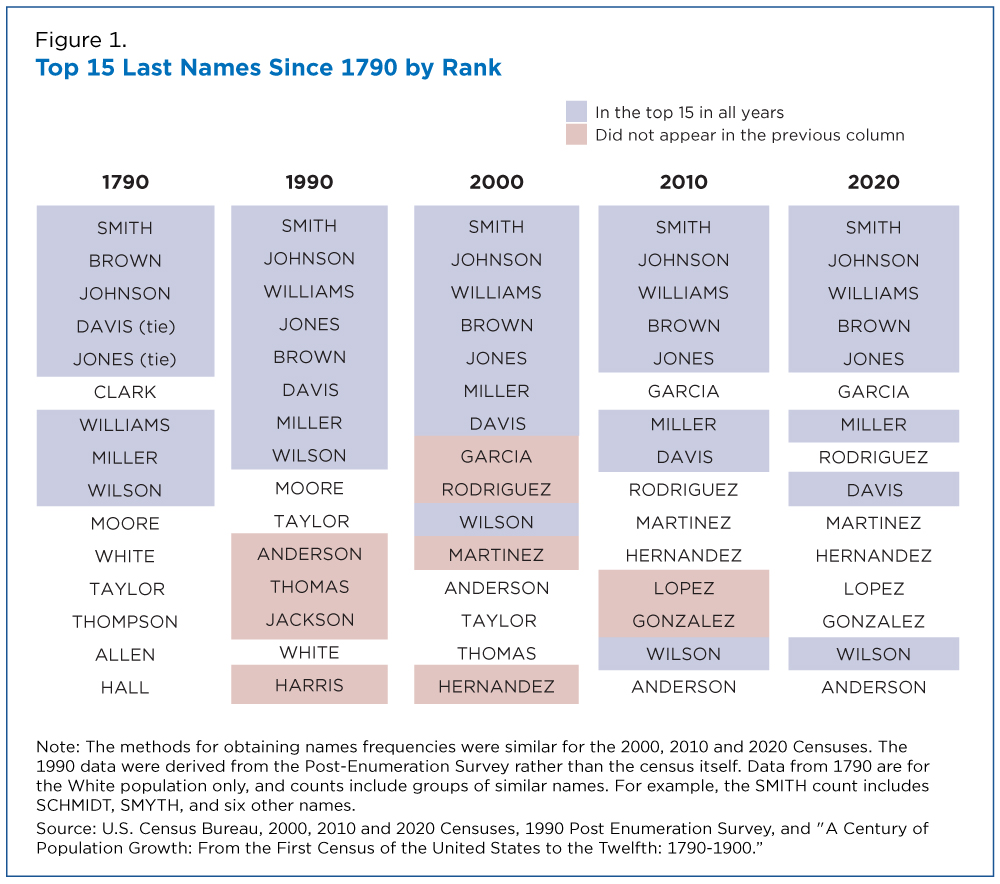
The rise in predominantly Hispanic last names between 2000 and 2020 is also notable.
In 2000, the top 50 last names included 10 that were used at least 90% of the time by respondents who identified as Hispanic. Garcia, the top-ranked among them in 8th place in 2000, jumped to 6th in 2010.
In the 2020 count, the rankings had largely stabilized. All the top 15 last names held their place except for Rodriguez, which bumped up into 8th place, moving Davis down a notch.
Name Concentration
Last names tend to cluster by racial and Hispanic origin group, and each group experiences a different amount of clustering.
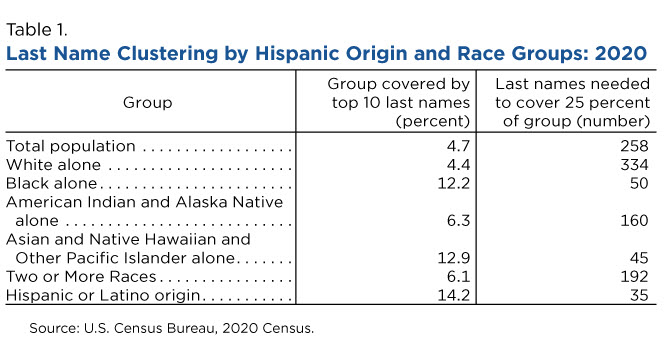
For example, people of Hispanic or Latino origin have the highest percentage of their population (14.2%) sharing the group’s top 10 last names (Table 1).
In other words, fewer names cover a larger swath of the Hispanic or Latino population compared to other groups.
“I’m not surprised there,” Comenetz says, “because the most common predominantly Hispanic names have one language origin.”
In contrast, respondents who identified as White alone (i.e., White and no other race or origin) had the smallest percentage of their population (4.4%) using the top 10 last names for their racial group.
In short, a greater number of last names was needed to cover 25% of the White alone population compared to the other groups.
Differences in concentration may influence which names climb the ranks.
Fastest Growing
All but one of the fastest-growing last names among the top 1,000 were predominantly Asian between 2010 and 2020 (Table 2).
This reflects a shift in immigration patterns. The 2000 to 2010 list of fastest growing names included several predominantly Hispanic names.
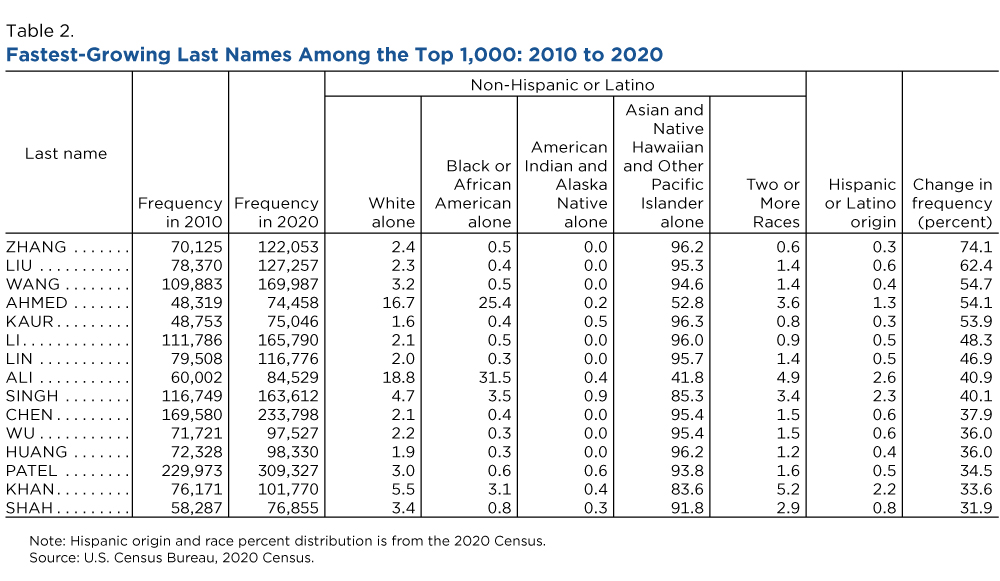
“Among the fastest growing names list, they’re all predominantly Asian, except the name Ali,” said Comenetz. “It’s common in South Asia, East Africa and the Middle East.”
Greater Variety for Women
First name data are available for the first time since 1990.
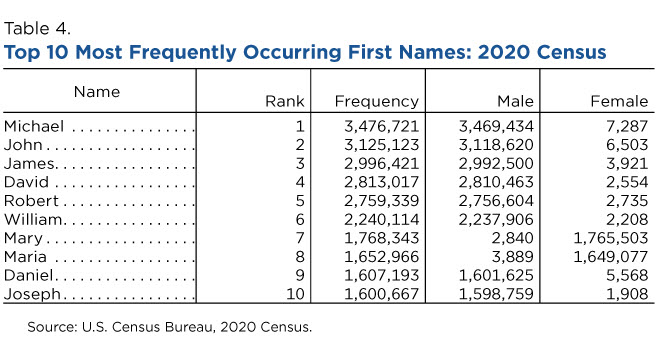
Despite women outnumbering men in the United States, the top five first names among the 2020 U.S. population were traditionally male: Michael, John, James, David and Robert.
Why? Because a larger fraction of men share the most common male names, while a smaller fraction of women share the most common female names.
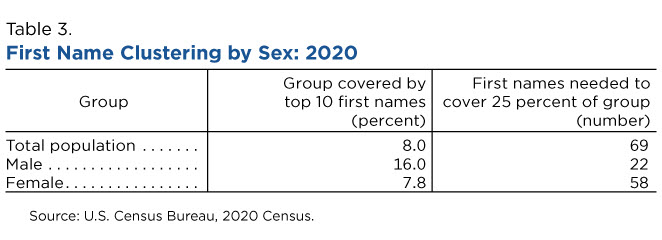
“Sixteen percent of men have the top 10 male names,” said Comenetz. “For women, it’s only a little under 8%.”
In other words, women had more first name variety than men.
Compared to men, nearly three times as many names were needed to cover 25% of the female population (Table 3).
This is reflected in the overall first name ranking, where eight of the top 10 most common first names are predominantly male (Table 4).
Comparing Name Datasets
How popular is your name for newborns? You can find out by looking at the annual Social Security Administration (SSA) release of babies’ first names, with data going back to the 1800s.
Comparing the 2020 first name datasets from SSA and the Census Bureau, there is little overlap between the two lists (Table 5). The SSA counts the names of the babies born in 2020, while the Census Bureau counts the names of all respondents.
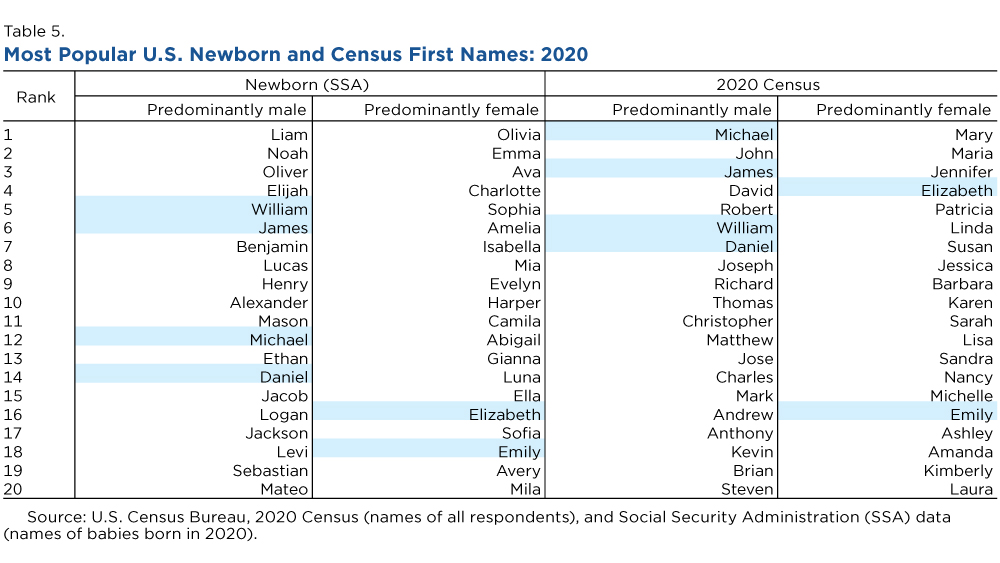
This comparison shows that there is not much overlap in the popularity of names of babies born in 2020 and the names of the total U.S. population that year.
“The census represents a kind of average of everybody currently living here,” says Comenetz. “There’s so much variety in how people name their kids that a single year does not fit the average.”
Sharing a Name
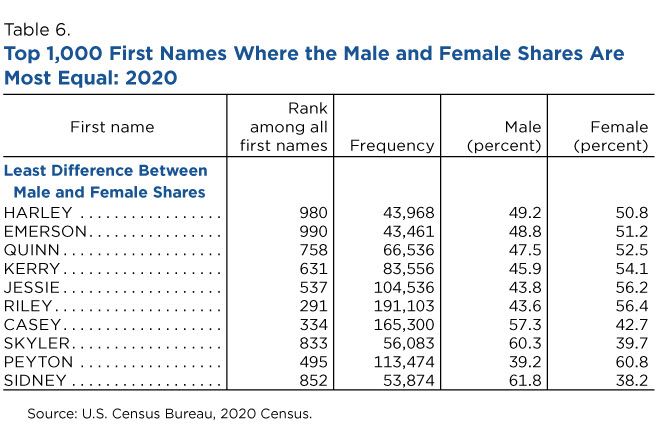
Most first names are used 95% or more of the time by either men or women exclusively but there are a few that are equally common among both.
Some in the top 1,000 first names are close to a 50/50 split between the sexes (Table 6).
Popular first names may come and go, but it’s clear the most common last names have staying power.
“Despite all the changes in population, I suspect Smith would still be the most popular last name in 2075,” said Comenetz. “I’d be surprised if it isn’t.”
Related Statistics
Subscribe
Our email newsletter is sent out on the day we publish a story. Get an alert directly in your inbox to read, share and blog about our newest stories.
Contact our Public Information Office for media inquiries or interviews.
Related America Counts Stories
-
PopulationWhat's in a Name?August 09, 2017The five most frequent surnames in 2010 remained mainly reported by whites and blacks but Hispanic surnames rose in popularity.
-
PopulationEnglish Most Common Race or Ethnicity in 2020 CensusOctober 10, 2023Recently released 2020 Census data on race and ethnicity provide detailed characteristics of more than 100 White groups.
-
PopulationThe Fourth of July: The Nation’s Population Then and NowJuly 02, 2025The U.S. population is nearly 123 times larger than it was in 1780, the nearest estimate to when the Declaration of Independence was signed in 1776.
-
Emergency PreparednessEarthquake Risk May Hit Closer to Home Than You ThinkOctober 14, 2026The 140th anniversary of the Charleston earthquake reminds us of the risks to people, housing and economies in places not typically associated with earthquakes.
-
Emergency PreparednessTornado Activity Shifts East — Heightening Risks in the SouthOctober 07, 2026Census data can help vulnerable communities that have a concentration of mobile homes cope with more frequent tornado activity over a longer season.
-
Families and Living ArrangementsU.S. Parents Gave $26.6 Billion to Their Adult Children in 2024September 30, 2026About 2.6 million parents provided financial support to 3.7 million children age 21 and over who did not live at home.
-
Business and EconomyAmerican Manufacturing: A History in Census DataSeptember 28, 2026On the 15th anniversary of Manufacturing Day, we celebrate the sector’s contribution to the U.S. economy.