New Population Estimates Show Historic Decline in Net International Migration
Estimated reading time: 8 minutes
Today, the U.S. Census Bureau released a new series of population estimates that reflect demographic change since the 2020 Census. International migration is one of the most dynamic sources of demographic change and that has certainly been the case this decade.
The new Vintage 2025 estimates show a historic decline in net international migration (NIM). Specifically, NIM:
- Peaked at 2.7 million in 2024.
- Declined to 1.3 million in 2025 (as of July 1).
- Is projected to further decline to approximately 321,000 in 2026 if current trends continue (Figure 1).
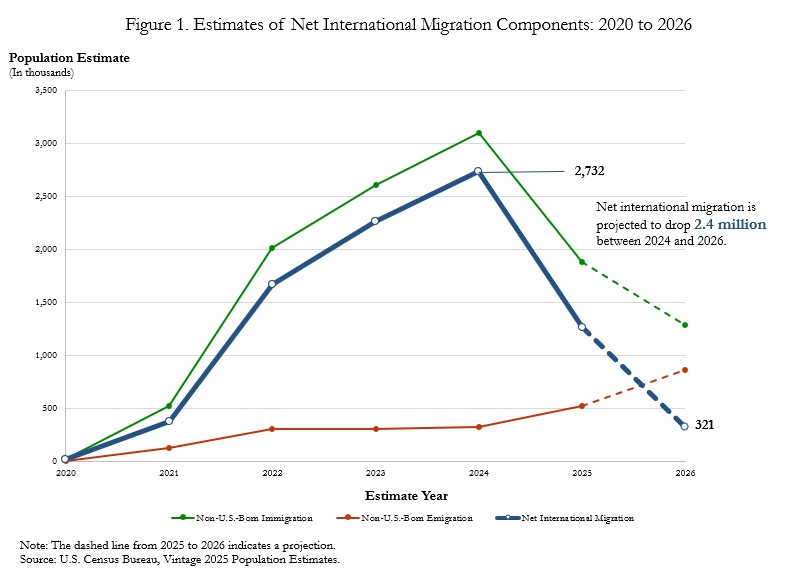
The large drop in NIM from 2024 to 2026 was caused by both a decrease in immigration and an increase in emigration (people moving out of the United States) during that period.
The 2025 data refer to July 1, 2024, to June 30, 2025. This most recent estimates year spans two periods of very different immigration policies for the United States. Therefore, data users should take the dates into consideration when looking at the current level of international migration for the Vintage 2025 population estimates.
What Is Net International Migration (NIM)?
Net international migration is defined as the “net” number of gains and losses in the national population due to migration. NIM is calculated by taking the number of immigrants and subtracting the number of emigrants (ins minus outs). Positive NIM results when the number of new arrivals is larger than the number of people leaving the United States.
The Components of NIM
NIM estimates are made up of several components:
- Immigrants: People born outside the United States who migrate to the United States, also called non-U.S.-born immigration. This is the largest component of NIM. This category includes babies born in another country to U.S. citizen parents. Estimates are not available by legal status.
- Emigrants: People moving out of the United States, including immigrants and people who were born in another country to U.S. citizen parents, also called non-U.S.-born emigration. This is the second largest component of NIM.
- Net Native Migration: People born in the United States who move between the United States and other countries (this is a relatively small part of NIM).
- Net Puerto Rico Migration: People who move between the 50 states and the District of Columbia and Puerto Rico (another relatively small part of NIM for the United States).
- Net Movement of the Armed Forces: People in the U.S. armed forces who move to and from the United States (another relatively small part of NIM).
How Are the NIM Estimates Calculated?
The Census Bureau continuously looks for ways to improve our methods to keep pace with changes in the U.S. population. Over the past several years, we have conducted research to make the methodology for estimating NIM more flexible and responsive to short-term fluctuations in migration.
For the Vintage 2025 estimates, we’ve made several revisions to our methods for estimating the following NIM components by estimate year:
- Unlike previous vintages, we did not adjust the American Community Survey (ACS) data used in the non-U.S.-born immigration estimate for July 1, 2024, to June 30, 2025, because of its closeness to available administrative data (also known as “benchmark data”).
- We analyzed a variety of data sources to improve our estimates of non-U.S.-born emigration. (Data sources noted below.)
- We used survey data from Mexico to update our estimates of non-U.S.-born emigration and net native migration.
- We updated our projections for the next estimates year (July 1, 2025, to June 30, 2026) to reflect trends since January.
We talk more about each of these in the following section.
Non-U.S.-born immigration
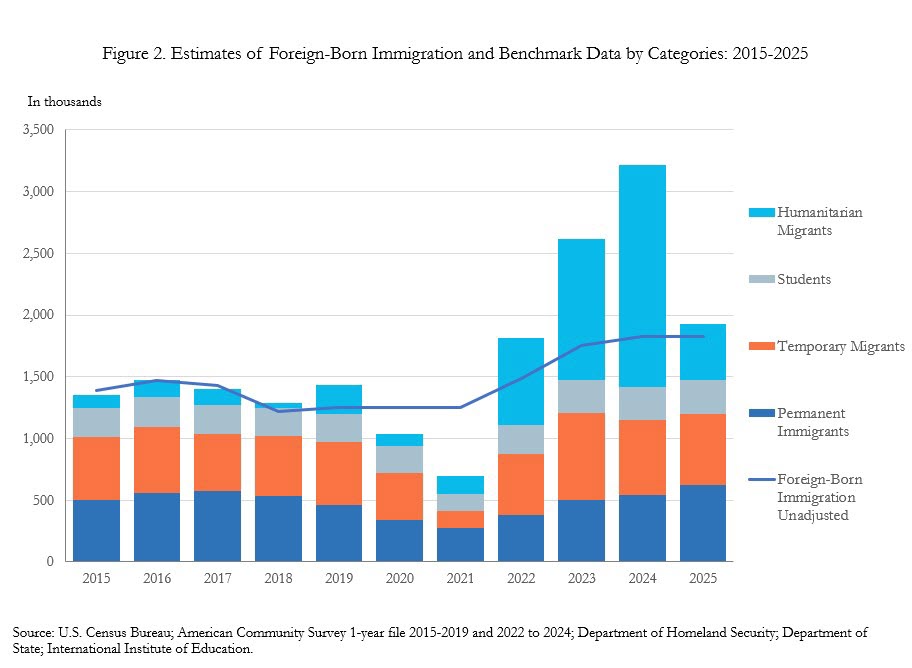
We use data from the ACS to develop the total number of non-U.S.-born immigrants each year. Specifically, we examine the foreign-born population and the population born abroad of U.S. citizen parents whose residence one year ago (ROYA) was abroad. For most years since 2020, we have used administrative data (also known as “benchmark data”) to adjust the ROYA estimate to make it more current.
Figure 2 shows bars for the benchmark data by immigration categories and a line for the unadjusted ROYA estimate.
Data are available for download [XLS].
For years where the benchmark is lower or higher than the ROYA estimate, we make an adjustment to the total number of immigrants. Since the ROYA estimate for 2025 was very close to the benchmark, we did not make an adjustment. (Note that the ACS data that are available to us when we produce the NIM estimates lag by one year. Therefore, the 2024 1-year ACS file was used for Vintage 2025.)
While the total number of non-U.S.-born immigrants may seem high for 2025 given recent policy changes, the reference period is an estimates year that includes the last six months of 2024 and the first six months of 2025 (as previously discussed). Additionally, there is a lot of momentum in the immigration system and policy changes may take time to have an effect. For example, most of the international students included in the estimates would have entered the United States in Fall 2024 at the start of the academic year.
Additionally, in Vintage 2024, we made an adjustment to the total number of non-U.S-born immigrants to account for the large number of humanitarian migrants (such as refugees and asylum seekers) who entered the United States from 2022 to 2024. The adjustment also impacted the estimates for states and counties by raising their total immigration flow, although it did not yet specifically account for the destinations where humanitarian migrants were settling due to limitations in the available data.
For the Vintage 2025 estimates, we used data from the Department of Justice’s Executive Office of Immigration Review (EOIR) to distribute the humanitarian migrants to the specific states and counties where they were living. This method change only impacts the 2022 to 2024 periods of the Vintage 2025 time series.
Non-U.S.-born emigration
Measuring emigration presents unique challenges because this population is no longer in the United States to respond to a survey or census. Further, there are very few mechanisms to remove the records of these people from administrative data after they have emigrated.
For Vintage 2025, we looked at several sources of data to determine how informed adjustments may be made to the ACS-based emigration estimates including trends in survey data, repatriations data from the Department of Homeland Security (DHS) and data from other countries.
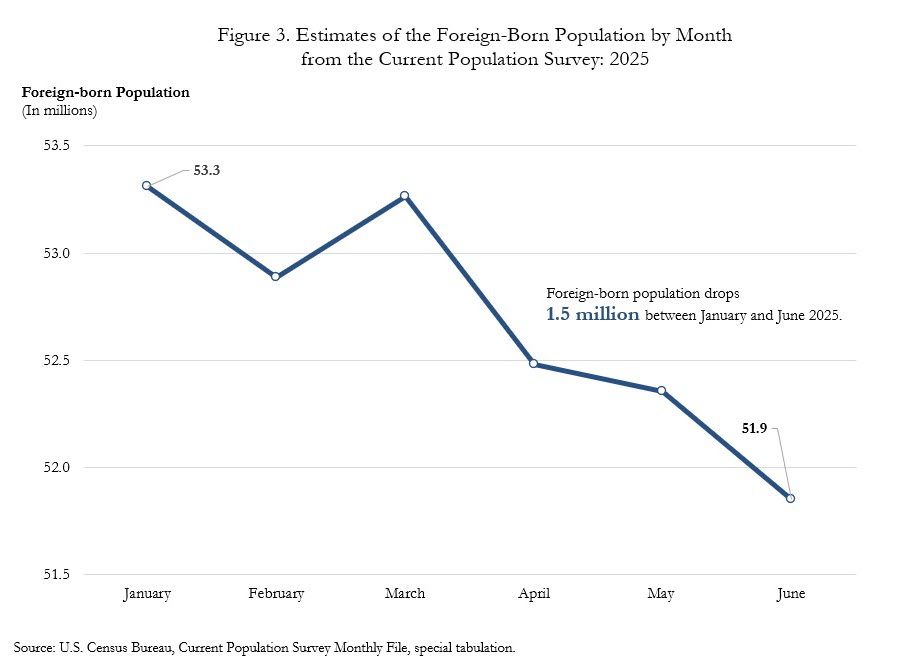
For example, we analyzed trends in the monthly data from the Current Population Survey (CPS), which is a labor force survey conducted by the Census Bureau for the Bureau of Labor Statistics. Figure 3 shows that the foreign-born population in the CPS declined from 53.3 million in January 2025 to 51.9 million in June 2025, a decline of 1.4 million. While the change in the foreign-born population in a survey over time can imply emigration, it can also reflect survey non-response, coverage error or the impact of population controls.
The CPS has a relatively small sample size compared to the ACS, especially for the foreign-born population. We have historically used ACS data instead of CPS data to estimate the size and geographic distribution of the foreign-born population. However, the CPS provides more current estimates with the monthly files, making it a valuable benchmark that informed the emigration research for Vintage 2025.
We also monitored trends in repatriations data or DHS removals by arrest location, which include both removals from the border and removals from the interior of the United States. Border repatriations (people apprehended within close proximity to the border) would likely not meet the residency requirements to be included in the population estimates, while interior repatriations (people apprehended from the interior of the country) are more likely to meet those requirements.
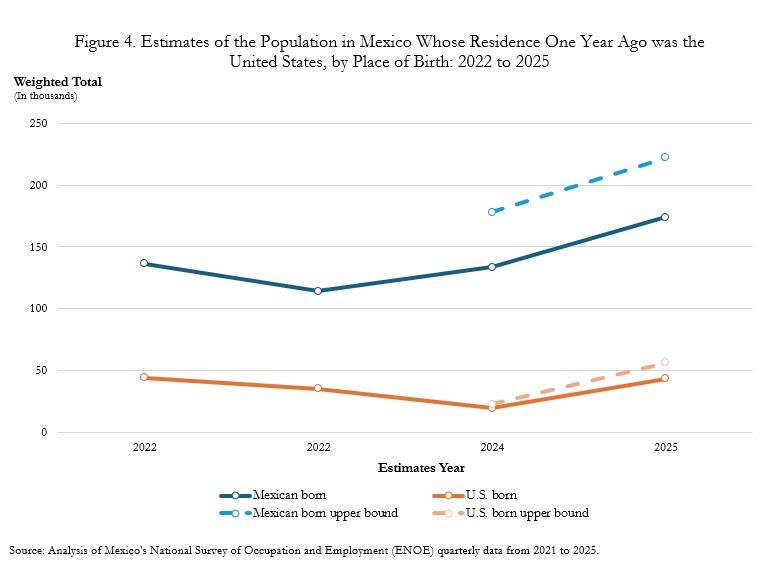
Finally, we analyzed data from Mexico’s National Survey of Occupation and Employment (ENOE), which includes a question about a respondent’s ROYA. We focused on the survey estimate of the Mexican-born and U.S.-born populations whose ROYA was in the United States but were now living in Mexico (emigrants). This number increased in estimates year 2025 compared to earlier years (Figure 4). We used the upper-bound of the ENOE results to adjust the estimates of emigration to Mexico that are part of our regular processing. The upper-bound estimate accounts for sampling error in the survey.
Net native migration
The ENOE data also showed a substantial increase in the number of U.S.-born people living in Mexico whose ROYA was in the United States (Figure 4). Further analysis revealed that these were mostly children who probably emigrated with their Mexican-born parents; we also used the ENOE survey data to adjust the estimates of net native migration.
Projections for July 1, 2025, to June 30, 2026
To meet the needs of surveys like the CPS, which collect and publish data monthly, each vintage of estimates includes a projection period. Historically, we have held the last year of observed NIM data constant for the projection period. This means that for the Vintage 2025 estimates, we would have held the level of NIM in the July 1, 2024, to June 30, 2025, period constant for 2026 through 2028. However, given the fluidity in international migration trends for the United States since January 2025, the projected NIM would have been too high.
For the Vintage 2025 projection period, we had to make assumptions about where current trends in international migration are heading. To inform these assumptions, monthly data from our internal Benchmark Database were used where possible to estimate the amount of decline in immigration since January 2025 and produce the national total for the 2026 period. The 2026 value was then held constant for 2027 and 2028.
For the July 1, 2024, to June 30, 2025, period the estimates of non-U.S.-born emigration for migrants from Mexico and other Latin American countries were increased. For the 2026 projection period, it was assumed that the 2025 estimate would double in 2026; then, we held the 2026 value constant for 2027 and 2028. Again, emigration is a difficult component of population change to measure and is particularly challenging to project given all the factors that can influence it.
Comparisons With Other Estimates
Each January, the Congressional Budget Office (CBO) releases its Demographic Outlook which includes projections of net immigration. Figure 2 compares the Vintage 2025 NIM estimates with the CBO net immigration projections, which were released in January 2026.
Note, the CBO data were released in calendar years, but to facilitate comparison, we have converted them to estimate years so they align with the population estimates.
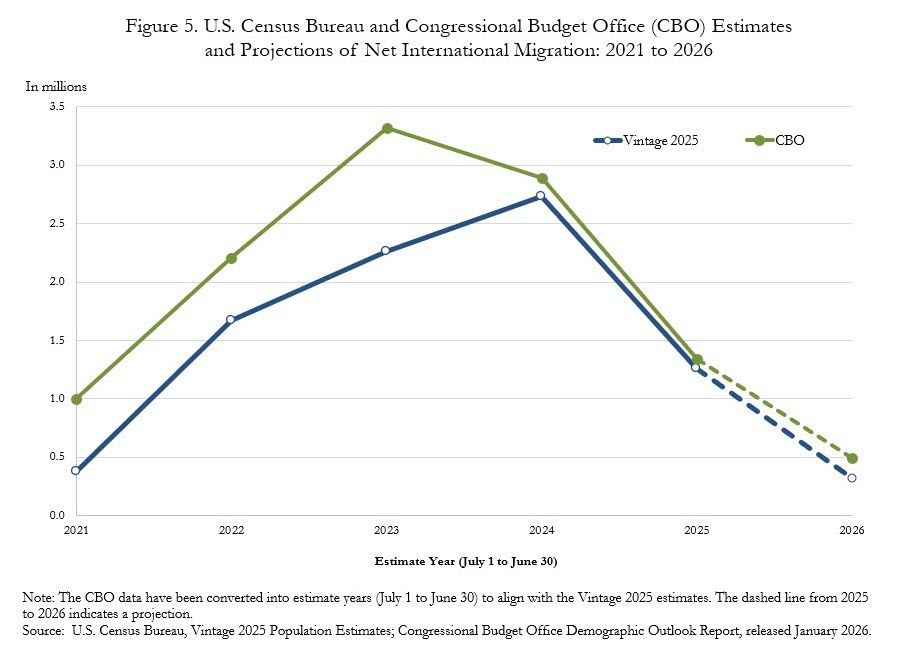
Overall, trends in the CBO and Census estimates are similar. However, from 2021 to 2023, the CBO values for net international migration were considerably higher than the Vintage 2025 NIM estimates. From 2024 to 2026, the data are very close, especially in 2025.
The similar values for 2025 and 2026 are notable given that the Census Bureau and CBO use different methodologies to develop the NIM component of their estimates and projections.
Conclusion
Currently, the estimates of NIM are trending toward negative net migration. If those trends continue, it would be the first time the United States has seen net negative migration in more than 50 years.
By leveraging our methodology that combines administrative data from other federal agencies with data from the ACS, we can more accurately monitor these trends. This enables us to be responsive to sudden changes in international migration flows whether they are caused by a global pandemic, a surge in humanitarian migration, or changes in immigration policy. We will continue to leverage both administrative and ACS data over 2026 and beyond to ensure we produce accurate and timely estimates of NIM for the next vintage of population estimates.
Related Information