Updating the Planning Database With the 2020 Census Contact Strategy and Low Response Score
Updating the Planning Database With the 2020 Census Contact Strategy and Low Response Score
Estimated reading time: 5 minutes
Censuses and surveys provide vital information for nearly all aspects of society. Underpinning these efforts is the meticulous planning from organizations tasked with collecting this information from millions of respondents.
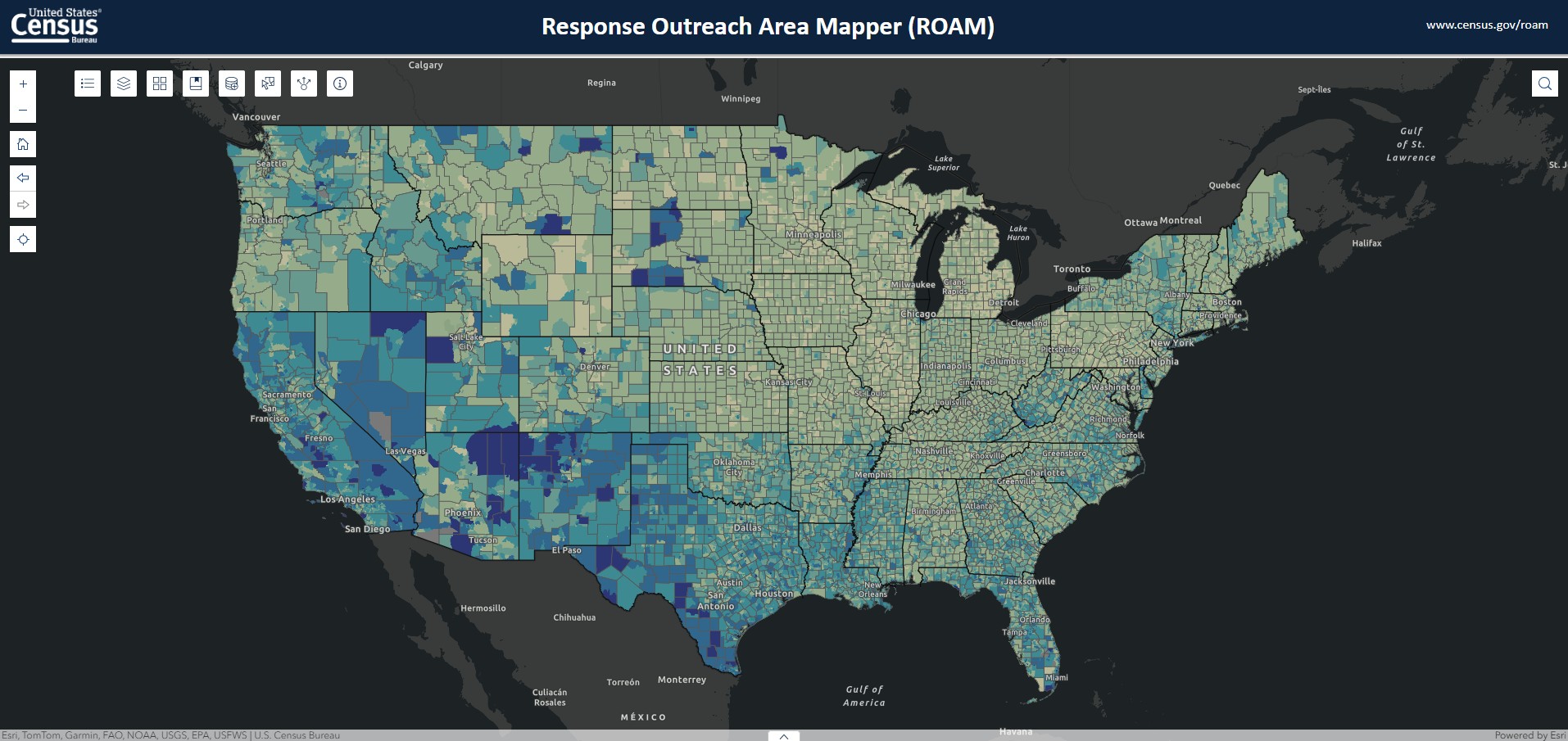
A key aspect of taking censuses and conducting surveys is understanding the communities to which questionnaires are sent and the likelihood of residents responding. To help inform future survey and census planning, the U.S. Census Bureau has released operational statistics from the 2020 Census, as well as predicted low response rates (“scores”) for tracts and block groups in the United States. The 2020 Census contact strategy variables and 2020-based Low Response Score (LRS) are available for the first time with the release of the 2024 Planning Database (PDB). The interactive tool, Response Outreach Area Mapper (ROAM), was also updated with the new PDB variables to make the data more easily accessible to users.
What Is the Planning Database?
The Census Bureau's PDB was first released using data from the 2000 Census. The PDB is a publicly available resource containing operational statistics from the most recent census for all tracts and block groups in the 50 states, Washington, D.C., and Puerto Rico. The PDB also compiles data on various housing, demographic and socioeconomic characteristics that may be related to higher nonresponse. The PDB was developed to aid survey and census planning. Among its uses:
- Identifying geographic areas for special outreach.
- Examining expected survey completion rates.
- Linking to spatial data to create thematic maps.
- Generating reports, cross tabulations, and simple analyses.
- Planning for interviewer-administered surveys and censuses.
The PDB contains important information about neighborhoods, delineated as block groups and tracts, and a measure of the likelihood that residents would participate in a census or survey.
What Is the Response Outreach Area Mapper?
The Census Bureau developed ROAM, an interactive mapping tool to help identify hard-to-count areas. It is built around the LRS and other key statistics from the PDB. Along with the PDB, ROAM allows Census Bureau staff to plan for field resources and develop communication and partnership campaigns to manage response rates. ROAM contains demographic profiles and low response scores for hard-to-count areas based on estimates available on the PDB. Last updated in 2019, ROAM has now been refreshed with data from the 2024 PDB.
New to the 2024 PDB: Census Contact Strategy
The 2020 Census operation contact strategies for tracts and block groups from 2020 Census operations were made available for the first time on the 2024 PDB, released January 22. The contact strategy is the method the Census Bureau used to invite respondents to participate in the 2020 Census. The PDB includes housing unit counts for the contact strategies listed below.
| Internet First | The Census Bureau mailed letters to more than 113 million households about completing the 2020 Census questionnaire online or by phone. |
| Internet Choice | The Census Bureau mailed the 2020 Census paper questionnaire to 31 million households with the option to respond online or by phone instead. |
| Update Leave | The Census Bureau hand-delivered 2020 Census materials to about 6 million households. |
The 2020 Census was the first U.S. census to offer the internet as the primary way for households to respond. More than 90 million responses were collected through the Internet Self-Response (ISR) application.
Internet Choice was designated for areas that had low self-response rates to the American Community Survey (ACS) and at least one of the following:
- Low internet response rates.
- High proportions of people age 65 and over.
- Low rate of internet subscriptions.
The Update Leave operation was designated for areas where mail may not be deliverable to the housing unit or areas recently affected by natural disasters.
Key Changes to the PDB: Response and Return Rates
The 2020 Census self-response and return rates were first released in the 2023 PDB. The definitions were updated for the 2024 PDB so that return rates now include self-response eligible vacant housing unit counts and make them more comparable to return rates from previous decennial censuses. To protect confidentiality, the vacant-unit counts include a small amount of random “noise,” which helps prevent possible disclosure of data about occupied housing units. This had only a minimal effect on return rates, with a median change of 0.2 or 0.3 percentage points, depending on geography.
| Self-Response Rate | The percentage of housing units that provided a sufficient internet, paper or phone response after accounting for duplicate responses. |
| Return Rate | The percentage of “occupied” housing units that provided a sufficient internet, paper or phone response after accounting for duplicate responses. |
The PDB includes these rates by mode of response (internet, paper or phone) as well as for bilingual responses.
Additionally, the PDB includes the total self-response rate from the more recent ACS for tracts only.
Updated Low Response Score Model
The 2020 Census-based LRS is being released for the first time this decade. Previously, the LRS was based on statistics from the 2010 Census. The LRS is the predicted return rate for all modes of self-response if a census or survey were to be conducted. This differs from the 2010 Census-based LRS, which predicted the return rate for mailed paper questionnaires.
The LRS model has been updated to account for state-specific variations in the outcome for self-response. For Connecticut, census counts and statistics were recoded to the new planning regions, which supplanted the original counties after the 2020 enumeration. The following independent variables from the 2020 Census enumeration were used to predict the LRS for tracts and block groups as of the 2024 PDB release.
| Demographic | Percentage of the population that is Hispanic. |
| Percentage of the population that is non-Hispanic Black alone. | |
| Percentage of the population that is non-Hispanic White alone. | |
| Percentage of the population that is male. | |
| Percentage of the population ages 5 to 17. | |
| Percentage of the population ages 18 to 24. | |
| Percentage of the population ages 25 to 44. | |
| Percentage of the population ages 45 to 64. | |
| Percentage of the population age 65 and older. | |
| Population density. | |
| Household Structure | Average household size. |
| Percentage of occupied housing units with a householder living alone. | |
| Percentage of occupied housing units with a female householder and no spouse. | |
| Percentage of occupied housing units with a householder and spouse. | |
| Housing | Percentage of occupied housing units that are renter occupied. |
| Percentage of housing units that are vacant. | |
| Group Quarters | Percentage of the population living in group quarters. |
| Operational | Percentage of housing units in Internet First. |
| Percentage of housing units in Internet Choice. |
The previous LRS model used demographic and household characteristics from the ACS in addition to 2010 Census counts. Efforts are underway to reintroduce more recent ACS data and other enhancements into the LRS model. We will release more details about the 2020-based LRS methodology in a future report.
Related Information