New Census Tool Pinpoints Communities With Limited Access to Air Conditioning That are Most Vulnerable to Summer Heat Waves
More than nine out of 10 U.S. households have air conditioning (AC) in their homes, but that national count is meaningless to communities where AC access is virtually nonexistent.
As the scorching days of summer approach, state and local governments want to know which neighborhoods are most vulnerable to heat risk.
The U.S. Census Bureau recently released the Local Air Conditioning Estimates (LACE), an experimental measure of air conditioning prevalence at the state, county and tract levels. These estimates can help community planners gauge who is most at risk of heat exposure and compare air conditioning access across communities, states and regions.
Getting data down to the neighborhood level is even more compelling as it can help state and local governments prepare for extreme heat events.
Municipalities that try to address extreme heat dangers often lack consistent local estimates of households that have air conditioning. Some areas produce their own estimates, but those don’t allow for wider comparisons like LACE.
How LACE Can Help
Viewing AC access at different levels of geography tells a more complete story.
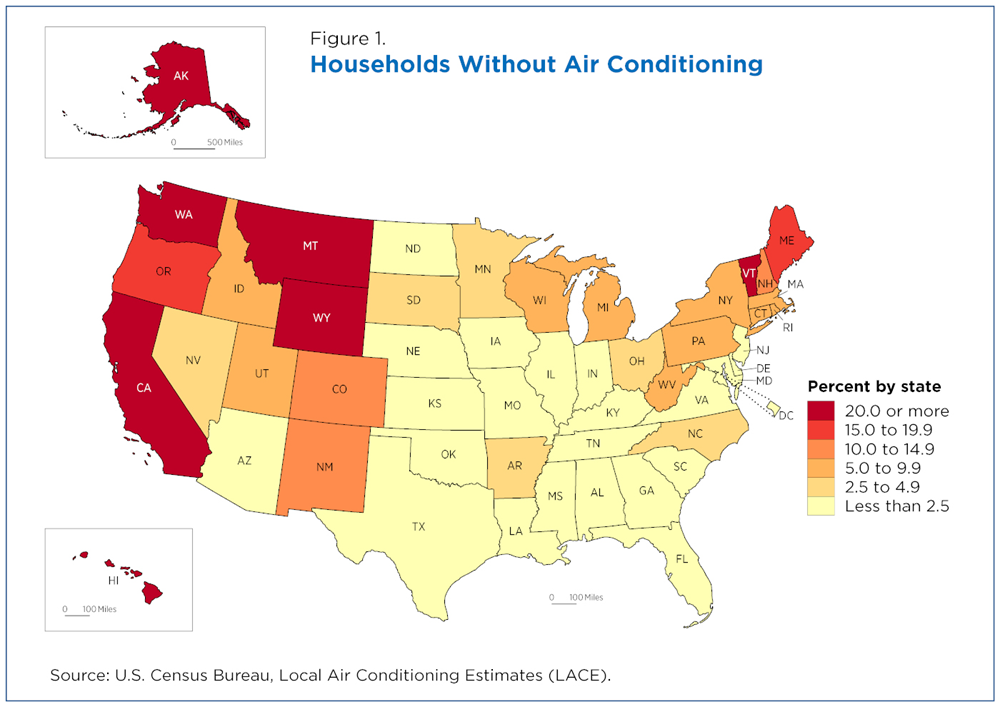
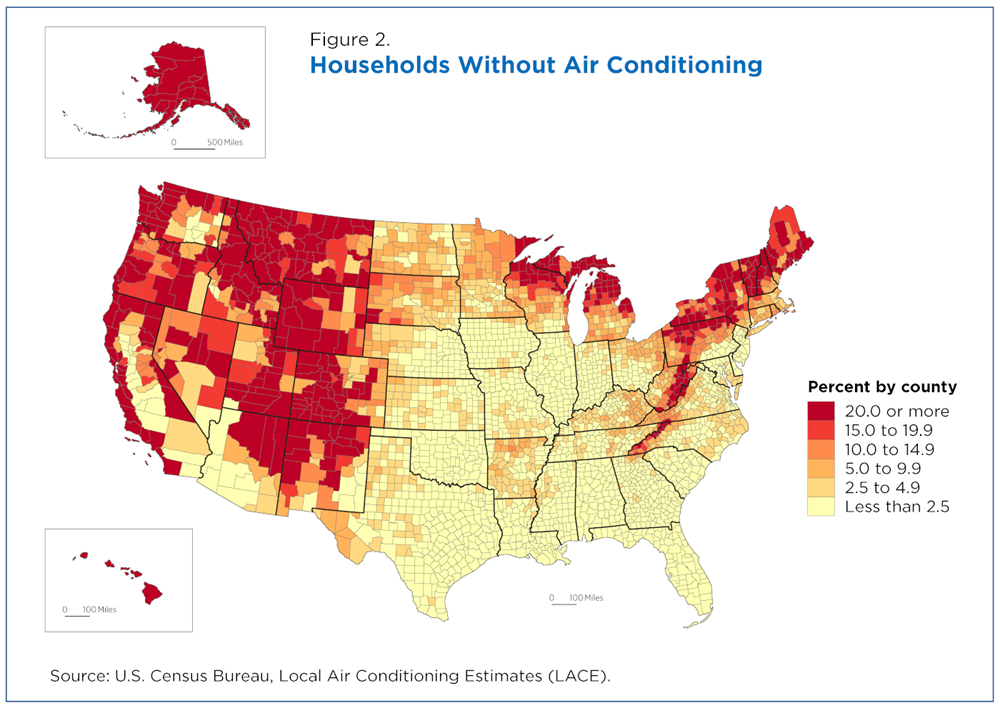
For example, statewide data show low access in some states in the West, Great Lakes and Northeast (Figure 1). But once you drill down to the counties in those states, it’s clear that each has pockets of high, medium and low air conditioning access (Figure 2).
Getting data down to the neighborhood level is even more compelling as it can help state and local governments prepare for extreme heat events.
For example, some cities offer portable air conditioning units to residents who don’t have air conditioning in their home. Knowing which neighborhoods have the greatest need helps target community outreach and distribution plans.
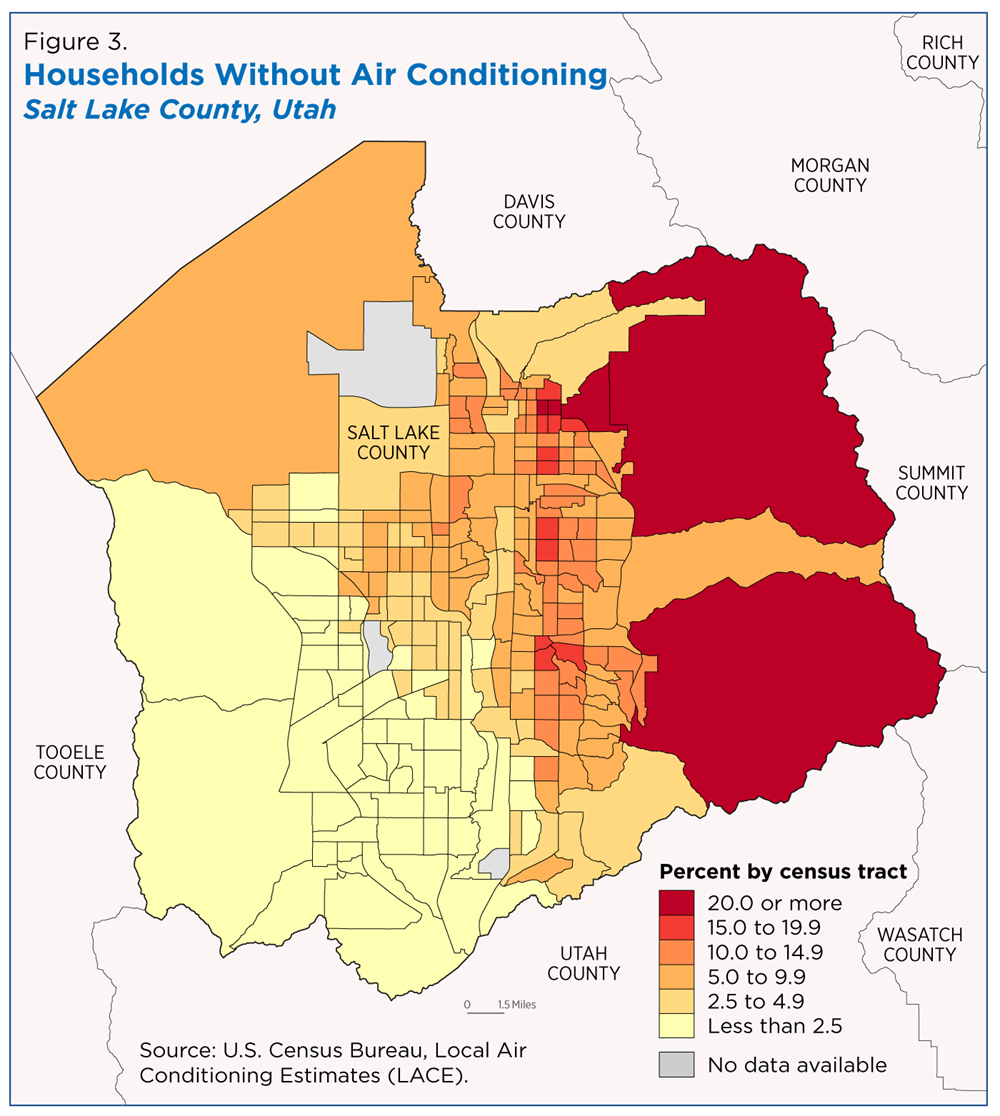
Take Salt Lake County, Utah (Figure 3). Only 6.6% of households countywide don’t have air conditioning, according to LACE. But estimates range between 0.0% and 23.2% at the neighborhood and tract levels.
LACE helps municipalities identify areas with households that likely lack air conditioning. Having this data as part of the experimental data product series allows local governments to contact the Census Bureau and provide feedback on the accuracy and utility of these estimates.
About LACE
The Census Bureau produces LACE data based on responses to the American Housing Survey (AHS) and the American Community Survey (ACS).
The AHS asks questions about air conditioning the ACS doesn’t and publishes estimates for the nation, census divisions and select metro areas. The ACS has a larger sample size, allowing us to publish granular estimates for smaller geographies.
By using machine learning and cross-survey modeling, we combine the strengths of both surveys to provide estimates of air conditioning prevalence down to the tract level.
Cross-survey modeling is a new technique that uses data from one survey to create an algorithm that is then applied to determine how respondents may have answered the same question on a different survey.
This involves taking one survey or dataset with detailed subject matter and applying the characteristics to a dataset with detailed geographic information — in this case, the AHS and ACS.
The result: experimental estimates of air conditioning prevalence for smaller geographies.
LACE was recently featured in a webinar to help data users learn about the techniques used to create the estimates in more detail and showcase ways to use them.
The Census Bureau welcomes feedback on the quality of the LACE estimates, opinions on the quality of the techniques and information on the usefulness of the data. Feedback can be sent to [email protected].
Related Statistics
Subscribe
Our email newsletter is sent out on the day we publish a story. Get an alert directly in your inbox to read, share and blog about our newest stories.
Contact our Public Information Office for media inquiries or interviews.
Related America Counts Stories
-
PopulationHeat Risks and Cooling Problems in America’s HouseholdsSeptember 04, 2025The American Housing Survey shows 13.2 million households — more in urban than rural areas — were uncomfortably hot for 24 hours or more in 2023.
-
HousingHow Do Power Outages Affect Households?October 02, 20242023 American Housing Survey data show that housing units in rural areas were more affected by power outages than those in urban areas.
-
PopulationCensus Data Tool Helps FEMA Better Understand Disaster VulnerabilityMarch 15, 2022The U.S. Census Bureau’s Community Resilience Estimates (CRE) tool helps FEMA better understand “at-risk” populations during a natural disaster.
-
Families and Living ArrangementsU.S. Parents Gave $26.6 Billion to Their Adult Children in 2024September 30, 2026About 2.6 million parents provided financial support to 3.7 million children age 21 and over who did not live at home.
-
Business and EconomyAmerican Manufacturing: A History in Census DataSeptember 28, 2026On the 15th anniversary of Manufacturing Day, we celebrate the sector’s contribution to the U.S. economy.
-
EducationBeyond Diplomas: Nondegree Credentials Linked to Higher EarningsSeptember 22, 2026High school graduates and even those with college degrees earned more with nondegree credentials targeting specific work skills.
-
Emergency PreparednessCalm Atlantic Hurricane Season Could Mean Active One in the PacificSeptember 17, 2026Census Bureau data tools can help communities prepare for and recover from hurricanes and other disasters wherever they are.