
South and Midwest Had Highest Fertility Rates, but Even West and Northeast Had Pockets of High-Fertility Counties
The nation’s fertility rate has dropped nearly every year since 2007, but this national decline masks substantial geographic variation.
Fertility rates differ widely across U.S. counties, and even within individual states there are often both high and low fertility counties.
By combining population estimates data released today on the age characteristics of U.S. counties with birth data released in March, we calculated the general fertility rate (GFR) for every county in the nation.
Counties with the most births are often not the ones with the highest fertility rates.
The GFR is the number of births per 1,000 females ages 15 to 44, and this story focuses only on U.S. counties that had at least 1,000 females in that age group in 2025 (2,703 of the 3,144 counties).
National Fertility Decline With Regional Variations
Nationally, the GFR has dropped from 69.5 in 2007 to 53.1 in 2025 — the lowest level reported in the national data series, which is available back to 1909.
Although there is no direct comparison of general fertility rates to total fertility rates (TFR), they go hand in hand.
In 2007, the national GFR was just below 70 (69.5) when total fertility rates were about 2.1 births per woman, which is generally considered “replacement level.” In 2024, the GFR was 53.8 and the TFR was 1.6.
In line with the nation, all regions were well below the 70 GFR threshold in 2025.
The South had the highest GFR at 55.8, followed closely by the Midwest at 54.7. The West had a GFR of 51.0, and the Northeast came in lowest, at 49.9.
Even with low GFRs, all regions experienced more births than deaths between 2024 and 2025. That’s because it takes time for low fertility rates to alter the population age structure, and even then, other demographic factors like migration and mortality affect the balance of births and deaths.
Where Are County Fertility Rates Highest?
There are clusters of high GFR counties in many, but not all, states.
For example, there are high GFR counties in southeastern North Carolina that extend into South Carolina, and in southern Georgia that extend into northern Florida.
Moving westward, many states have at least one cluster of counties with high GFRs.
Figure 1 shows the GFR values for counties in the United States in 2025.
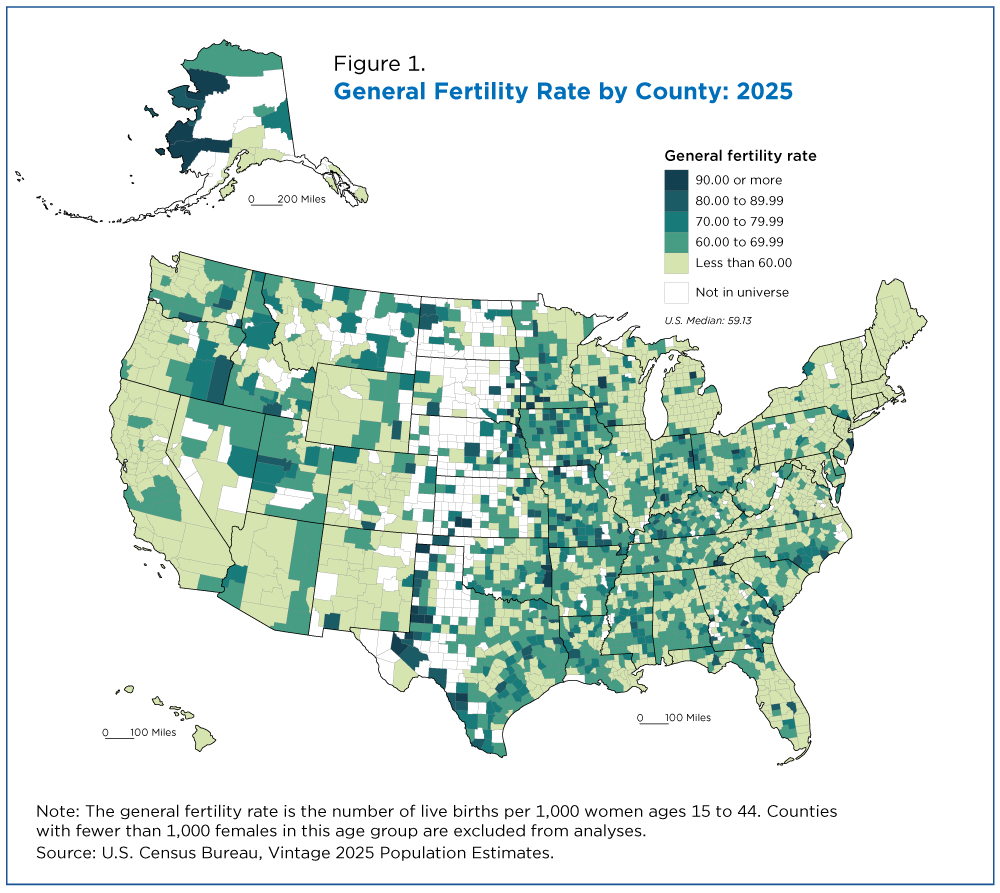
Notably, there are only a few states that do not have any counties with a GFR above 60, including the entirety of New England: Connecticut, Maine, Massachusetts, New Hampshire, Rhode Island and Vermont.
High Numbers of Births Do Not Always Equal High Fertility
The next part of our analysis examined fertility rates and births by county type: metro, micro and counties outside metro and micro areas. This is presented as a scatterplot in Figure 2, which also scales the dots for each county by population size of females ages 15 to 44.
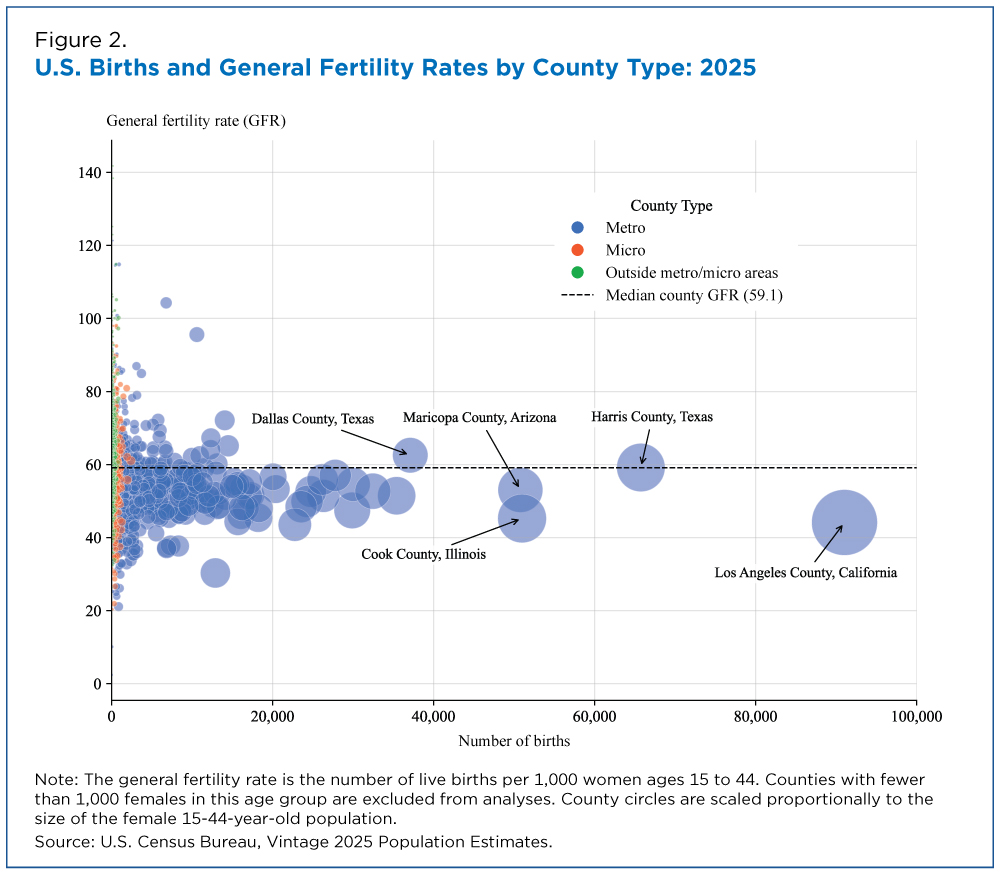
One key pattern emerges from the graphic right away: counties with the most births are often not the ones with the highest fertility rates. In fact, the data suggest the opposite: counties with the highest numbers of births frequently have fertility rates below the median of all counties.
More populated counties tend to have more births because of their sheer size, but fertility rates can be impacted by a variety of factors: from the age structure of the population to other social or economic conditions.
The blue dots in Figure 2 (metro counties) often have thousands — or tens of thousands — of births, but many are clearly below the median county fertility rate of 59.1.
For example, Los Angeles County — the nation’s most populous — had the most births by far in 2025 (over 91,000), but a GFR of only 44.1.
Counties with both higher births and higher fertility rates were uncommon among large U.S. counties, but there were a few standouts in Texas. Among all counties with at least 20,000 births in 2025, the highest three general fertility rates were all in Texas:
- Dallas County: 37,108 births, GFR of 62.6.
- Harris County: 65,753 births, GFR of 59.2.
- Tarrant County: 27,795 births, GFR of 57.0.
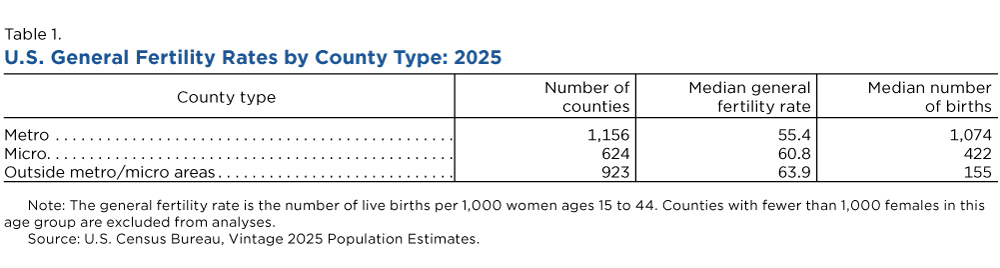
Micro counties (the orange dots in Figure 2) tended to have fewer total births, but also higher fertility rates than metro counties.
Counties outside of metro/micro areas (the green dots) tended to have the fewest births but also the highest fertility rates among the county types, including some very high ones (120+).
Other than a few exceptions in each group, the differences between county types are stark (Table 1).
Ultimately, fertility is one important piece of population change, but it’s not the only one. Populations also change due to deaths, domestic migration and international migration, components that also have varying impacts across the United States.
New population estimates data released today — which conclude the Vintage 2025 series — allow for any of these components to be analyzed in new and exciting ways.
Related Statistics
Subscribe
Our email newsletter is sent out on the day we publish a story. Get an alert directly in your inbox to read, share and blog about our newest stories.
Contact our Public Information Office for media inquiries or interviews.
Related America Counts Stories
-
Marriage and DivorceFewer Unmarried Women Gave Birth in the Past DecadeMay 19, 2026Several states in the South had higher levels of recent births to unmarried women than many states in the Midwest, Northeast and West.
-
PopulationContinued Decrease in Mortality Brings Natural Increase Closer to Pre-Pandemic LevelsDecember 19, 2023New population estimates show that 19 states had more deaths than births in 2023, down from 25 in 2022.
-
PopulationFertility Rates: Declined for Younger Women, Increased for Older WomenApril 06, 2022Despite broader stability in fertility trends, a Census Bureau analysis shows that the age at which U.S. women gave birth changed from 1990 to 2019.
-
Emergency PreparednessTornado Activity Shifts East — Heightening Risks in the SouthOctober 07, 2026Census data can help vulnerable communities that have a concentration of mobile homes cope with more frequent tornado activity over a longer season.
-
Families and Living ArrangementsU.S. Parents Gave $26.6 Billion to Their Adult Children in 2024September 30, 2026About 2.6 million parents provided financial support to 3.7 million children age 21 and over who did not live at home.
-
Business and EconomyAmerican Manufacturing: A History in Census DataSeptember 28, 2026On the 15th anniversary of Manufacturing Day, we celebrate the sector’s contribution to the U.S. economy.
-
EducationBeyond Diplomas: Nondegree Credentials Linked to Higher EarningsSeptember 22, 2026High school graduates and even those with college degrees earned more with nondegree credentials targeting specific work skills.