
First-Time Moms With Bachelor’s Degrees More Likely to Be Married Than Those Without
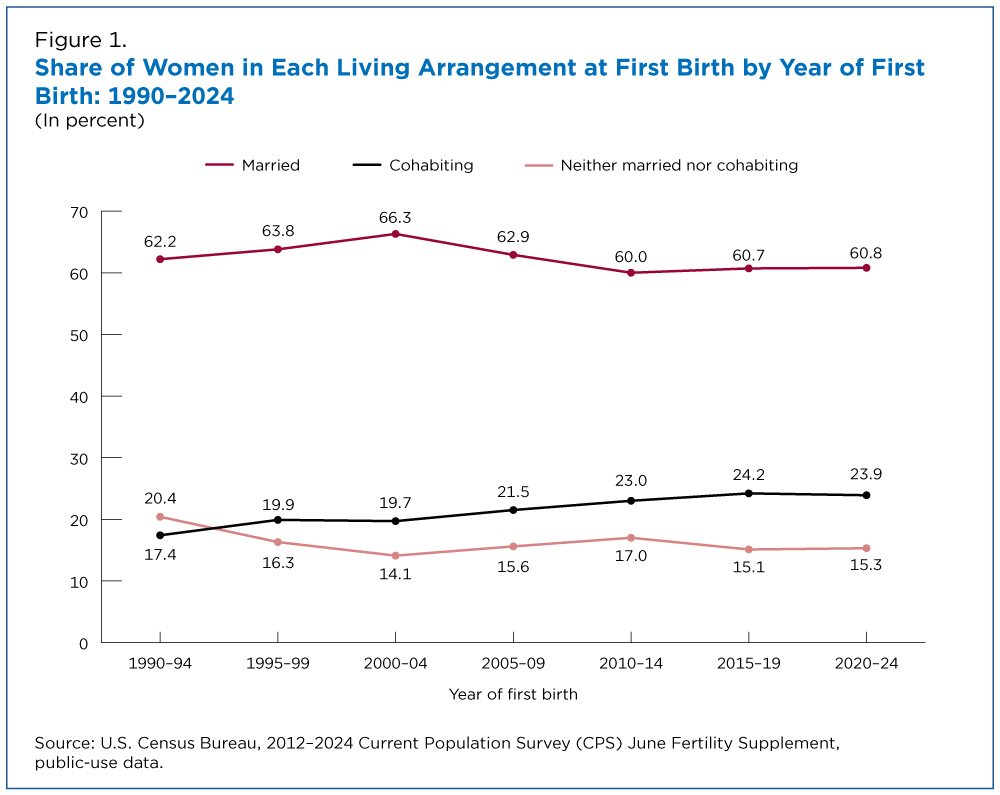
About a quarter (24%) of women who had their first child from 2020 to 2024 lived with an unmarried partner, up from around 17% in the early 1990s, according to a new U.S. Census Bureau report.
But a smaller share of women had their first child while neither married nor living with a partner, dropping from roughly 20% to about 15% in 30 years.
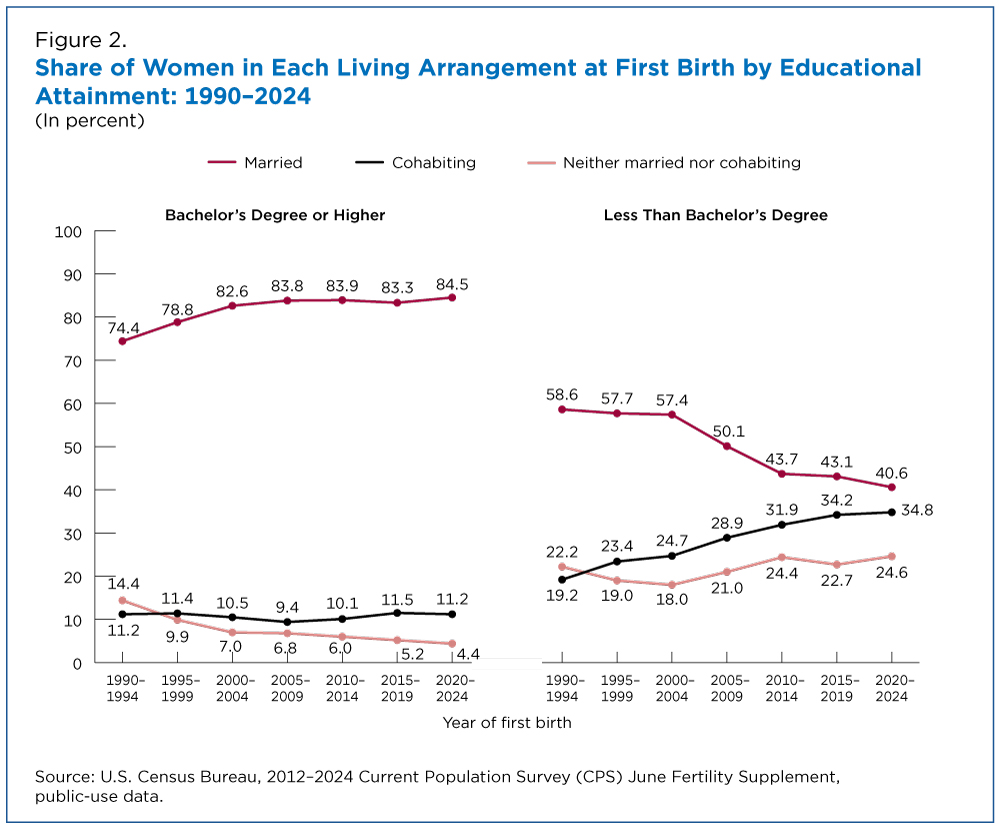
From 2020 to 2024, only about 4% of first-time mothers with a bachelor’s degree or higher were neither married nor living with a partner, and roughly 11% were cohabiting.
During the same time, the estimated share of first-time mothers who were married at the time of birth remained at approximately 60%.
Mothers' Education
Over the years, it also became more common among women with a bachelor’s degree or higher to be married at first birth, with the share jumping from about 75% in the early 1990s to roughly 85% this decade.
From 2020 to 2024, only about 4% of first-time mothers with a bachelor’s degree or higher were neither married nor living with a partner, and roughly 11% were cohabiting.
The opposite occurred among those with less than a bachelor’s degree: fewer were married at first birth (roughly 40% this decade compared to about 60%) but the share living with a partner rose from about 20% to 35%.
These educational differences highlight a growing divide in family stability: socioeconomically advantaged individuals are increasingly likely – and their less advantaged peers decreasingly likely – to be in stable arrangements such as marriage.
Other highlights:
- Between 2020 and 2024, Asian mothers were the most likely to be married at first birth (87.1%), followed by White (71.3%), Hispanic (43.9%) and Black mothers (29.0%), though the difference between Hispanic and Black mothers is not statistically significant.
- Approximately 40% of first-time Black mothers were neither married nor cohabiting at the time of childbirth in 2020-2024, followed by Hispanic (22.2%), White (8.5%) and Asian mothers (5.5%). However, the difference between White and Asian mothers is not statistically significant.
About the Research
All comparative statements have undergone statistical testing and, unless otherwise noted, all comparisons are statistically significant at the 90% confidence level. All data are subject to error arising from a variety of sources, including sampling, nonsampling and modeling. More information about the Current Population Survey Fertility Supplement is available here.
Related Statistics
Subscribe
Our email newsletter is sent out on the day we publish a story. Get an alert directly in your inbox to read, share and blog about our newest stories.
Contact our Public Information Office for media inquiries or interviews.
-
FertilityChildlessness on the Rise — Except for Women Ages 45 to 50September 23, 2025From 2014 to 2024, the share of older mothers rose as fewer teens and women in their 20s and 30s had children.
-
Families and Living ArrangementsLess Than Half of U.S. Family Households Include Children Under 18November 12, 2024A new interactive data visualization explores the characteristics of family households by the householder’s age.
-
Families and Living ArrangementsNumber of Kids Living Only With Their Mothers Has Doubled in 50 YearsApril 12, 2021Newly released Current Population Survey tables show the percentage of children under 18 who live with two parents declined since 1968.
-
Families and Living ArrangementsU.S. Parents Gave $26.6 Billion to Their Adult Children in 2024September 30, 2026About 2.6 million parents provided financial support to 3.7 million children age 21 and over who did not live at home.
-
Business and EconomyAmerican Manufacturing: A History in Census DataSeptember 28, 2026On the 15th anniversary of Manufacturing Day, we celebrate the sector’s contribution to the U.S. economy.
-
EducationBeyond Diplomas: Nondegree Credentials Linked to Higher EarningsSeptember 22, 2026High school graduates and even those with college degrees earned more with nondegree credentials targeting specific work skills.
-
Emergency PreparednessCalm Atlantic Hurricane Season Could Mean Active One in the PacificSeptember 17, 2026Census Bureau data tools can help communities prepare for and recover from hurricanes and other disasters wherever they are.