
In the Wake of the COVID-19 Pandemic, Manhattan Borough’s Worker Shares Trended Younger, More Female and Service-Oriented
The COVID-19 pandemic had a profound impact on our nation’s cities. During the period of social distancing and remote work, people moved away from city centers and some businesses closed for good.
Although most restrictions were temporary, the economic and demographic shifts in many of our nation’s cities endured. In the post-pandemic era, city life settled into a new normal with a different mix of businesses, workers and residents.
Between 2021 and 2023, Manhattan residents worked in most industries at the same or lower rates, except for the Arts, Entertainment, Recreation and Accommodation and Food Services sectors.
To illustrate this trend, we focus on the borough of Manhattan in New York City, the nation’s most densely populated area and one of its most prominent business districts.
Manhattan, once known primarily for finance, has undergone an extraordinary labor market transformation in recent years with consistent post-pandemic workforce growth in the Arts, Entertainment, and Recreation and Accommodation and Food Services industry sectors.
These new workers also trended younger and a greater share were female in 2023 than in 2021.
Recently released census data in the OnTheMap data tool allow us to track these changes in workforce characteristics over time. This unique mapping tool analyzes where workers are employed and live – and can also help identify small-area labor force dynamics.
Workers Employed in Manhattan
The data indicate more than 265,000 additional workers were employed in Manhattan in 2023 than in 2021 (2,133,324 and 1,868,021, respectively) – a 14.2% increase, far outpacing the national gain of 4.4% over the same period.
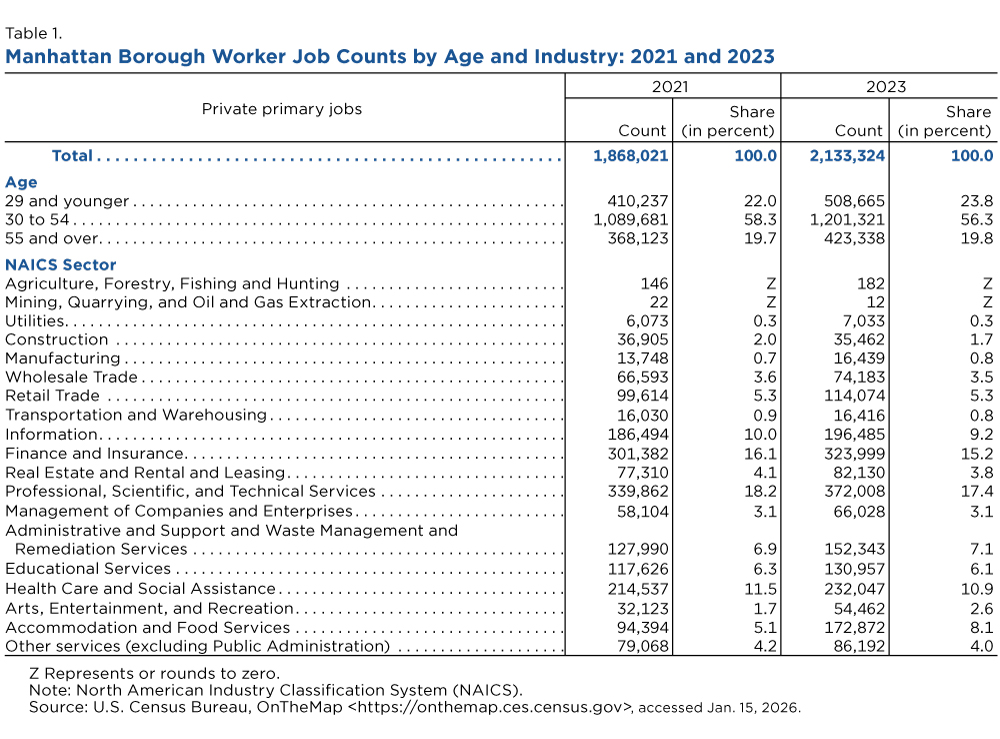
Industry shares were flat or declined across all sectors between 2021 and 2023, with four exceptions (Table 1):
- Manufacturing edged up (0.7% to 0.8%).
- Administrative and Support and Waste Management and Remediation Services rose slightly (6.9% to 7.1%).
- Arts, Entertainment, and Recreation increased notably (1.7% to 2.6%).
- Accommodation and Food Services jumped substantially (5.1% to 8.1%).
People working in Manhattan also skewed younger over this period: the share of workers age 29 and younger grew by 1.8% -- an overall increase of nearly 100,000 young workers (Figure 1).
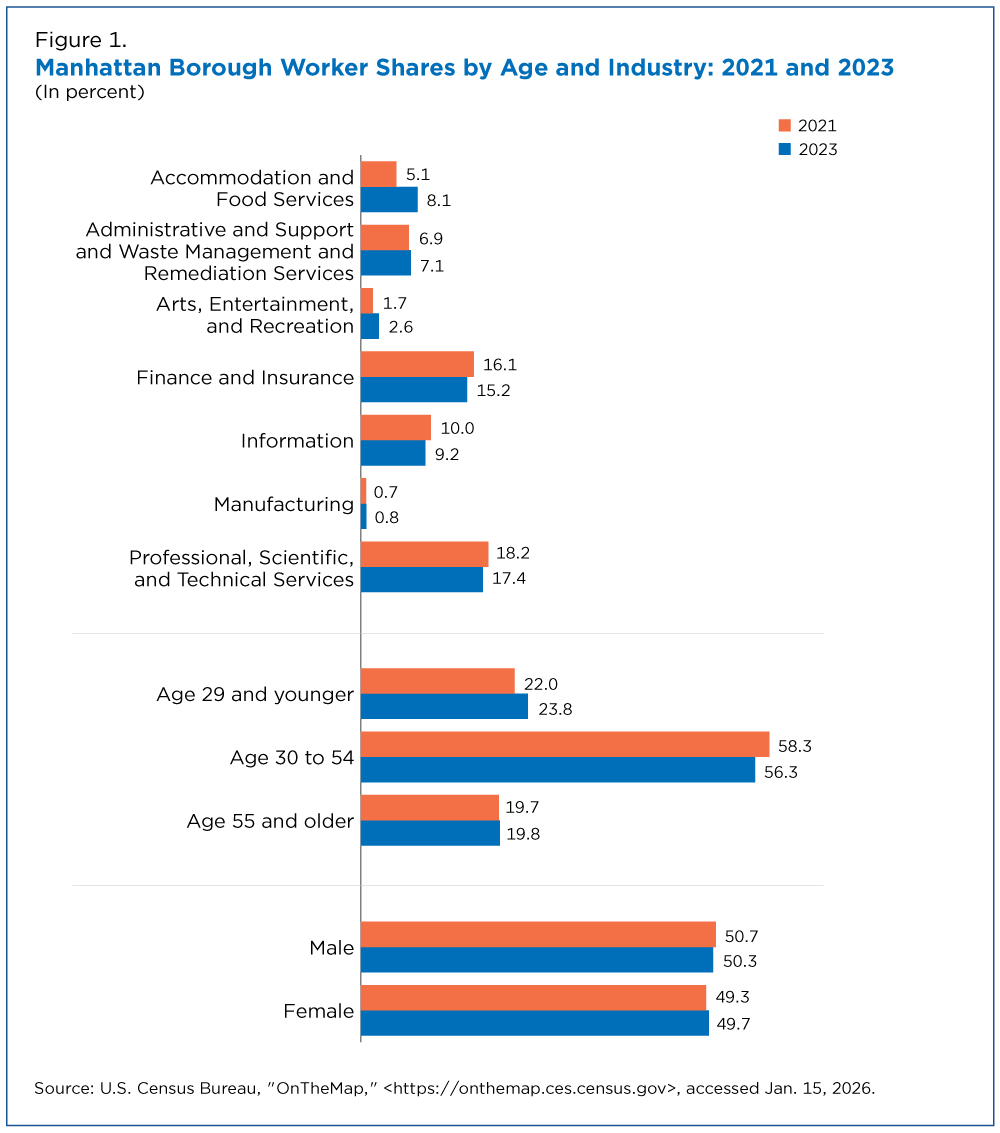
These workers were also increasingly female. Of the 265,000 workers added between 2021 and 2023, women outnumbered men by more than 13,000. As a result, the female share climbed from 49.3% to 49.7% -- adding more than 139,000 women workers.
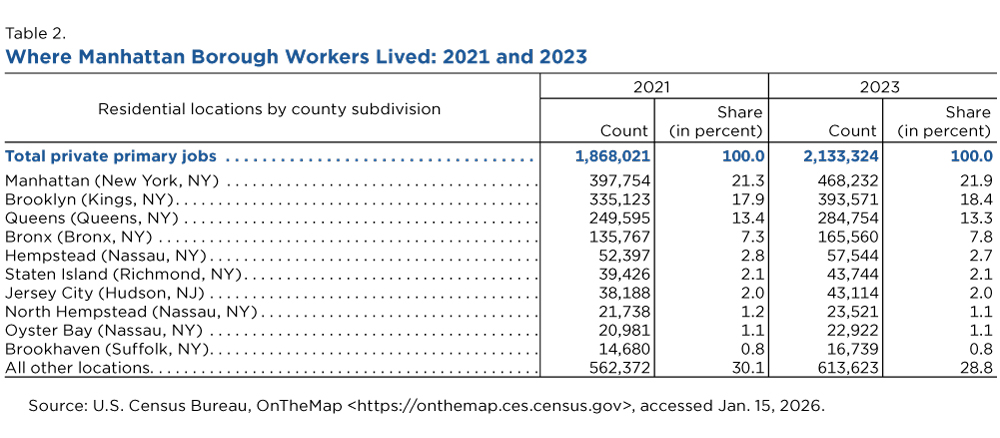
The home locations of workers employed in Manhattan also shifted over this period (Figure 2).
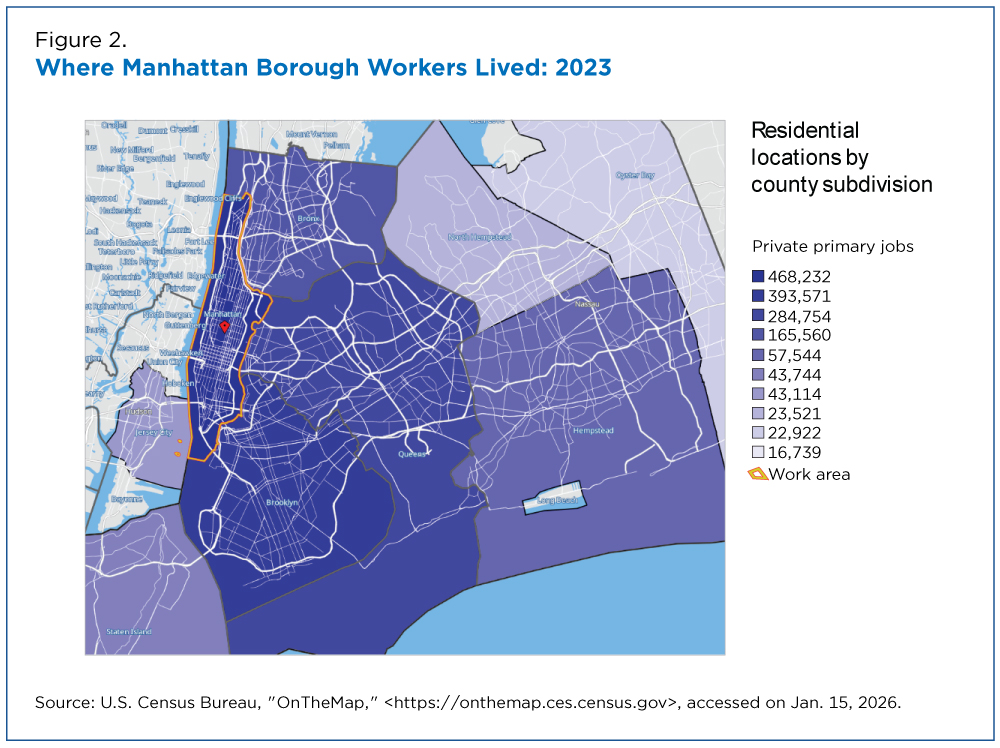
Manhattan workers were more likely to reside in the Manhattan, Brooklyn or Bronx boroughs in 2023 than in 2021. The share of workers living in those boroughs increased by 1.7 percentage points from 46.5% in 2021 to 48.2% in 2023 (Table 2).
Workers Living in Manhattan
It was a similar story for working people residing in Manhattan.
Between 2021 and 2023, Manhattan residents worked in most industries at the same or lower rates, except for the Arts, Entertainment, Recreation and Accommodation and Food Services sectors (Table 3).
Combined shares of these two sectors jumped from 7.2% to 10.5% (Table 3).
More than 89,000 additional workers lived in Manhattan in 2023 than in 2021 (655,939 and 566,856, respectively).
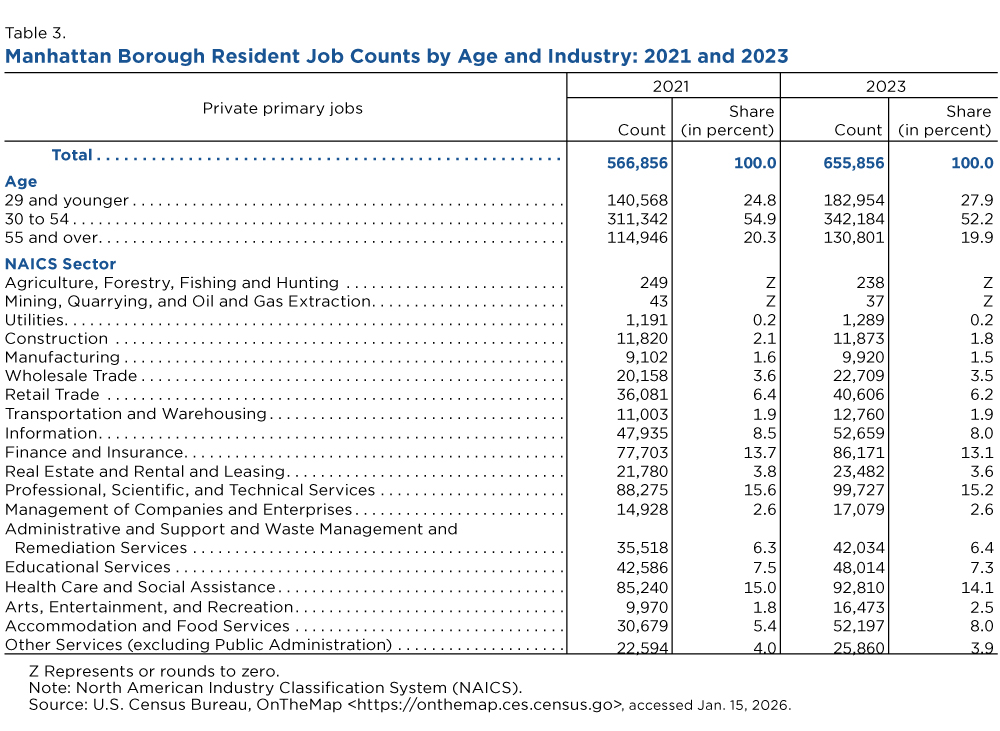
Similarly, Manhattan’s working residents also trended younger, with the share of workers age 29 or younger increasing by 3.1 percentage points from 2021 to 2023.
These resident workers were increasingly female, too. Their share rose from 50.2% to 50.7% between 2021 and 2023, (a difference of over 48,000 new female workers).
Living and Working in Manhattan
OnTheMap also lets us view worker flows into, out of and within an area of interest and indicates that Manhattan had a significant in- and outflow of workers (Figure 3).
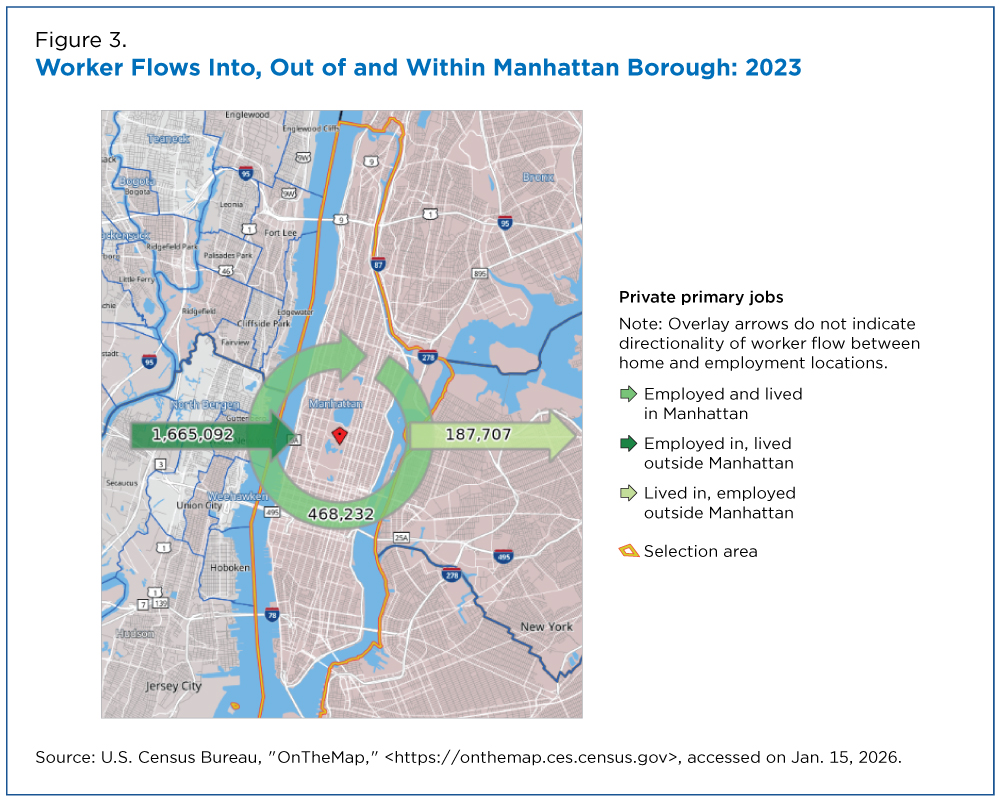
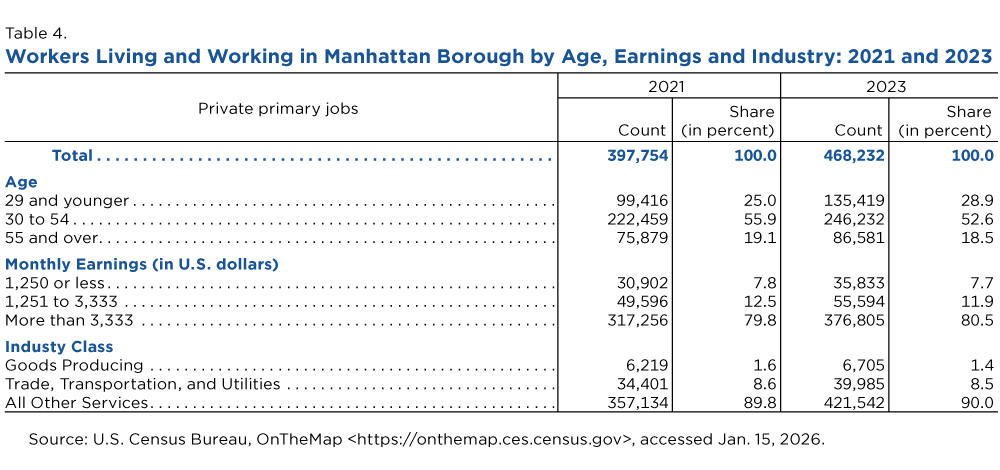
Of the 566,856 workers living in Manhattan in 2021, 70.2% were also employed in the borough. This share rose to 71.4% in 2023, an increase of more than 70,000 people.
Workers under age 29 accounted for most of that growth. Their share of "interior flow" workers climbed 3.9 percentage points (25.0% to 28.9%), an increase of more than 36,000 additional workers (Table 4). This aligns with previous data showing Manhattan’s workforce trended younger over this period.
Tracking the Trends
Future releases of Longitudinal Employer-Household Dynamics Origin-Destination Employment Statistics (LODES) in the OnTheMap tool will show whether these trends continued into 2024 and 2025.
OnTheMap is a web-based mapping and reporting application that shows where workers are employed and where they live.
Users can analyze employment dynamics for nearly any geography in the nation, including states, counties, cities, school districts, ZIP codes and census tracts. The tool also provides companion reports on age, earnings, industry distribution, race, ethnicity, educational attainment and sex.
The latest release includes data from 2002 to 2023 for most of the 50 states and the District of Columbia.
Related Statistics
Subscribe
Our email newsletter is sent out on the day we publish a story. Get an alert directly in your inbox to read, share and blog about our newest stories.
Contact our Public Information Office for media inquiries or interviews.
-
Business and EconomyRevenue and Employment Trends Reveal Shifts in U.S. EconomyDecember 30, 2025Revenue and employment losses in select retail industries continued, while online sales brokers and local delivery boomed.
-
EmploymentEffects of the COVID-19 Pandemic on Private and Public EmploymentNovember 20, 2024Private employment dropped by a smaller percentage and rebounded, surpassing pre-pandemic levels. State and local government employment has not fully recovered.
-
Business and EconomyHow AI and Other Technology Impacted Businesses and WorkersSeptember 17, 2025Businesses report that, in most cases, adoption of new technologies like robotics and Artificial Intelligence had no impact on worker numbers or skill level.
-
Families and Living ArrangementsU.S. Parents Gave $26.6 Billion to Their Adult Children in 2024September 30, 2026About 2.6 million parents provided financial support to 3.7 million children age 21 and over who did not live at home.
-
Business and EconomyAmerican Manufacturing: A History in Census DataSeptember 28, 2026On the 15th anniversary of Manufacturing Day, we celebrate the sector’s contribution to the U.S. economy.
-
EducationBeyond Diplomas: Nondegree Credentials Linked to Higher EarningsSeptember 22, 2026High school graduates and even those with college degrees earned more with nondegree credentials targeting specific work skills.
-
Emergency PreparednessCalm Atlantic Hurricane Season Could Mean Active One in the PacificSeptember 17, 2026Census Bureau data tools can help communities prepare for and recover from hurricanes and other disasters wherever they are.