
Divorce Can Negatively Affect Children, Even Into Adulthood
Nearly one-third of Americans born between 1988 and 1993 experienced their parents’ divorce before reaching adulthood, a watershed event for a child that can negatively impact them throughout their life.
A U.S. Census Bureau working paper linked parental divorce to lower income, reduced likelihood of living away from home while attending college, and higher rates of teen pregnancy, incarceration and mortality.
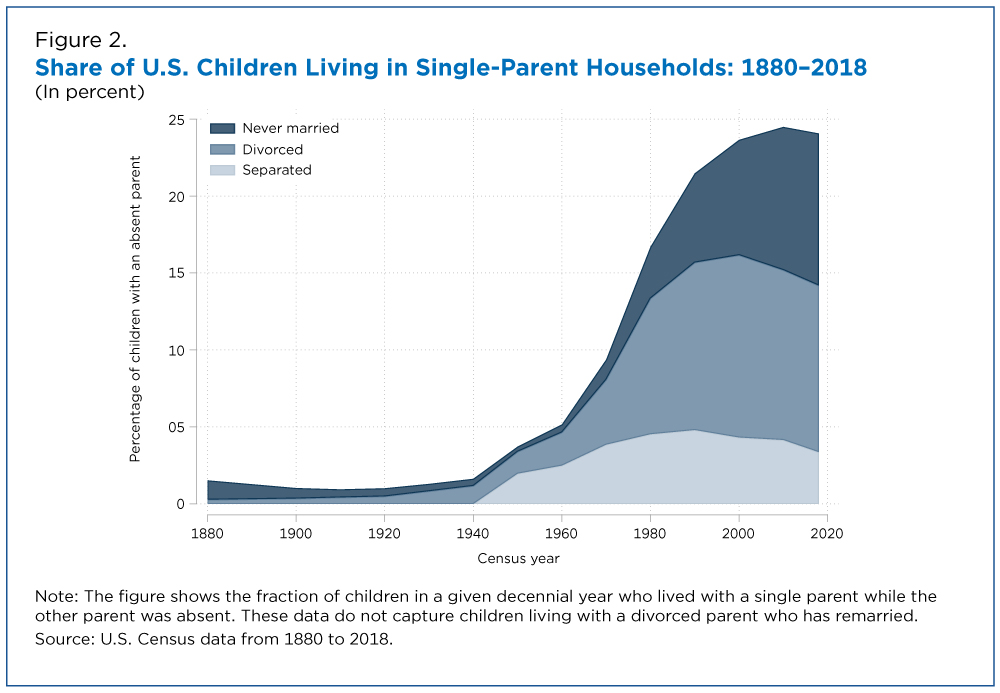
Before 1950, less than 2% of children lived with a single parent who was divorced, separated or never married. By 2000, nearly 25% did.
Researchers Maggie R. Jones (U.S. Census Bureau), Andrew C. Johnston (University of California Merced) and Nolan G. Pope (University of Maryland) analyzed Census Bureau data, federal tax records and Social Security Administration information to determine the long-term impact of divorce on children.
They traced parental marital histories and connected them to household and child outcome data.
Divorce Outcomes
The effects of divorce often last into adulthood.
For example, the working paper found that divorce in early childhood reduced children’s income in their mid- to late 20s by 9% to 13%.
Teen birth rates among children of divorce jumped 63% following the split, compared to pre-divorce levels.
The risk of early death (before age 25) increased by 35% to 55% at the time of divorce and remained elevated for at least a decade — an impact comparable to lacking health insurance.
The sample group’s incarceration rate of 0.46% in 2010 was three times higher than for children of always-married parents. Divorce when children were between ages 5 and 20 increased incarceration risk by 0.15 to 0.28 percentage points.
Additionally, experiencing the divorce of their parents before the child is age 18 lowered the likelihood of living away from home while attending college by about 4 percentage points.
The Younger They Are
Outcomes were worse for children whose parents divorced in early childhood (ages 0-5). Compared to siblings who experienced a parental divorce in adulthood, early-childhood divorce:
- Increased teen births by roughly 60%.
- Increased the likelihood of incarceration by 40%.
- Increased mortality risk at age 25 by 45%.
- Reduced income at age 25 by 9%, and by age 27, by 13%.
- Lowered the likelihood the child lives on a college campus in their late teens and early 20s.
These estimates capture the average effect among children of divorce.
Notably, divorce did not significantly impact the likelihood of marriage or employment among sampled children in their mid-twenties.
Change of Circumstances
According to the research, divorce disrupts key aspects of parenting: financial investments (education, nutrition, health care and shelter) and what researchers call “direct transmission” (modeling behavior to teach values).
Divorce can impact parental activities by altering family resources and parent-child interaction. When one household splits into two, household income drops, potentially lowering each parent’s ability to provide the pre-divorce levels of monetary investment and personal attention.
Divorced households fell from the 57th to the 36th percentile of income and recovered only about half of that lost income over the next decade.
Post-divorce, both parents may work more due to increased financial strain: mothers worked 8% more hours and fathers 16% more, possibly reducing parent-child contact.
The probability of moving nearly tripled after a divorce. Sampled families relocated to neighborhoods with 7% lower incomes and fewer economic opportunities.
The researchers also found that divorce increased the average distance between children and their nonresident parent by 100 miles on average, a gap that widened to over 200 miles after 10 years.
“These changes in family life reveal that, rather than an isolated legal shock, divorce represents a bundle of treatments — including income loss, neighborhood changes and family restructuring — each of which might affect children’s outcomes," Pope said.
The working paper’s authors caution that these same outcomes may occur in similar families that remain intact. Divorce is simply a marker for family disruption observable in the data.
Divorce Across the U.S. Population
The impact and prevalence of divorce are not spread evenly across the U.S. population.
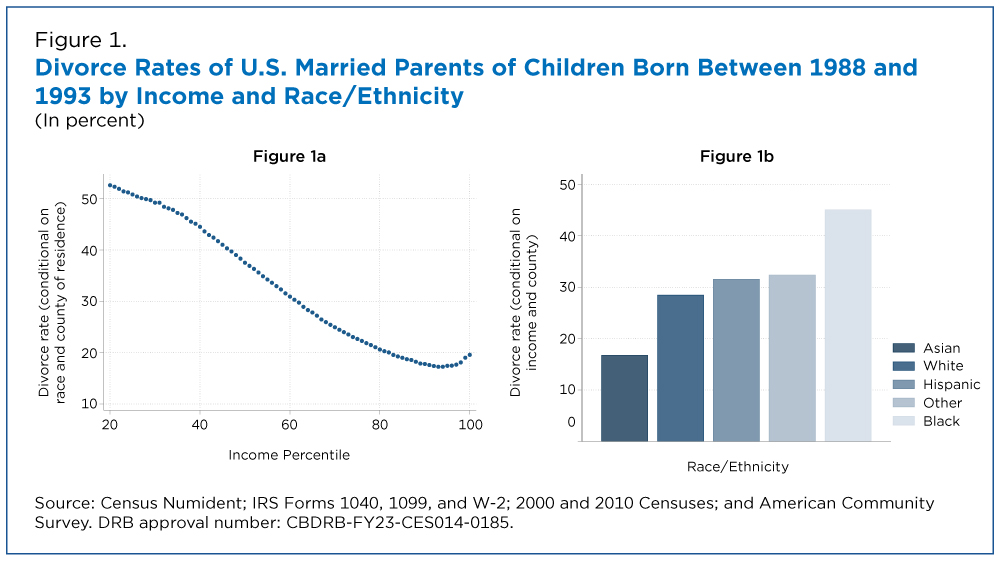
Divorce rates declined sharply as income rose: children in the bottom fifth of parent income were over 30 percentage points more likely to experience divorce than those in the top fifth (Figure 1a).
Parental divorce rates experienced by children also varied substantially by racial/ethnic group (Figure 1b):
- Asian children: 17%.
- White children: slightly under 30%.
- Hispanic children: slightly over 30%.
- Black children: 45%.
Trends Across Time
The structure of American families has changed dramatically over the past century.
Before 1950, less than 2% of children lived with a single parent who was divorced, separated or never married. By 2000, nearly 25% did.
This increase was driven by three distinct trends (Figure 2):
- Separation rates increased after World War II, before which divorce was still difficult to obtain.
- Divorce rates climbed significantly between 1960 and 1980 as laws changed from fault-based to no-fault.
- “Never-married” rates rose from only 1% in 1965 to 13% by 2000.
These changes have affected families unevenly, hitting the impoverished and less educated the hardest.
Key Takeaways
“First, we show that divorce significantly alters children’s resources and living arrangements,” Pope said. “Second, divorce represents a turning point, with child outcomes changing meaningfully at divorce.”
In addition, the research shows that effects persist into adulthood, contributing to lower income, reduced college residency, and higher incarceration, teen birth and mortality rates.
“Lastly, given that divorce has negative effects on children’s outcomes and is more prevalent among low-income families,” Pope said, “addressing its impacts may be important for reducing the intergenerational transmission of disadvantage.”
Related Statistics
Subscribe
Our email newsletter is sent out on the day we publish a story. Get an alert directly in your inbox to read, share and blog about our newest stories.
Contact our Public Information Office for media inquiries or interviews.
-
Marriage and DivorceU.S. Divorce Rates Down, Marriage Rates Stagnant From 2012-2022October 08, 2024In 2022, Washington, D.C., had among the highest marriage rates and Arkansas among the highest divorce rates.
-
Families and Living ArrangementsNational Marriage and Divorce Rates Declined From 2011 to 2021July 13, 2023Puerto Rico had among the lowest marriage and divorce rates in 2021.
-
Families and Living ArrangementsNumber of Kids Living Only With Their Mothers Has Doubled in 50 YearsApril 12, 2021Newly released Current Population Survey tables show the percentage of children under 18 who live with two parents declined since 1968.
-
Emergency PreparednessTornado Activity Shifts East — Heightening Risks in the SouthOctober 07, 2026Census data can help vulnerable communities that have a concentration of mobile homes cope with more frequent tornado activity over a longer season.
-
Families and Living ArrangementsU.S. Parents Gave $26.6 Billion to Their Adult Children in 2024September 30, 2026About 2.6 million parents provided financial support to 3.7 million children age 21 and over who did not live at home.
-
Business and EconomyAmerican Manufacturing: A History in Census DataSeptember 28, 2026On the 15th anniversary of Manufacturing Day, we celebrate the sector’s contribution to the U.S. economy.
-
EducationBeyond Diplomas: Nondegree Credentials Linked to Higher EarningsSeptember 22, 2026High school graduates and even those with college degrees earned more with nondegree credentials targeting specific work skills.