
Decreases in Net International Migration Slowed Population Growth Across the Country
America’s growth is slowing — again.
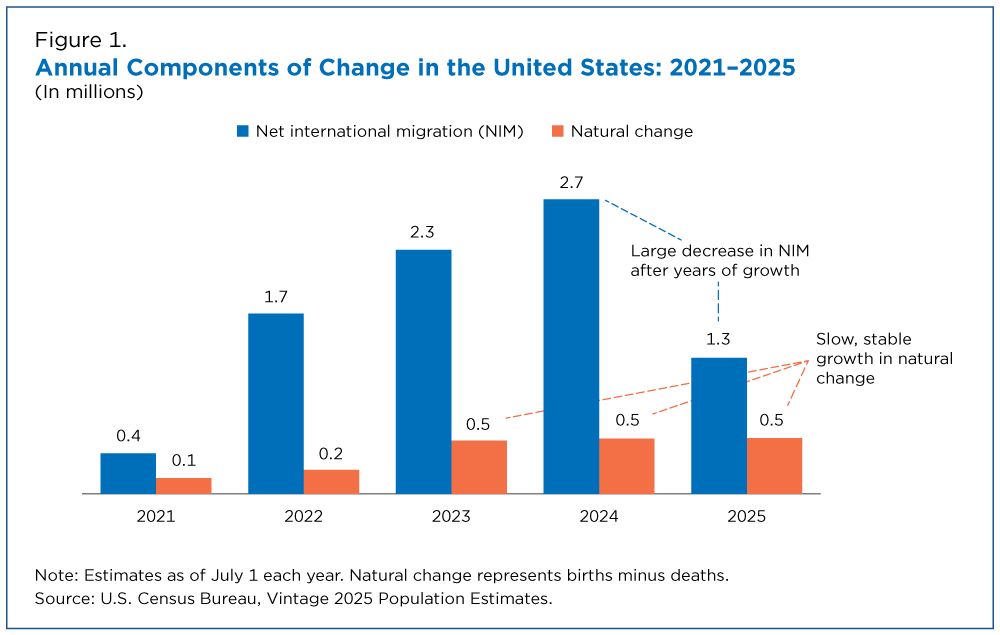
After a brief post-pandemic uptick – 0.8% in 2023 and a robust 1.0% in 2024 – U.S. population growth slowed to 0.5% between 2024 and 2025.
“With natural change less of a contributor to growth than it used to be, some states – especially those without positive net domestic migration – are dependent on international migration for their population to grow."
— Marc Perry, senior demographer
at the U.S. Census Bureau
A sizeable reduction in net international migration (NIM) – people moving between the United States and other countries – was the main reason for the slowdown. Natural change, the difference between the number of births and deaths, remained relatively stable (Figure 1).
Different Impact on States
Both the nation and states saw their population growth slow in the last year but for different reasons. For instance, while domestic migration – movement between states – doesn’t affect the national population, it can increase or decrease state populations.
“With natural change less of a contributor to growth than it used to be, some states – especially those without positive net domestic migration – are dependent on international migration for their population to grow,” says Marc Perry, senior demographer at the U.S. Census Bureau. “The large drops in growth rates we see for some states this past year is a reminder of that.”
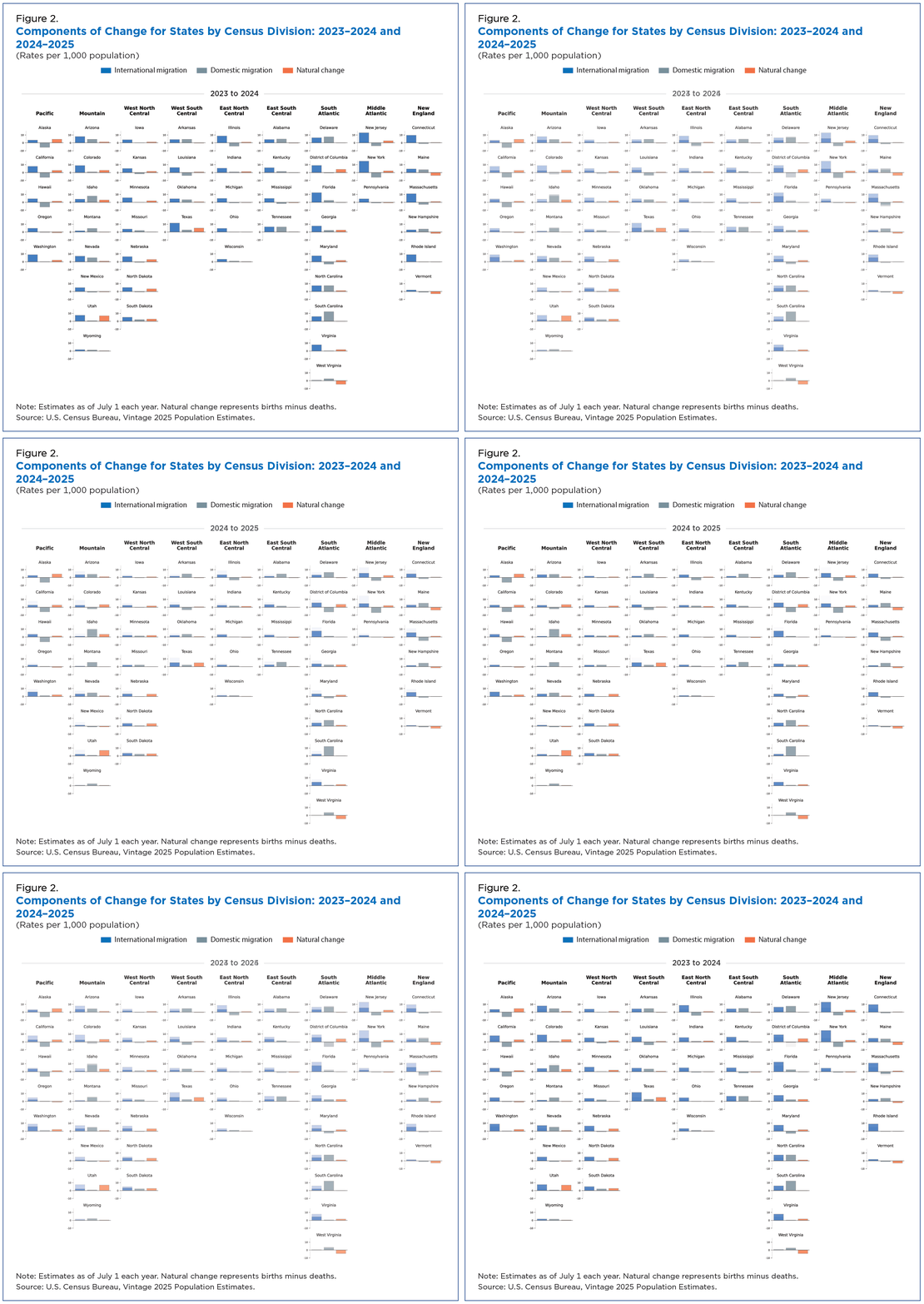
Figure 2 and Figure 3 show components of change per 1,000 population for the past two years. Each state has three bars, representing each component of change: net international migration (blue), net domestic migration (gray) and natural change (orange).
Figure 2 is a dynamic version that toggles between the two years, while Figure 3 is a static image of the same data.
On Figure 3, the 2023-2024 period is displayed on the top half of the graph and 2024-2025 on the bottom. States are grouped from left to right in columns by the nine census divisions: Pacific, Mountain, West North Central, West South Central, East North Central, East South Central, South Atlantic, Middle Atlantic and New England.
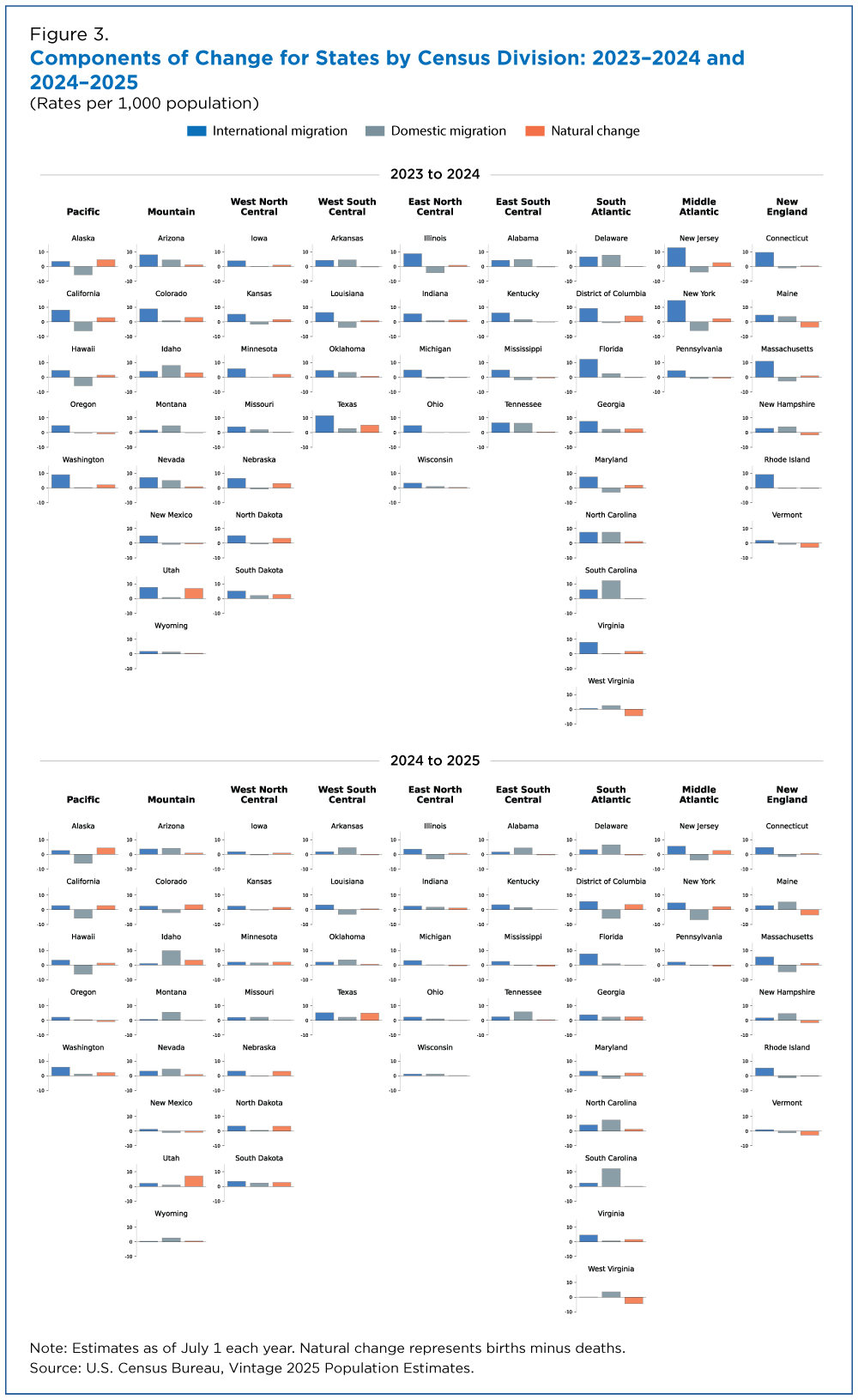
Between 2023 and 2024, the blue bars are the largest – typically by a significant margin – in 40 states and the District of Columbia (D.C.), indicating net international migration was the major growth factor there.
This was the case in many northeastern coastal states: NIM growth drove population change in Connecticut, Massachusetts, New Jersey, New York and Rhode Island.
Why did international migration fluctuations impact these and other states like them so much?
First, among the five northeastern states mentioned, all had negative net domestic migration – they lost more people than they gained from domestic moves. Second, although four of the five had positive natural change (more births than deaths), international migration gains were substantially larger in each one.
Natural change fueled significant growth in other states like Alaska, Idaho, North Dakota, South Dakota and Utah between 2023 and 2024. As a result, their population change did not depend as much on net international migration.
Some states like West Virginia lost population due to negative natural change (more deaths than births) that was not offset enough by positive NIM or domestic migration, resulting in overall population decline.
Recent Shifts in Population Patterns
When international migration slowed between 2024 and 2025, states throughout the country felt it, particularly those that relied on it most heavily for growth.
The top half of Figure 3 contrasts sharply with the bottom half (2024-2025): every blue bar for NIM shrank, some significantly.
Because of reduced international migration, population gain from NIM was the largest component of change in only 30 states and D.C., down from 40 states and D.C. the year before.
Domestic migration became more prominent overall and the largest component of change in 16 states (up from nine the year before).
States that saw their largest component shift from international migration in 2023-2024 to domestic migration in 2024-2025 were Arizona, Maine, Missouri, Nevada, Oklahoma, Tennessee and Wyoming.
In three states – California, Colorado and Utah – natural change became the largest source of growth due to international migration declines. Alaska was the only state where natural change was the largest component of change during both periods.
California is a good example of how variation in components of change can dramatically impact population patterns.
The state’s population increased between 2023 and 2024 despite losing over 240,000 people through domestic migration. That’s because NIM added more than enough people (312,761) to cover the losses. Natural change contributed to growth but to a lesser extent (111,794).
In 2025, California experienced domestic out migration as it had the year before (a loss of nearly 230,000). This time, however, NIM declined so much – by over 200,000 – that it could no longer offset the domestic migration losses.
Despite a little help from positive natural change (109,715), the state still had a small population loss overall.
Upcoming Population Estimates
In March, the Census Bureau is scheduled to release estimates of the July 1, 2025, population totals and components of change for U.S. metropolitan and micropolitan statistical areas and counties, and population totals for Puerto Rico municipios.
The county and metro/micro estimates will provide additional insight into how these demographic patterns are playing out geographically within states.
The data in this story come from the Population Estimates Program’s January 2026 release that includes population totals, components of change and voting-age population of the nation, 50 states, D.C. and Puerto Rico. To explore more of the data, visit <www.census.gov/programs-surveys/popest/data/tables.html>.
Related Statistics
Subscribe
Our email newsletter is sent out on the day we publish a story. Get an alert directly in your inbox to read, share and blog about our newest stories.
Contact our Public Information Office for media inquiries or interviews.
-
PopulationOnly 50 U.S. Counties Had Populations Over a Million in 2024March 17, 2025A new data visualization highlights U.S. counties between 1970 and 2024 whose populations ever surpassed a million.
-
PopulationAn Aging Nation: U.S. Median Age Surpassed 39 in 2024June 26, 2025Median age rose in 85% of the nation’s 387 metro areas from 2020 to 2024 and was higher than the national median of 39.1 in almost half of metro areas.
-
PopulationU.S. Metro Areas Experienced Population Growth Between 2023 and 2024April 17, 2025New Census Bureau population estimates show 88% of U.S. metro areas gained population between 2023 and 2024.
-
Emergency PreparednessTornado Activity Shifts East — Heightening Risks in the SouthOctober 07, 2026Census data can help vulnerable communities that have a concentration of mobile homes cope with more frequent tornado activity over a longer season.
-
Families and Living ArrangementsU.S. Parents Gave $26.6 Billion to Their Adult Children in 2024September 30, 2026About 2.6 million parents provided financial support to 3.7 million children age 21 and over who did not live at home.
-
Business and EconomyAmerican Manufacturing: A History in Census DataSeptember 28, 2026On the 15th anniversary of Manufacturing Day, we celebrate the sector’s contribution to the U.S. economy.
-
EducationBeyond Diplomas: Nondegree Credentials Linked to Higher EarningsSeptember 22, 2026High school graduates and even those with college degrees earned more with nondegree credentials targeting specific work skills.