Number and Percent of Births to Unmarried Women Varied by Geography in 2023
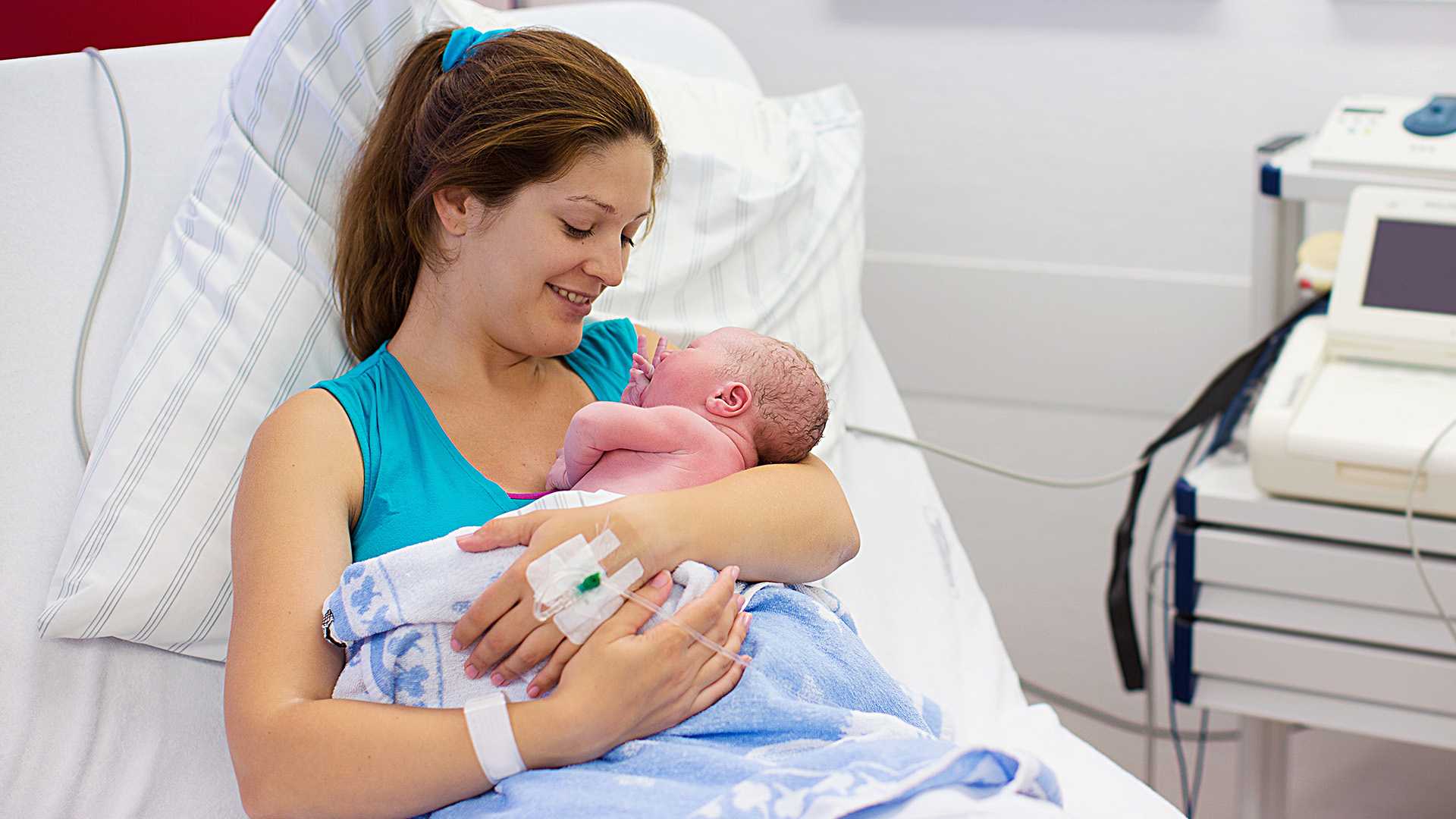
The number of women who were unmarried when they gave birth in the last year dropped to about 1.2 million in 2023, around a 15% decline in just over a decade, according to a recent U.S. Census Bureau report.
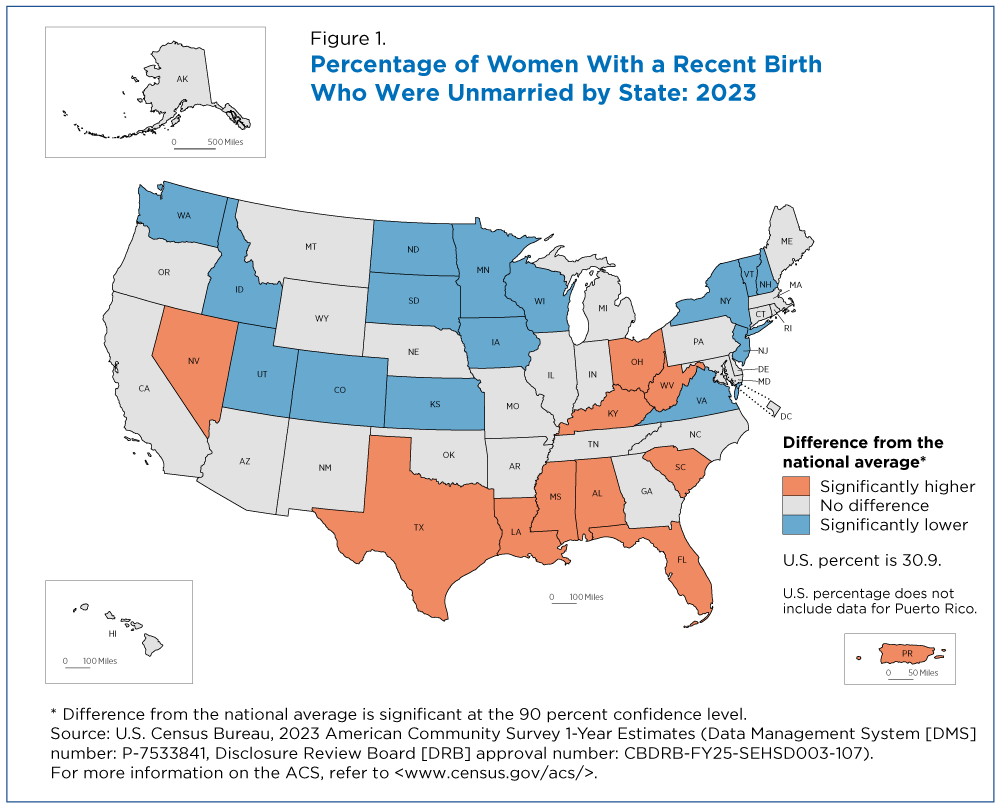
Almost one-third (30.9%) of the 4 million women ages 15 to 50 who gave birth in the last year in 2023 were unmarried. In 2011, 35.7% or 1.5 million of the 4.1 million in that age group who gave birth in the last year were unmarried.
The national decline in unmarried women having babies is mirrored in most states. In states where the numbers did not drop, the numbers remained statistically unchanged.
Variation by State in 2023
Eight states in the South — Alabama, Florida, Kentucky, Louisiana, Mississippi, South Carolina, Texas and West Virginia — had higher levels of recent births to unmarried women than the nation.
In contrast, six states in the Midwest (Iowa, Kansas, Minnesota, North Dakota, South Dakota, Wisconsin), four in the Northeast (New Hampshire, New Jersey, New York, Vermont), and four in the West (Colorado, Idaho, Utah, Washington) had lower levels of recent births to unmarried women than the nation. Just one state in the South (Virginia) had lower than national levels of recent births to unmarried women.
Variation by Metropolitan Statistical Area in 2023
The picture is more complex at the metropolitan statistical area (MSA) level.
MSAs with higher-than-average percentages of unmarried women who gave birth in the last year were in the South, parts of the Midwest, California and Puerto Rico.
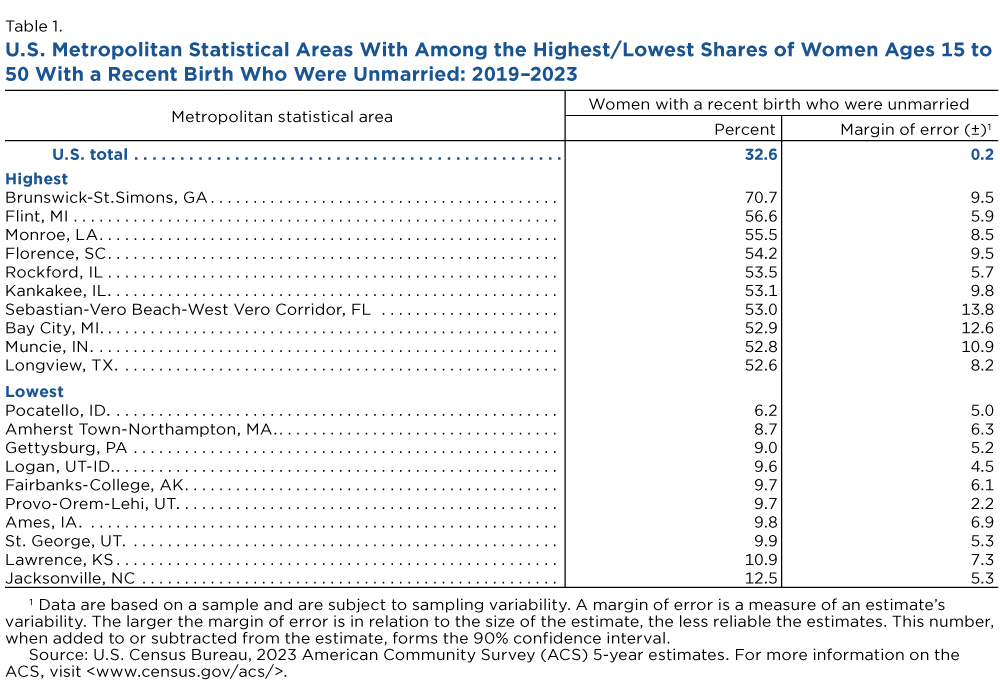
Brunswick-St. Simons, Georgia had among the highest percentage: 70.7%.
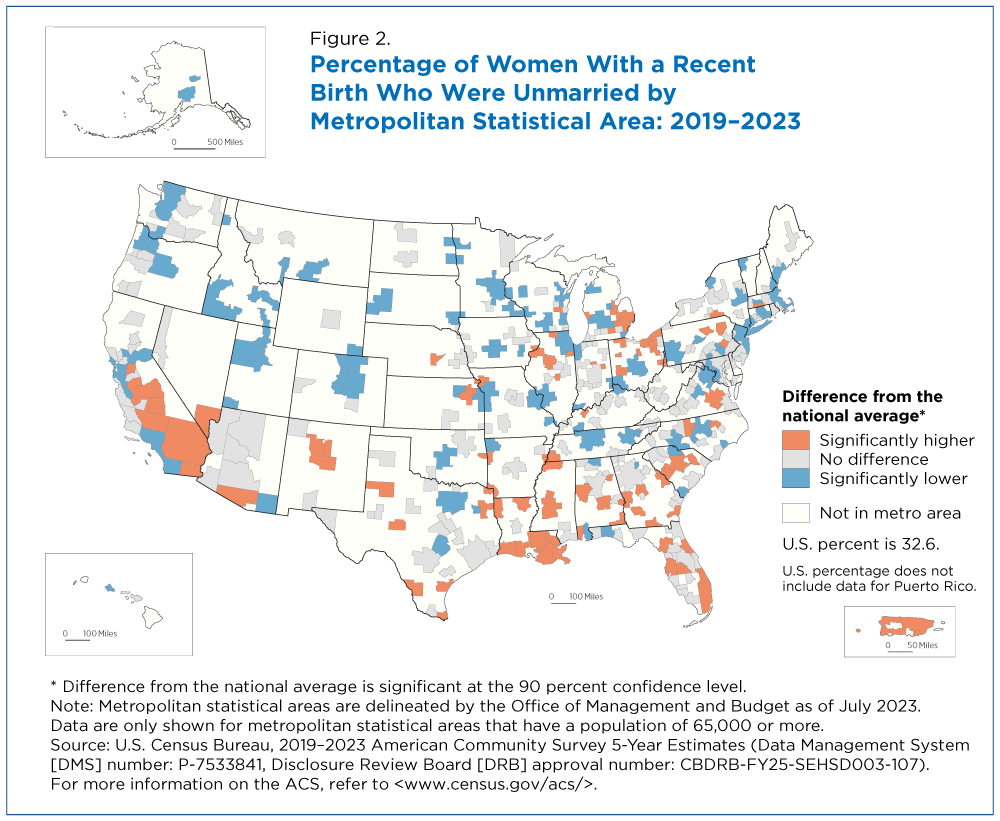
MSAs with a lower-than-average percentage were scattered throughout the United States, but had higher concentrations in the Northeast, parts of the Midwest and the West.
Pocatello, Idaho had among the lowest percentage of women with a recent birth who were unmarried: 6.2%.
Socioeconomic Context
Some of the differences in geographic patterns may be related to socioeconomic characteristics like poverty and income, which vary by state and county.
Poverty
The report shows a strong positive correlation at the state level between the percentage of women with a recent birth who were unmarried and the percentage of people in households below the poverty line.
Marriage Rates
Varying state marriage rates are another factor. For example, Washington, D.C., Colorado and Nebraska had among the nation’s highest marriage rates in 2022 while New Mexico and Puerto Rico had among the lowest.
Education
It is worth noting that several of the MSAs that had among the lowest percentages of women with a recent birth who were unmarried are home to large state universities: Amherst Town-Northampton, MA (University of Massachusetts Amherst); Logan, UT-ID (Utah State University); Provo-Orem-Lehigh, UT (Utah Valley University); Ames, IA (Iowa State University); and Lawrence, KS (University of Kansas).
This aligns with previous research that has found that women with higher education (a bachelor’s degree or higher) or who are economically advantaged are more likely to be married.
Recent Census Bureau research shows that women with a first birth between 2020 to 2024 with a bachelor’s degree were more likely to be married than those without a degree.
Notes
The U.S. percentage differs between the state and MSA tables and figures because the state data come from the 2023 American Community Survey 1-year estimates and the MSA data come from the 2023 American Community Survey 5-year estimates. This page provides guidance and information on differences between the two files.
Related Statistics
Subscribe
Our email newsletter is sent out on the day we publish a story. Get an alert directly in your inbox to read, share and blog about our newest stories.
Contact our Public Information Office for media inquiries or interviews.
Related America Counts Stories
-
FertilityChildlessness on the Rise — Except for Women Ages 45 to 50September 23, 2025From 2014 to 2024, the share of older mothers rose as fewer teens and women in their 20s and 30s had children.
-
Families and Living ArrangementsLiving Arrangements of Young Parents: Solo, Married, Partner or ParentJune 14, 2021There were 1.8 million biological parents ages 15-22 in the United States in 2018 and half were living with a spouse or unmarried partner.
-
Families and Living ArrangementsOver a Third of Partners in Opposite-Sex Couples Were the Same AgeApril 27, 2026A new interactive data visualization explores characteristics of opposite-sex married and unmarried couples who lived together in 2025.
-
Emergency PreparednessTornado Activity Shifts East — Heightening Risks in the SouthOctober 07, 2026Census data can help vulnerable communities that have a concentration of mobile homes cope with more frequent tornado activity over a longer season.
-
Families and Living ArrangementsU.S. Parents Gave $26.6 Billion to Their Adult Children in 2024September 30, 2026About 2.6 million parents provided financial support to 3.7 million children age 21 and over who did not live at home.
-
Business and EconomyAmerican Manufacturing: A History in Census DataSeptember 28, 2026On the 15th anniversary of Manufacturing Day, we celebrate the sector’s contribution to the U.S. economy.
-
EducationBeyond Diplomas: Nondegree Credentials Linked to Higher EarningsSeptember 22, 2026High school graduates and even those with college degrees earned more with nondegree credentials targeting specific work skills.