By 2060, U.S. Population Will Be Younger Than Almost Half the World’s Countries Despite Continued Growth of Older Adults
The world is getting older, faster than ever before. So is the United States, whose share of population age 65 and over is projected to jump from 18.9% in 2025 to 23.4% by 2060, according to a new U.S. Census Bureau report.
An Aging World: 2025 shows that despite continued growth of its older population, the nation will still be younger than nearly half the world’s countries by 2060.
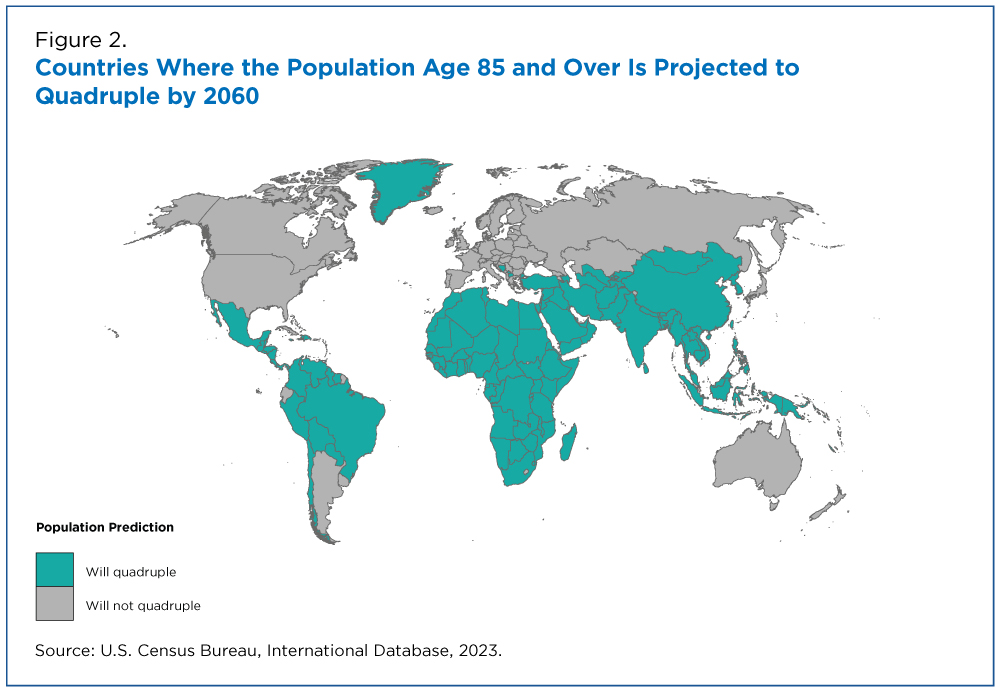
In 160 countries — mostly in Africa, Asia, Latin America and the Caribbean — the population age 85 and over is expected to quadruple between 2025 and 2060.
“In 2025, the United States ranked as the 48th oldest country out of 227,” said Maria Aysa Lastra, a senior demographer at the Census Bureau. “By 2060, the country will fall to 110th place because countries in other regions are aging much more rapidly.”
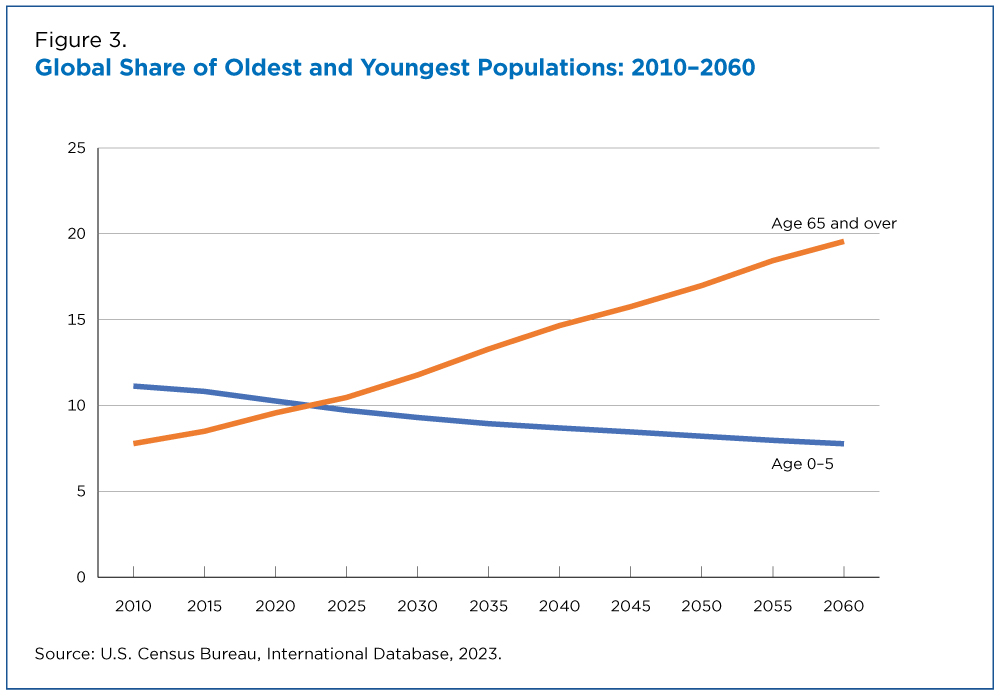
By 2025, for the first time in human history, the share of adults age 65 and over outnumbered the share of children ages 0 to 5 in the world’s population – a gap projected to increase in the coming years.
How the World Is Aging
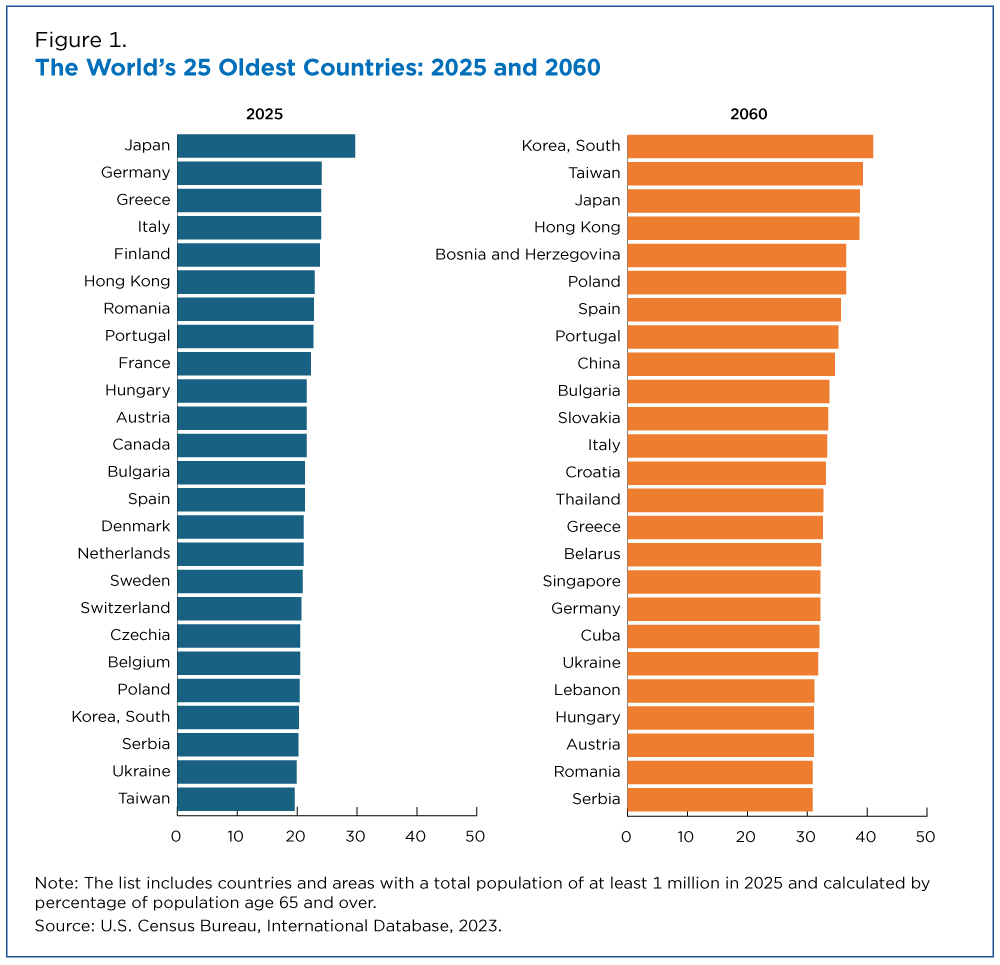
In 2025, Japan was the oldest country in the world with 29.7% of its population age 65 and over. By 2060, however, projected global aging will have accelerated so much that a share that size won’t even be among the top 25 oldest.
That year, Japan is expected to drop down to the third oldest country, with South Korea taking the lead with 41% of its population age 65 and over (Figure 1).
Europe is projected to remain the world’s “oldest” region, with the percent of its population age 65 and over increasing from 21.0% to 30.8% between 2025 and 2060.
By 2060, however, we project that in sheer numbers, there will be more people in that age group in Africa (249 million) than in Europe (214 million).
Older Adults Are Driving Most of the World’s Population Growth
The world population passed 8 billion in 2023 and is expected to grow by more than 2 billion by 2060. More than half that growth — about 1.148 billion people — will likely come from increases in the population age 65 and over.
The share of the world population age 65 and over is projected to nearly double, from 10.5% in 2025 to 19.6% by 2060.
In 160 countries — mostly in Africa, Asia, Latin America and the Caribbean — the population age 85 and over is expected to quadruple between 2025 and 2060 (Figure 2).
Many of the largest cohorts ever born are in places where living beyond 85 was once rare but is becoming commonplace.
Historic Shift: More Older Adults Than Young Children
Until very recently, children ages 0 to 5 made up a larger share of the world population than adults age 65 and over. That changed between 2020 and 2025, when the share of older adults eclipsed this youngest group for the first time (Figure 3).
Another expectation: the share of women will continue to be greater than that of men, thanks to women’s longer life expectancy. But this gap is expected to narrow from 80.6 males for every 100 females age 65 and over in 2025, to 84.7 males for every 100 females in 2060.
Living Longer — But Not Always Healthier
People are living longer but the number of years they spend in good health has not risen at the same rate, a challenge for all aging nations.
In the United States, for example, the proportion of years lived in full health after age 60 decreased by more than 2 percentage points between 2000 and 2019 – slightly more for men than for women.
Between 2016 and 2019, 73% of U.S. adults age 65 and over lived with two or more chronic illnesses.
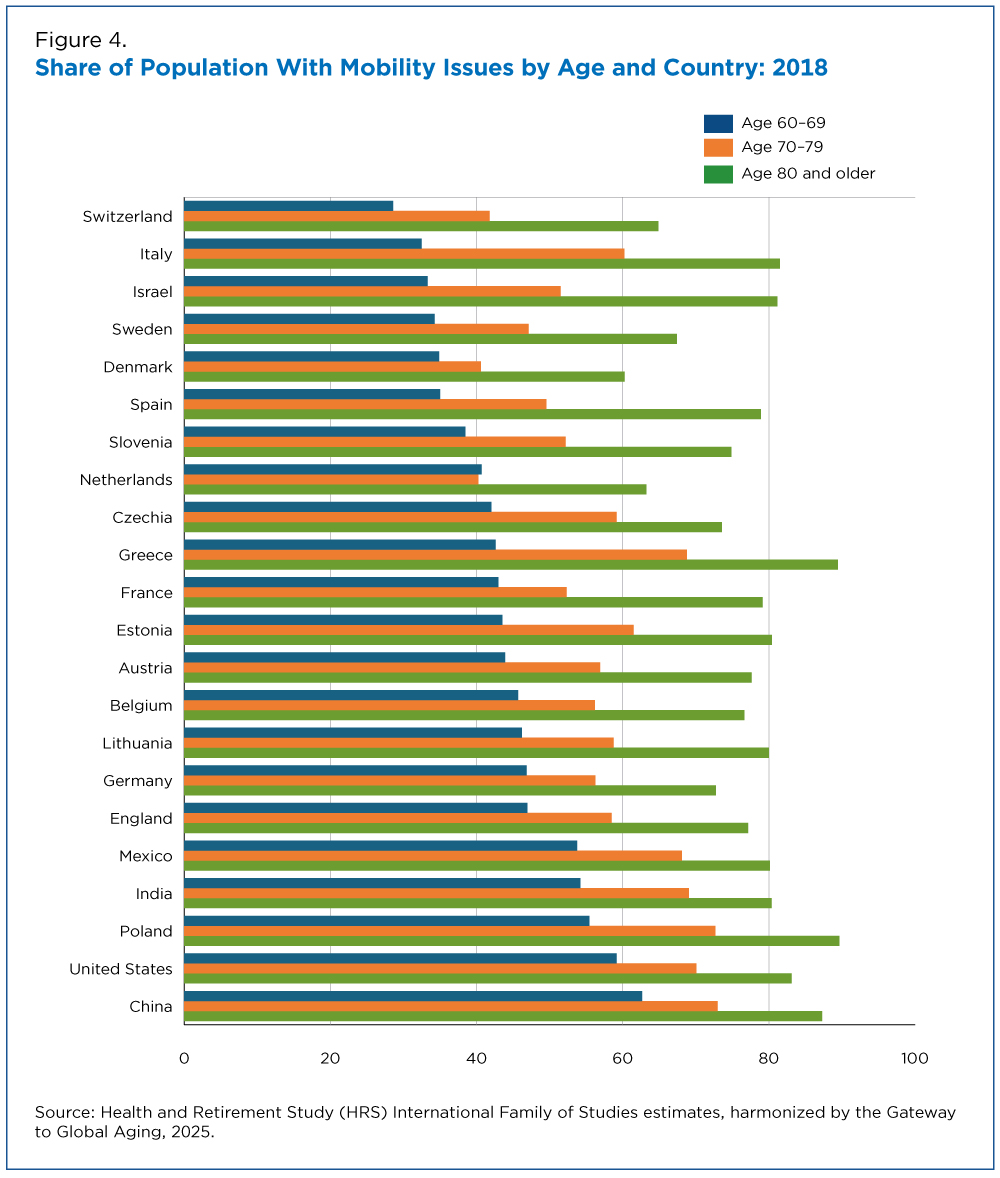
Older adults had more mobility issues than younger populations in all countries. But mobility problems in the United States seemed to start at earlier ages (Figure 4). In 2018, around 60% of adults ages 60 to 69 in the United States and China reported mobility problems, compared to less than 30% that age in Switzerland.
COVID 19 and Dementia Among Top 5 Leading Causes of Death in 2021
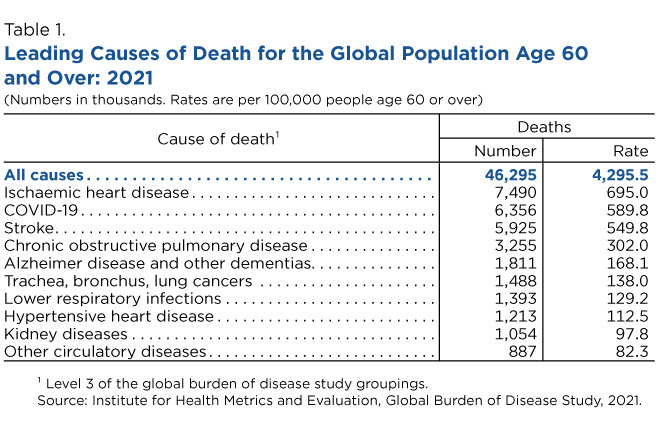
According to the report, COVID-19 and Alzheimer’s disease and other dementias were among the top 5 leading causes of death among adults age 60 and over in 2021 (Table 1).
Challenges for an Aging World
The report covers cross-national comparisons on access to healthcare and social care, employment, retirement, volunteering, poverty, living arrangements and other age-related issues.
Among key findings:
- Labor Force. Between 2012 and 2022, labor force participation among adults 65 and over fell in high‑income countries but rose in low- and middle-income countries.
- Poverty. Among Organisation for Economic Co-operation and Development (OECD) countries in 2020, older adults in the United States (21.6%) and South Korea (40.5%) faced some of the highest poverty rates.
- Caregiving. In many OECD countries, 3 out of 5 caregivers age 50 and over were women. Some high-income countries are beginning to compensate older caregivers to offset the health and financial stresses of caregiving.
- Volunteering. More than 50% of the older population did volunteer work in the United Kingdom and New Zealand, compared to less than 10% in Ukraine, Guatemala and Cape Verde.
About the Report
An Aging World: 2025 is sponsored by the National Institute on Aging. It is the sixth report in the Aging World series which started in 1987. The report contains statistics from the Census Bureau’s International Database, the international family of Health and Retirement surveys, the Gateway to Global Aging, the World Bank and other data sources.
Related Statistics
Subscribe
Our email newsletter is sent out on the day we publish a story. Get an alert directly in your inbox to read, share and blog about our newest stories.
Contact our Public Information Office for media inquiries or interviews.
Related America Counts Stories
-
AgeU.S. Population Aging as Nation Turns 250April 09, 2026New population estimates show women still outnumbered men at older ages, but the gap is narrowing due to lower mortality rates and historical factors.
-
PopulationPopulation Trends Across the GlobeNovember 26, 2024The Census Bureau’s released updated population estimates and projections for 34 countries that reveal population shifts.
-
PopulationWorld Population Estimated at 8 BillionNovember 09, 2023It took 13 years for the world population to go from 7 billion to 8 billion but it will take an estimated 14 years to add another billion amid slowing growth.
-
Emergency PreparednessEarthquake Risk May Hit Closer to Home Than You ThinkOctober 14, 2026The 140th anniversary of the Charleston earthquake reminds us of the risks to people, housing and economies in places not typically associated with earthquakes.
-
Emergency PreparednessTornado Activity Shifts East — Heightening Risks in the SouthOctober 07, 2026Census data can help vulnerable communities that have a concentration of mobile homes cope with more frequent tornado activity over a longer season.
-
Families and Living ArrangementsU.S. Parents Gave $26.6 Billion to Their Adult Children in 2024September 30, 2026About 2.6 million parents provided financial support to 3.7 million children age 21 and over who did not live at home.
-
Business and EconomyAmerican Manufacturing: A History in Census DataSeptember 28, 2026On the 15th anniversary of Manufacturing Day, we celebrate the sector’s contribution to the U.S. economy.