Mom and Pop Business Owners Day: March 29, 2024
Mom and Pop Business Owners Day: March 29, 2024
From the Corporate Finance Institute: What Is Mom-and-Pop?
“Mom-and-pop shops are usually family owned and controlled. With limited capital investment, they handle small business volumes and run with minimal numbers of employees. Typically, the shops are not franchised and only operate at single locations. Therefore, their customers are mostly from local communities. Their products and services are more personalized.
“Mom-and-pop stores are generally in the structures of partnership, limited liability company or an S corporation. By starting up a store as a limited liability company, the owner is not personally liable for the debts carried by the store.”

Key Stats
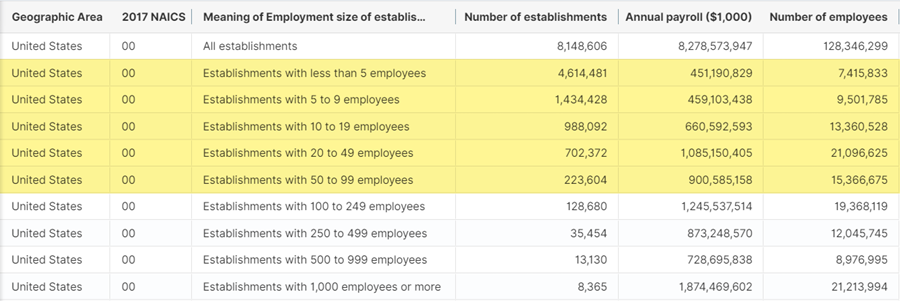
Source: 2021 County Business Patterns (CBP)

Note: The table below is cropped to list the rows for all establishments in the United States. The five rows with less than 100 employees are highlighted. Several columns are hidden. North American Industry Classification System (NAICS) code 00 reflects the sum of all the economic activity for all sectors. Click on the image for the full table.
More Stats
From Topics / Business and Economy / Small Business:
Here you will find detailed statistics about U.S. businesses that are essential to help small businesses succeed and grow.

From Data / Census Academy:
Source: Longitudinal Employer-Household Dynamics (LEHD) program.
About Us: Part of the Center for Economic Studies at the U.S. Census Bureau, the LEHD program produces cost effective, public-use information combining federal, state and Census Bureau data on employers and employees under the Local Employment Dynamics (LED) Partnership. State and local authorities increasingly need detailed local information about their economies to make informed decisions.
Source: Business Dynamics Statistics (BDS), 2021 back to 1978
Source: Small Business Pulse Survey (SBPS): Tracking Changes During The Coronavirus Pandemic
Source: Statistics of U.S. Businesses (SUSB) 2021 back to 1988

Source: Nonemployer Statistics (NES) 2020
NES is an annual series that provides subnational economic data for businesses that have no paid employees and are subject to federal income tax. The data consist of the number of businesses and total receipts by industry. Most nonemployers are self-employed individuals operating unincorporated businesses (known as sole proprietorships).
From the Library / America Counts: Stories:
From the Newsroom / Stats for Stories (SFS):