
Household Pulse Survey Collected Responses Just Before and Just After the Arrival of the First CTC Checks
This story was updated at 5:15 EST. Some of the content on school-related expenses was removed due to a data error.
A drop in the number of households with children that reported food insufficiency and trouble paying household expenses may be linked to the child tax credit checks issued last month, according to new Household Pulse Survey (HPS) results.
The Internal Revenue Service last month (July 15) began issuing a monthly Advance Child Tax Credit (CTC) to families with children. About 35 million eligible families received the first monthly payment of up to $300 for each child age 5 and under and up to $250 for each child ages 6 to 17. Payments will continue monthly through December.
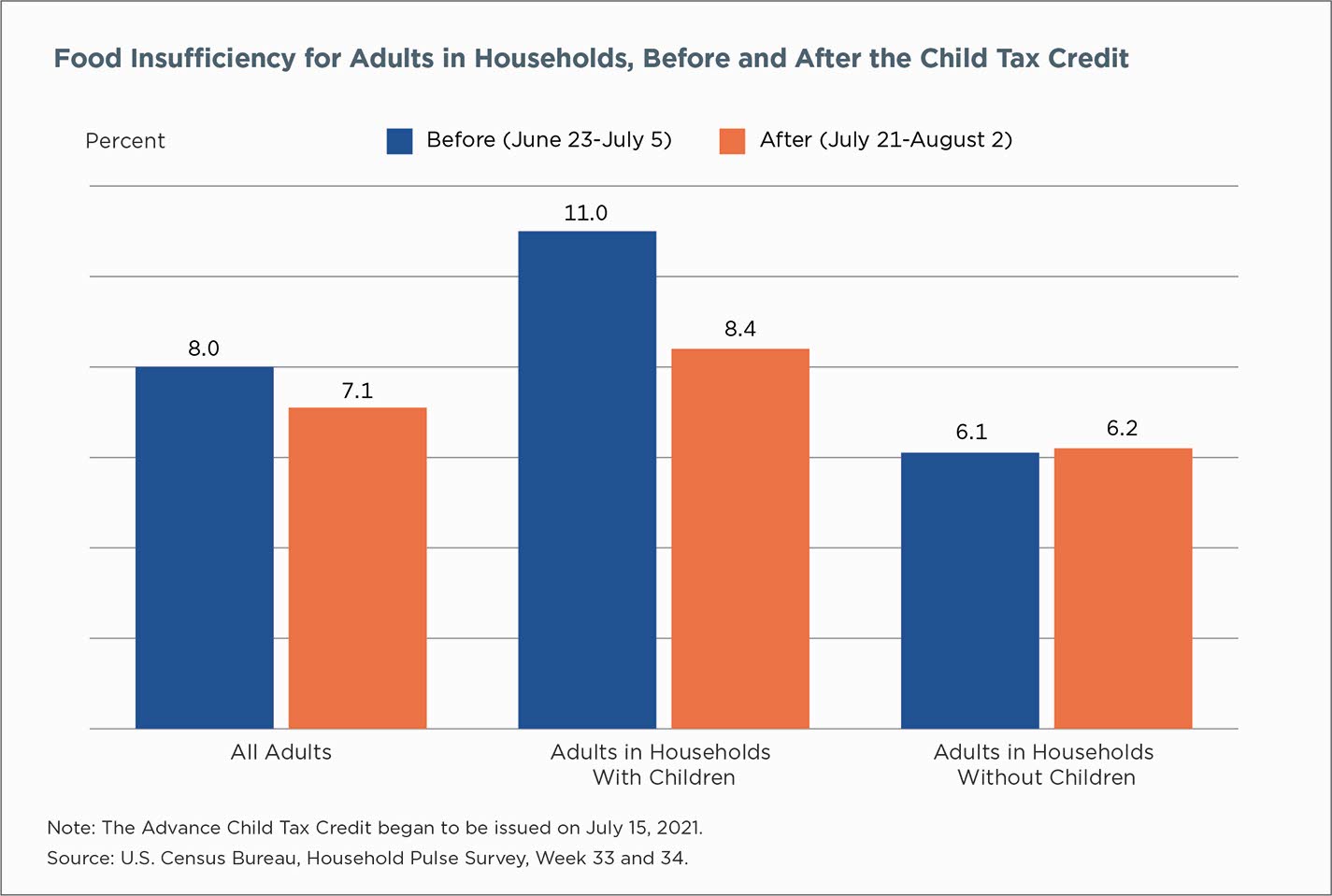
Even though adults in households with children are more likely to experience food insufficiency, those households saw a 3 percentage point decline between the surveys conducted before and after the CTC payments.
The U.S. Census Bureau’s experimental HPS collected survey responses just before and just after the arrival of the first checks.
The survey shows introduction of the CTC coincided with a drop in food insufficiency in households with children. It also showed that in those households, there was a drop in difficulty paying weekly expenses.
Several changes were made to the child tax credit as part of the American Rescue Plan, signed in March 2021.
The program provides the tax credit to all families with children, including those who are not required to file a federal tax return.
In addition, the credit was increased — up to $3,600 per year for children ages 5 and under at the end of this year on a sliding scale based on income; and up to $3,000 a year for those ages 6 to 17. Half of the annual credit amount is being paid out in advance in monthly checks that began on July 15.
Food Insufficiency Dropped Quickly After Checks Arrived
Although HPS data show an overall decline in the share of adults in households experiencing food insufficiency (sometimes or often not having enough to eat), the drop was largely driven by adults in households with children.
Even though adults in households with children are more likely to experience food insufficiency, those households saw a 3 percentage point decline between the surveys conducted before and after the CTC payments.
Adults in households without children did not see a change in food insufficiency during the same period.
Financial Hardship of Families With Children Also Dropped
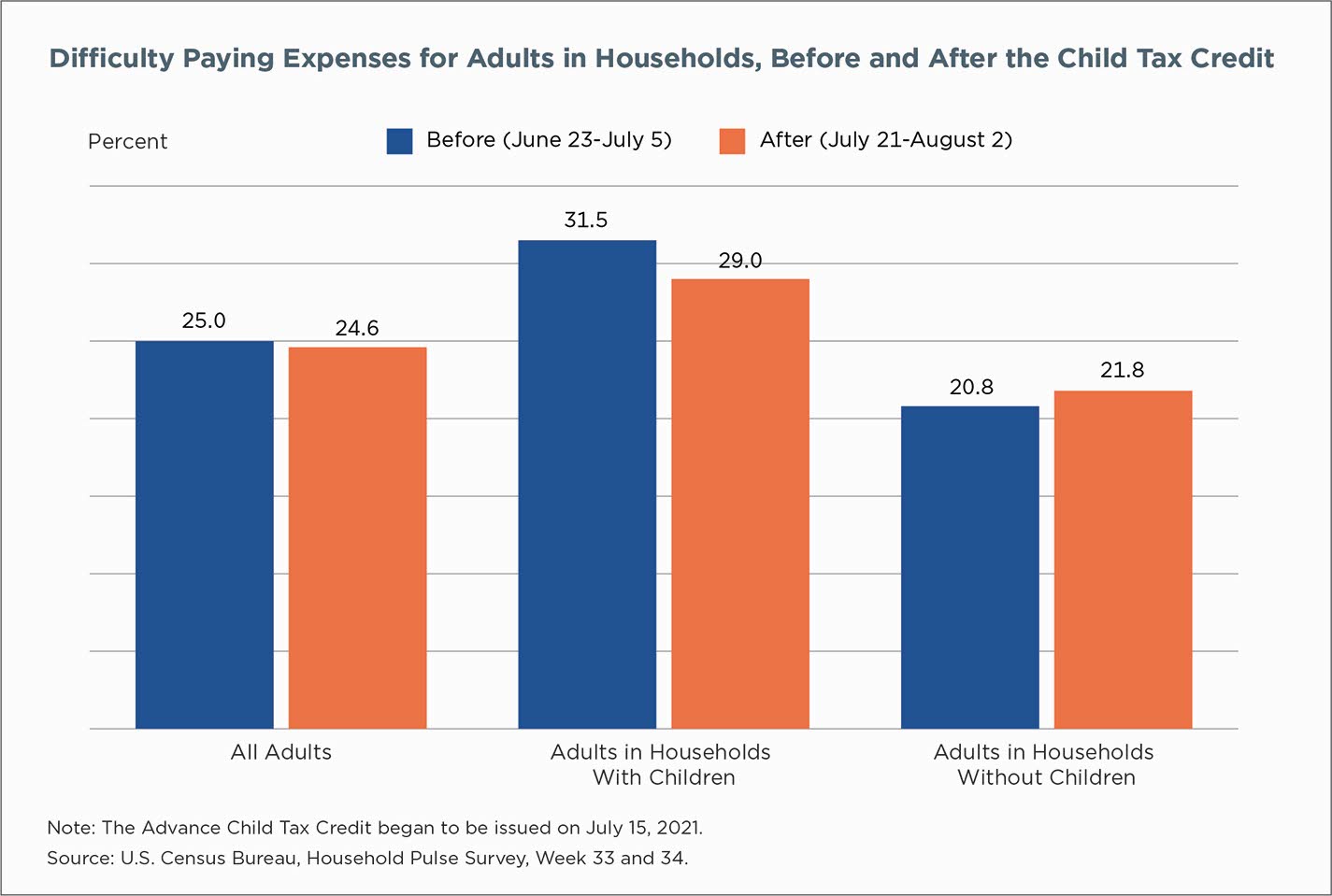
The HPS asks respondents how difficult it was to pay their usual household expenses in the previous week. Adults in households with children were more likely to say that it was somewhat difficult or very difficult in both time periods.
However, when we compare households with children before and after the arrival of the CTC payments, we see a decline in the share of adults in households struggling to pay expenses.
In contrast, the share of adults in households without children that had difficulty paying expenses increased slightly during this period.
How Families Spent Their CTC
Many HPS respondents reported spending their CTC payments on more than one thing. About 47% reported spending it on food.
Nearly 10% of adults in households that received the CTC — and 17% of those with at least one child under age 5 — spent their CTC on child care.
About HPS
The HPS is designed to provide near real-time data on how the pandemic has affected people’s lives. Information on the methodology and reliability of these estimates can be found in the source and accuracy statements for each data release.
Data users interested in state-level sample sizes, the number of respondents, weighted response rates and occupied housing unit coverage ratios, can consult the quality measures file available at the same location.
The data were collected from July 21-August 2 during week 34 of the survey. The Census Bureau sent invitations to 1,042,642 households and received a total of 64,562 responses, for a weighted response rate of 6.1%.
Daniel J. Perez-Lopez is a statistician in the Census Bureau’s Social, Economic and Housing Statistics Division.
Subscribe
Our email newsletter is sent out on the day we publish a story. Get an alert directly in your inbox to read, share and blog about our newest stories.
Contact our Public Information Office for media inquiries or interviews.
-
America Counts StoryCensus Survey Now Asks How COVID Vaccines Impact Recipients' BehaviorMay 04, 2021The new phase of the Census Bureau’s Household Pulse Survey digs deeper into vaccine hesitancy and other topics from mental health to use of telehealth.
-
America Counts StoryHomeschooling on the Rise During COVID-19 PandemicMarch 22, 2021The U.S. Census Bureau’s Household Pulse Survey shows a substantial increase in homeschooling during COVID-19.
-
Families and Living ArrangementsU.S. Parents Gave $26.6 Billion to Their Adult Children in 2024September 30, 2026About 2.6 million parents provided financial support to 3.7 million children age 21 and over who did not live at home.
-
Business and EconomyAmerican Manufacturing: A History in Census DataSeptember 28, 2026On the 15th anniversary of Manufacturing Day, we celebrate the sector’s contribution to the U.S. economy.
-
EducationBeyond Diplomas: Nondegree Credentials Linked to Higher EarningsSeptember 22, 2026High school graduates and even those with college degrees earned more with nondegree credentials targeting specific work skills.
-
Emergency PreparednessCalm Atlantic Hurricane Season Could Mean Active One in the PacificSeptember 17, 2026Census Bureau data tools can help communities prepare for and recover from hurricanes and other disasters wherever they are.