
Older and Large Firms Produce More Patents but Startups’ Inventions Are More Impactful
An increasing share of U.S. inventions are generated by large, well-established firms but the radical and impactful innovations more likely to come from younger firms are declining, according to research recently presented at a U.S. Census Bureau webinar.
The research, which linked patent inventors to the Census Bureau’s Longitudinal Employer-Household Dynamics (LEHD), showed that older firms tended to produce more but less impactful patents. Their growth may signal a slowdown in innovation.
The 20 U.S. counties with the most inventors accounted for 39% of inventors in 2001, which rose to 47% in 2016.
In a series of research papers, my co-author Ufuk Akcigit, professor of economics at the University of Chicago, and I created a database to investigate the characteristics and employment dynamics of patent inventors.
LEHD provides the full employment history of nearly all U.S. workers, including their earnings employer and demographic characteristics. That allows the linking of patents to the individual inventors.
Applying administrative data to profile inventors is relatively new and sheds light on the pace of innovation and economic growth, who inventors are and where they’re concentrated.
Startups Create Disproportionately More Radical Innovations
Previous research found that younger firms tend to produce radical innovations with more far-reaching impacts, while older, larger firms tend to produce incremental innovations that build upon the firm’s existing products and technological capabilities.
Using our new database on the employment histories of inventors, we found that the share of inventors working for “incumbent firms” — at least 20 years old and with at least 1,000 employees — rose from about 49% in 2000 to 58% in 2015 (Figure 1).
During that period, the share of inventors at young firms had dropped from 15% to below 8%.
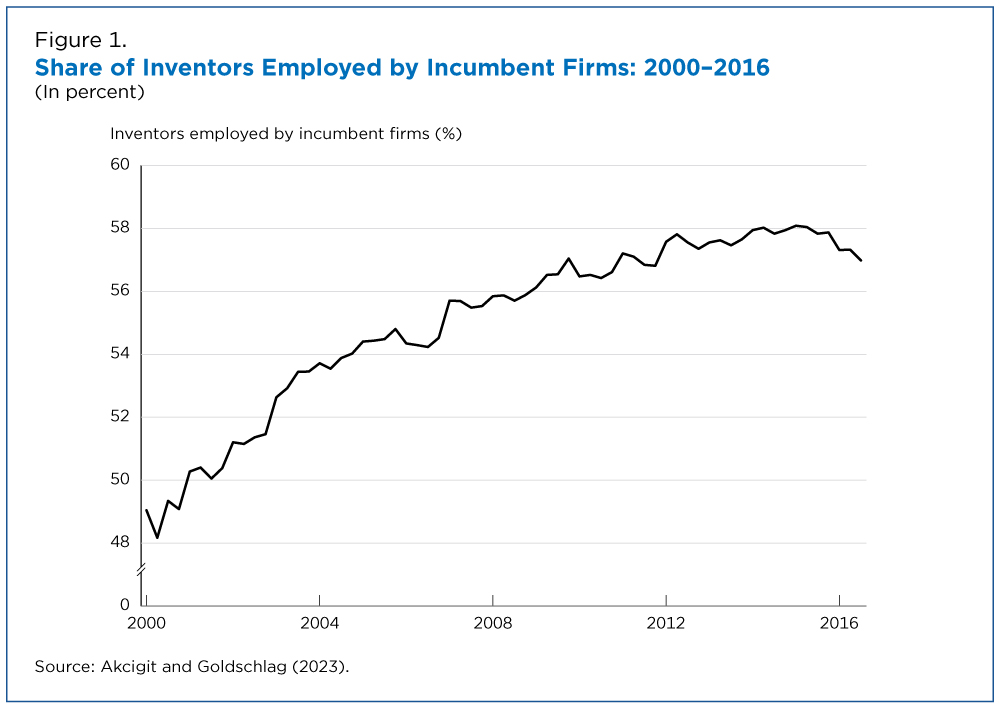
Inventors working for these older and larger firms during this period had a slightly higher count of patent applications than those working at firms less than six years old (5% higher), but their inventions tended to be less impactful, receiving fewer citations (35% fewer).
Patents of inventors at incumbent firms tended to receive fewer citations — a measure of the quality of a patent. They also had fewer patent claims and a higher share of citations referencing the firm’s prior work, evidence of incremental rather than radical innovation.
Who Employs Inventors Matters
To measure the impact types of firms had on inventors and their inventions, we compared how the earnings and patent activity of “twin” inventors – one hired by an incumbent firm and one by a young firm – changed after they were hired.
Our analysis shows that inventors hired by incumbent firms tended to earn more — about a 12% bump in salary compared to those hired by young firms — but they produced about 4% fewer patents and their patents were lower quality because they were less impactful.
This suggests a potentially growing gap between the social benefit (quality of innovation) and personal benefit (earnings) of inventor activity.
Invention and Entrepreneurship
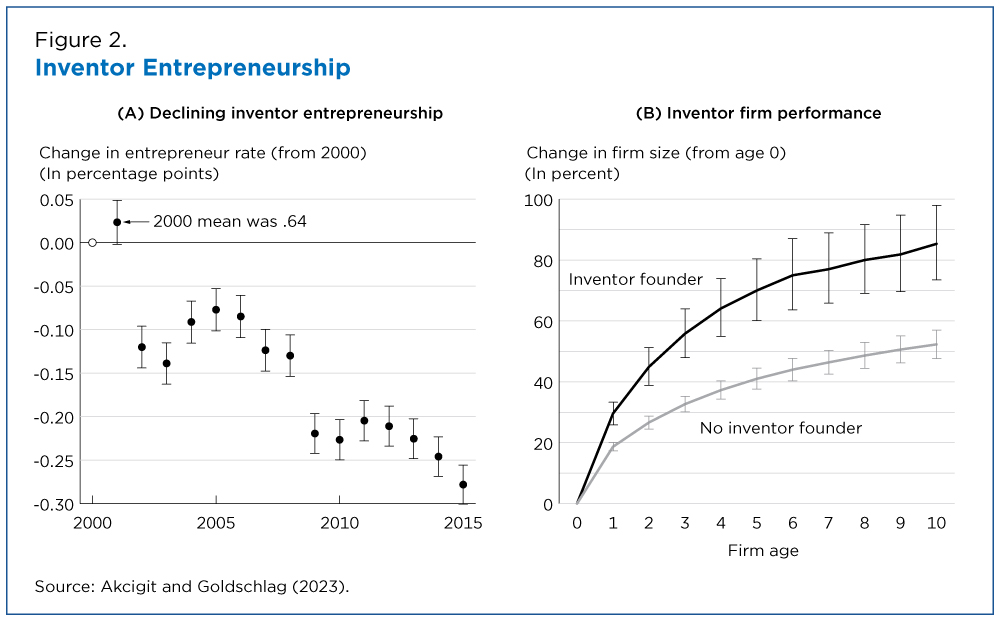
The inventor entrepreneurship rate fell by about 44% (0.3 percentage points) between 2000 and 2015 (Figure 2, Panel A). The decline is especially consequential because startups founded by inventors tend to be the same innovative startups that drive job creation.
Inventor-created firms are about 40% larger on average at birth than firms not created by inventors and they grow faster.
Employment at startup firms that survived up to five years grew by nearly 70% compared to 41% for all other firms (Figure 2, Panel B), but there was a significant drop in the number of inventors starting new businesses from 2000 to 2015.
Who Are the Inventors?
Among inventors, women were significantly underrepresented relative to the U.S. civilian workforce: In 2016, they accounted for about 47% of the workforce but less than 12% of all inventors and 16% among inventors under age 36, according to the analysis.
Foreign-born individuals, on the other hand, were overrepresented. Although they made up approximately 17% of the U.S. workforce in 2016, they accounted for over 30% of patent inventors.
In 2016, China and India's representation among the population of foreign-born inventors was much higher (41%) than their share of the foreign-born workforce (9%) and it's been climbing. Between 2000 and 2016 the share of foreign-born inventors from China and India grew by about 59%, from 25.6% to 40.6%.
Like the workforce in general, inventors aged between 2000 and 2016: the average age of U.S. inventors rose by about three years while the share under age 36 fell by almost 4 percentage points.
This trend may have important effects on innovation and entrepreneurship, according to research showing researchers’ output typically peaks in their late 30s to early 40s.
Earnings and Location
Inventors tend to be among the highest paid workers in the economy. This is particularly true for “superstar inventors,” those with the most impactful patents. Just over 88% of superstar inventors were in the top 10% of the earnings distribution and nearly 19% were among the top 1% of earners between 2000 and 2016.
Earnings were closely tied to inventive output, with the most productive inventors receiving the highest earnings on average.
Our analysis also found that inventors were increasingly concentrated in a relatively small number of counties. The 20 U.S. counties with the most inventors accounted for 39% of inventors in 2001, which rose to 47% in 2016.
About the Research
Linking patent inventors to the LEHD not only helps us better understand the characteristics of inventors and the dynamics of inventive activity, it also demonstrates the value of combining administrative data. That allows us to produce rich analyses for researchers, policy makers and the public.
These linkages are now available to researchers with approved access through the Federal Statistical Research Data Centers. You can find more details about the structure of the data and the matching methodology in our research paper.
Related Statistics
Subscribe
Our email newsletter is sent out on the day we publish a story. Get an alert directly in your inbox to read, share and blog about our newest stories.
Contact our Public Information Office for media inquiries or interviews.
-
Business and EconomyThe Steady Rise of the Nonemployer BusinessJuly 30, 2025New data confirm growth in nonemployer numbers outpaced their employer counterparts in 2023, continuing pre- and post-COVID 19 pandemic trends.
-
Business and EconomyHow AI and Other Technology Impacted Businesses and WorkersSeptember 17, 2025Businesses report that, in most cases, adoption of new technologies like robotics and Artificial Intelligence had no impact on worker numbers or skill level.
-
Business and EconomyHow to Measure Disasters’ Impact on Supply ChainsAugust 08, 2024Rhode Island floods earlier this year serve as a case study of how Census Business Builder can show the impact of disasters on people and businesses.
-
Families and Living ArrangementsU.S. Parents Gave $26.6 Billion to Their Adult Children in 2024September 30, 2026About 2.6 million parents provided financial support to 3.7 million children age 21 and over who did not live at home.
-
Business and EconomyAmerican Manufacturing: A History in Census DataSeptember 28, 2026On the 15th anniversary of Manufacturing Day, we celebrate the sector’s contribution to the U.S. economy.
-
EducationBeyond Diplomas: Nondegree Credentials Linked to Higher EarningsSeptember 22, 2026High school graduates and even those with college degrees earned more with nondegree credentials targeting specific work skills.
-
Emergency PreparednessCalm Atlantic Hurricane Season Could Mean Active One in the PacificSeptember 17, 2026Census Bureau data tools can help communities prepare for and recover from hurricanes and other disasters wherever they are.