
International Migration Remained Flat in the 10% of Counties That Did Not Experience a Decline
Every state, the District of Columbia (D.C.) and 90% of the nation’s 3,144 counties experienced a decline in net international migration (NIM) between 2024 and 2025.
And the remaining 10% of counties had no change, according to the U.S. Census Bureau’s Vintage 2025 population estimates released today.
A decline in net international migration across years does not mean states experienced negative NIM (more “outs” than “ins”). In fact, all states and D.C. experienced positive – but lower – NIM in 2025 than in 2024.
The Census Bureau implemented several changes that improved the accuracy of net international migration estimates at the state and county levels, better reflecting recent changes in migration flows.
What Is Net International Migration (NIM)?
NIM is the annual estimate of in-flows to the United States from abroad minus the out-flows. Positive NIM means more people came into an area via immigration than left via emigration — and negative NIM means more people emigrated than immigrated.
The Census Bureau produces annual NIM, birth, death and domestic migration estimates to develop national, state and county population estimates by characteristics.
Net International Migration Across States and Counties
A decline in net international migration across years does not mean states experienced negative NIM (more “outs” than “ins”). In fact, all states and D.C. experienced positive — but lower — NIM in 2025 than in 2024.
In 2025, Florida was the state with the largest NIM total, with 178,674 more people coming from abroad than leaving, and West Virginia had the smallest total (244).
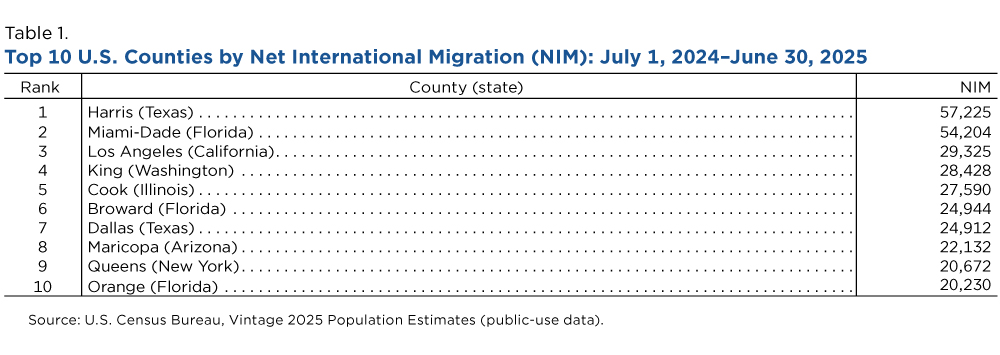
Harris (Texas), Miami-Dade (Florida) and Los Angeles (California) were the counties with the largest 2025 NIM estimates (Table 1).
NIM was concentrated in a handful of states and counties with large populations and migration flows.
The five states (Florida, Texas, California, New York and New Jersey) with the highest NIM totals in 2025 accounted for about half (47.9%) of all U.S. net international migration.
In addition, the 10 counties with the largest NIM estimates in 2025 made up about a quarter (24.5%) of the nation’s total (Table 1). These counties were among the 50 most populous, each with a population of over one million in 2025. (Refer to Table 1 of the press release for more information on counties by population size.)
NIM Difference Between 2024 and 2025
Emigration from July 1, 2024, to June 30, 2025, increased relative to recent years. The Vintage 2025 estimates include an adjustment to emigration levels (based on administrative data) to reflect this change — lowering the 2025 NIM level.
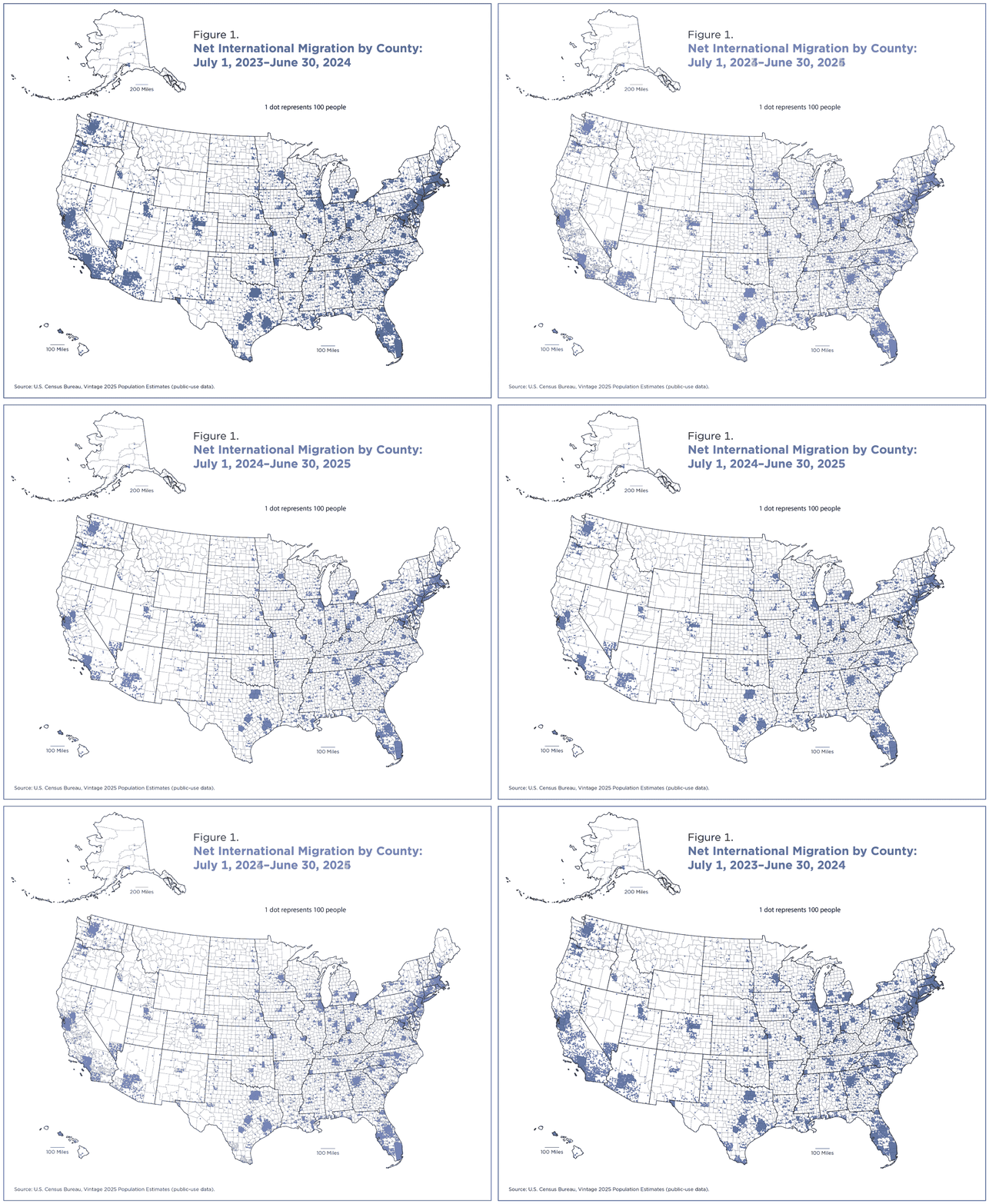
In Figure 1, each dot represents 100 net international migrants at the county level in estimates years (EY) 2024 and 2025. An estimate year represents July 1 of the previous year through June 30 of the current year (e.g., 2025 covers July 1, 2024 to June 30, 2025).
Fewer dots show up in 2025 than in 2024, illustrating the historic NIM decline across the United States. This is especially notable in large states like California and Texas and in the Northeast region.
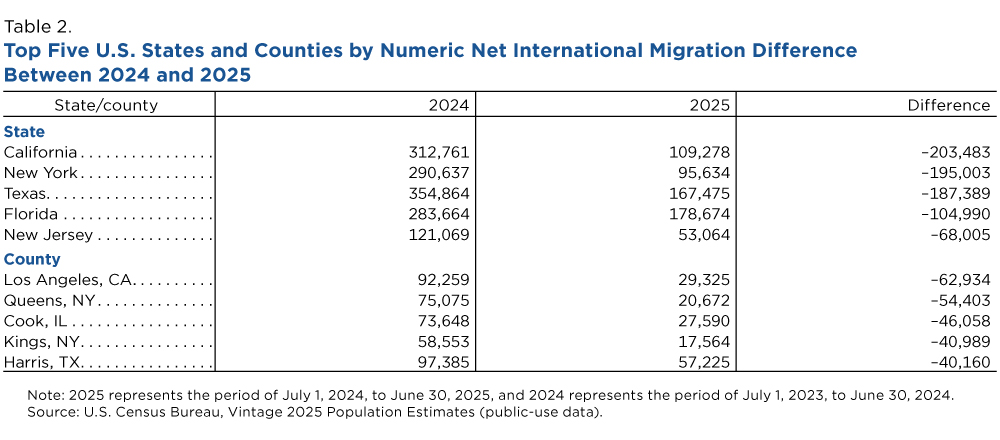
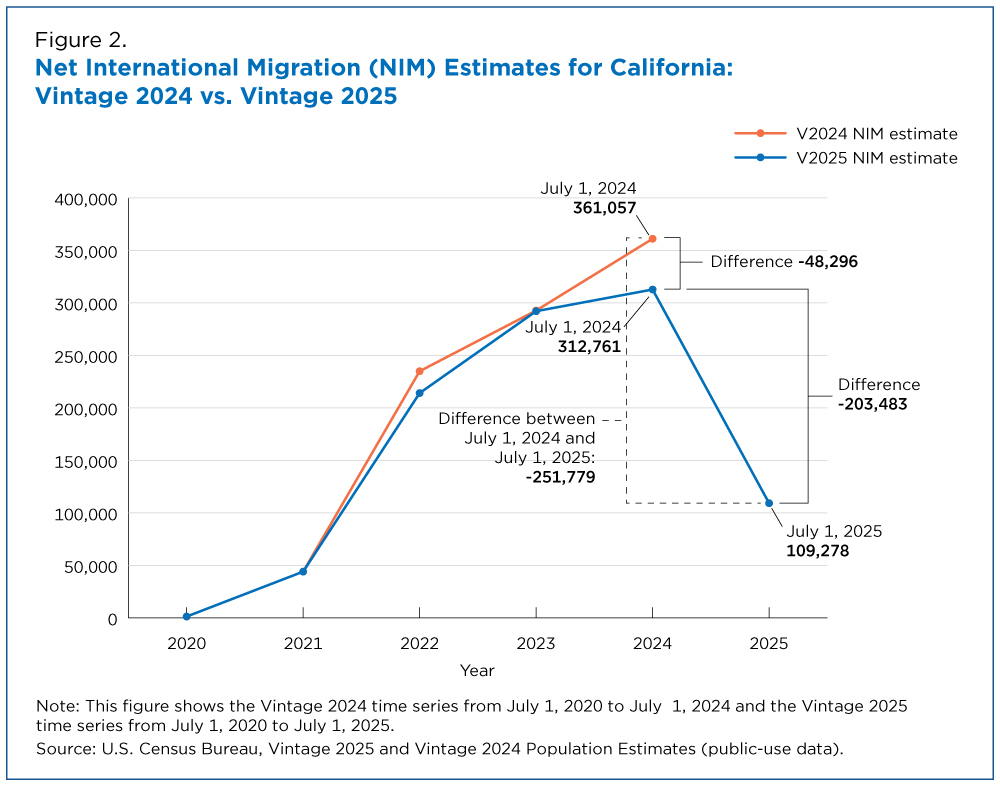
The smallest drop was in Vermont, where the NIM estimate declined from 1,249 in 2024 to 623 in 2025. California had the largest drop, from 312,761 to 109,278.
Table 2 shows the five states and counties with the largest numeric NIM declines.
In 2025, the five states with the largest numeric NIM declines also had the largest NIM estimates of all states and the District of Columbia. Four of the counties with the largest numeric NIM drops were also among the 10 counties with the largest NIM estimates in 2025 (Table 1).
The net international migration decline in 90% (2,832) of counties ranged from as little as one person in 169 counties to as many as 62,934 people in Los Angeles.
About 7% of counties had a drop in NIM greater than 1,000 people (Table 3), which include the largest NIM counties listed in Table 1.
Most counties (61.7%) experienced dips ranging from one person to 100 people.
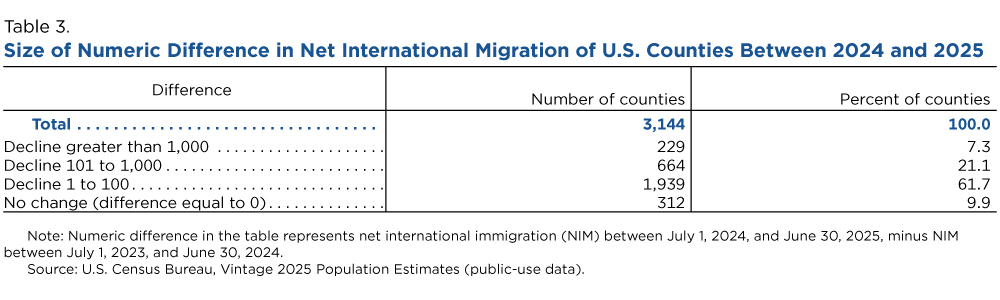
The 312 or 10% of counties that saw no change between those years were small counties with NIM estimates below 55.
Comparing NIM Estimates Across Vintages
Each year the Population Estimates Program releases a new vintage or time series of annual estimates starting from the most recent decennial census and extending to the vintage year.
The most recent vintage supersedes all other vintages, in part, because it’s the most accurate thanks to updated data and methods — including new input data from the 2024 American Community Survey (ACS) 1-year and 2020-2024 ACS 5-year estimates.
We also introduced new methodology that uses Department of Justice’s Executive Office of Immigration Review data to more accurately place humanitarian migrants in specific states and counties where they were living.
When comparing July 1, 2024 estimates in Vintage 2024 and Vintage 2025, 22 states were revised upward and 28 states and the District of Columbia were revised downward.
Consider California, one of the states revised downward.
Figure 2 shows the state’s NIM estimates from July 1, 2024 (Vintage 2024 orange line) and July 1, 2025 (Vintage 2025 blue line). The decline was 251,779.
But after the new input data and improved methodology were applied, the decline narrowed to only 203,843. The difference reflects a downward revision of 48,296 between the July 1, 2024 estimates in Vintage 2024 and 2025.
More details on Vintage 2025 updates are available in this blog and the methodology statement. The NIM changes implemented represent substantial improvements at the national, state and county levels, and we continue to explore ways to enhance the quality and accuracy of future vintages.
Related Statistics
Subscribe
Our email newsletter is sent out on the day we publish a story. Get an alert directly in your inbox to read, share and blog about our newest stories.
Contact our Public Information Office for media inquiries or interviews.
-
PopulationSome Like it Hot: County Domestic Migration Trends From 2011 to 2025March 26, 2026Counties that once attracted droves of domestic migrants have cooled off and other counties have replaced them as popular migration destinations.
-
PopulationU.S. Population Growth Slowest Since COVID-19 PandemicJanuary 27, 2026The decline in international migration was felt across the states, though its impact varied.
-
PopulationOnly 50 U.S. Counties Had Populations Over a Million in 2024March 17, 2025A new data visualization highlights U.S. counties between 1970 and 2024 whose populations ever surpassed a million.
-
Families and Living ArrangementsU.S. Parents Gave $26.6 Billion to Their Adult Children in 2024September 30, 2026About 2.6 million parents provided financial support to 3.7 million children age 21 and over who did not live at home.
-
Business and EconomyAmerican Manufacturing: A History in Census DataSeptember 28, 2026On the 15th anniversary of Manufacturing Day, we celebrate the sector’s contribution to the U.S. economy.
-
EducationBeyond Diplomas: Nondegree Credentials Linked to Higher EarningsSeptember 22, 2026High school graduates and even those with college degrees earned more with nondegree credentials targeting specific work skills.
-
Emergency PreparednessCalm Atlantic Hurricane Season Could Mean Active One in the PacificSeptember 17, 2026Census Bureau data tools can help communities prepare for and recover from hurricanes and other disasters wherever they are.